How to pick a mortgage lender: A first-time buyer’s guide

Not all banks are created equal... Here's how to choose the right one for your first mortgage.

Getting a foot on the property ladder is hard enough. And the reality is some lenders either have more appetite for first-time buyers… or are just plain better at helping them. In this guide we’re diving “beyond the rates” to explore what can make one lender a better bet than another when buying your first home.

10 things to look for in your first mortgage lender

  1. How much they’ll lend to you
  2. The minimum deposit they accept
  3. How they treat gifted deposits and family support
  4. Whether they integrate with government buying schemes
  5. Their fee structure and how it suits your loan size
  6. Their flexibility on limited credit history, new employment, self-employment, etc.
  7. Their reputation and track record with first-timers
  8. How fast and reliable their mortgage “agreement in principle” is
  9. How well they support you throughout the process
  10. How flexible they are on overpayments

You can click on any of the factors above to explore them further. Let’s break them down.

1. How much a mortgage provider will lend to you

Each lender has its own policy determining how much it is willing to lend. But all lenders will focus on at least these key factors when deciding how much they’ll lend:

Income

Lenders think in “income multiples”, and MoneyHelper says that most lenders cap lending at 4.5x your annual income. On a £30,000 per year salary that means a £135,000 limit.

But Lloyds actually stretches to 5.5x household income through its “First Time Buyer Boost” mortgage product. So with a combined household income of £45,000 that would mean a cap of £247,500. Virgin Money says it will stretch to 5x, but specifically for incomes between £50,000 and £75,000.

These specialised mortgage products go a bit beyond the 4.5x limit that MoneyHelper states, but they’re the exception not the norm. The Bank of England’s Financial Policy Committee warned banks to keep 85% of new mortgages at or below that 4.5x threshold.

Bear in mind that income multiples are just one factor of several influencing what a bank will be willing to lend.

Affordability

As well as your income, there’s you outgoings to think about. And that’ll include any existing debt you carry, because that will take a bite out of your monthly paycheck. Outgoings isn’t just about servicing debt though. Your gym membership, Spotify subscription, mobile contract, etc. all count.

Lenders don’t tend to give us any helpful benchmarks on outgoings, unfortunately. BUT, they do offer mortgage calculators for rough initial estimates on affordability, and a “Mortgage in Principle” for more accurate – and personalised – lending estimates based on your particular income and outgoings.

Loan to value (LTV)

Lenders do openly declare their LTV limits. The LTV is the maximum lendable based on the deposit size. A lender offering a maximum LTV of 80%. would lend you up to £80,000 if you had a £20,000 deposit.

Lloyds’ helpfuly-named “95% Mortgage” is a market-leader (without leveraging a guarantor or scheme – more on that below). With a deposit of £12,000 you could borrow up to £228,000.

Stability

Lenders will evaluate your perceived risk based on your credit history and the nature of your employment, amongst other things. The riskier a prospect they think you are, the less they’ll lend.

While UK banks don’t publish any benchmarks for credit scores, many can use a quick soft search of your credit file in order to provide you with a mortgage “Agreement in principle” – which is better really, because it’s based on other factors as well. This takes about 10 minutes.

2. The minimum deposit a mortgage provider accepts

64% of Brits trying to buy their first home said finding the deposit was their biggest hurdle. But specialist low-deposit schemes and mortgage products are out there.

Lloyds offers its £5,000 Deposit Mortgage for first-time buyers, on properties up to £300,000.

Newcastle Building Society’s “First Step” is a similar £5,000 deposit product. However this is only available on a specific fixed-term.

But if £5,000 is a stretch too far, you may be able to leverage family support.

3. How mortgage lenders treat gifted deposits and other family support

Family help can come in many different forms, the most common being –

  • Gifted deposits
  • Having someone act as a guarantor
  • Family-assisted mortgages

These can be more little bit more involved than a standard mortgage, but could help you buy a house sooner.

As an example of what you might be able to expect from a bank, Lloyds has its “Lend a Hand mortgage” – which lets a family member use their savings as security for a first-time buyer – and also its First Home Deposit Gift scheme, which lets a family member borrow more on their mortgage to help a first-time buyer with their deposit.

4. Which mortgage lenders work with government buying schemes

There are lots of government housing schemes so it’s important to find out how well your lender can work with you on them.

Schemes include:

  • First Homes
  • Shared Ownership
  • Lifetime ISAs and Help to Buy ISAs
  • Local or developer-specific assistance
  • Other government or housing-assistance schemes

5. How a mortgage lender’s fee structure suits your loan size

On smaller mortgages, the impact of a product fee can be more impactful than the impact of a slightly better interest rate. That’s especially true in an era where people tend to switch to a new mortgage product every few years.

E.g. on a £120,000 mortgage over a 2-year fix, a 0.2% rate difference saves around £240 per year, but a £1,495 fee wipes out that saving.

UK mortgage product fees typically range from £0 to £1,999, clustering around £995/999. Yorkshire Building Society currently charges £1,495 on several of its mortgages.

6. How flexible a mortgage lender is on factors like limited credit history, new employment or self-employment

Some lenders who are perhaps less interested in first-time buyers will only consider borrowers with a long credit history and years of stable employment. Others take a more flexible view. If you don’t fit the “standard” mould, this flexibility can be the difference between approval and rejection.

7. A mortgage lender’s reputation and track record with first-time buyers

In terms of market share among UK lenders, Lloyds provided the highest number of mortgages to first-time buyers in the second half of 2025.

Many first-time buyers will want to pick a reputable, established lender for their mortgage. You can look at review sites and talk to friends/family about which lender they used to buy their home. Everyone will have different experiences, but this can still help you get an idea of what to expect from a lender.

8. How fast and reliable a mortgage provider’s “mortgage in principle” is

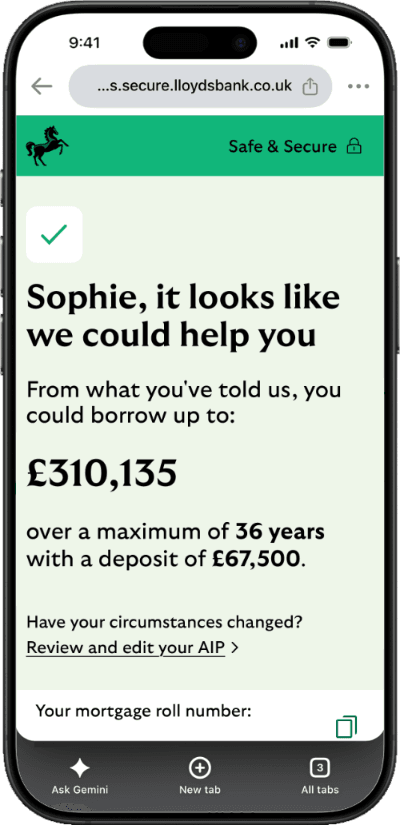
A mobile phone showing an agreement in principle for a first-time buyer.
An agreement in principle for a first-time buyer.

Also known as an “Agreement in principle” or a “Decision in principle” this is a lender’s educated estimate of how much they’d be willing to lend you, based on an assessment of your income, outgoings and credit file. It’s not a formal loan offer, but it’s the next best thing when you’re starting to look at properties. With an agreement in principle, estate agents will know that you’re a realistic prospect when looking at a property.

We got an agreement in principle from Lloyds while researching this article. For a single applicant it took 7.5 minutes and did not impact their credit file. It took a moment to remember the month and year they started their current job – which was one of the questions.

If you’ve lived at your current address for less than three years, you’ll need to dig out your old address.

Always check that there’s no impact on your credit file – lenders should be upfront about this. Assuming there isn’t, you can even get a few agreements in principle and put them side by side.

9. How well a mortgage lender supports you throughout the process

As this is likely the first time you’ve gone through the process, having the right support can be key. When deciding on a lender, look at whether you’ll be able to speak to a real person, if someone is there to explain the mortgage offer, how easy it is to get answers and whether you get updates during the application process.

10. How flexible a mortgage lender is on overpayments

Overpayment policies can vary product-to-product even within one lender’s range, however more commonly a lender has one policy that applies to all its mortgages.

In the UK, up to 10% overpayment per year without penalty is a common standard. So if you had a £150,000 mortgage, you could overpay by up to £15,000 in a year without penalty.

It’s a nice bit of flexibility to have, and making overpayments when you can is a good habit which can bring down the overall cost of your mortgage.

Bottom line

You should be looking for how a lender handles smaller deposits, more complex income situations, gifted deposits or family support and government schemes. It’s also important to know what a lender’s criteria is for calculating affordability, what the application process looks like and what you need to do once an offer is accepted.

Many lenders will have information tailored to first-home buyers. This is where you’ll find details about how that lender approaches all the things that’ll matter to you. Take Lloyds’ first-time buyer hub as an example. It has a mortgage calculator, information about how it works with government schemes and details about its different mortgage options for first-time buyers.

Frequently asked questions

Do all mortgage lenders accept gifted deposits?

No. Lenders have different rules around gifted deposits, including who can provide the money and what evidence is required. If you're interested in a specific lender, you should research how it handles gifts.

Can my parents help me get a mortgage?

It will depend on the lender and your circumstances. In some cases family members might be able to help with a gifted deposit, act as a guarantor or other family-assisted mortgage arrangement.

Does having a guarantor help me get a bigger mortgage?

If you don't have much of a deposit, then a guarantor can provide a mortgage lender with the security it needs to offer you the mortgage you're after.

Can I get a mortgage with a 5% deposit?

Yes, but not from all lenders. Lloyds, for example, offers mortgages at 95% loan to value, meaning the buyer provides a 5% deposit.

Should I choose my mortgage lender before finding a house?

It can be helpful to get an agreement in principle before you start looking at houses. This will give you an indication of how much you might be able to borrow, but it's not a guaranteed mortgage offer.

Do mortgage lenders have different affordability criteria?

Yes. Every lender has its own criteria, so you might get different results depending on which one you use.

How long does a mortgage application take?

This will vary depending on the lender, how complex the application is, the property and whether additional information is required. A simple application can be quicker than one involving, say, unusual income or family assistance.

Sources

Think carefully before securing debts against your home. Your home may be repossessed if you do not keep up repayments on your mortgage. Lending is subject to status.
Jason Loewenthal's headshot

Jason is a writer and editor. He worked as a senior subeditor for Finder for 5 years and in that time became familiar with a wide range of financial products and services. Before that, he worked for Australian Associated Press. He has a BA from Macquarie University in Australia. Jason loves to help other people find new ways to save money. See full bio

More guides on Finder

Go to site