
How to get a mortgage as a first-time buyer

What steps are involved in securing your first mortgage? We drill into the details.

Buying your first home is an exciting step, but the mortgage process can feel overwhelming! Every first-time buyer’s journey will look a little different, but below you can find our step-by-step guide to the typical process:

  1. Build up your deposit
  2. Get to know your credit file
  3. Sign up with a broker or adviser
  4. Check schemes and government support
  5. Work out your budget
  6. Choose your mortgage
  7. Apply for your mortgage

Step 1: Build up your deposit

Figures from the mortgage broker Tembo show that the average first-time buyer deposit currently sits at £42,324, but this varies massively depending on location.

Some schemes let you get a mortgage with a 5% deposit (or sometimes even lower). However, putting down a larger deposit means you borrow less and typically unlock lower interest rates – meaning the amount you pay back each month should be less. Therefore, saving up a larger chunk, such as between 10% and 25%, can be beneficial.

Using the most recent average first-time buyer house price in the UK – £228,140 – and average mortgage rates, here’s a breakdown of how the average monthly mortgage payment can vary depending on the deposit you put down.

Deposit %Deposit amountAverage mortgage rate (2-year fix)Monthly mortgage payment
5%£11,4076.01%£1,398
10%£22,8145.61%£1,274
15%£34,2215.44%£1,184
25%£57,0355.37%£1,037

While saving your deposit, you might find it useful to look for an all-in-one savings and mortgage platform like Tembo, which has specific savings accounts for first-time buyers. These include Lifetime ISA options and accounts with a bonus interest rate if you use Tembo as a mortgage broker. Most high-street banks like Lloyds, Nationwide, NatWest and others also offer both savings and mortgage support.

Lifetime ISAs: Quick overview

A Lifetime ISA can be a useful tool when you’re saving up a deposit on your first home. Whatever you deposit, the government will also contribute a 25% bonus, and you can earn interest on your savings.

For example, Tembo calculates that if you put £4,000 a year into their Cash lifetime ISA for 5 years, you would have £27,826 (figure correct as of September 2026). That’s a boost of almost £8,000 on top of what you’ve saved.

However, there is a penalty if you withdraw your money without meeting the criteria and house purchases are capped at £450,000. So, a Lifetime ISA is only suitable if you’re likely to buy a house that’s £450,000 or less – otherwise it’s probably not the right scheme for you.
Step 2: Get to know your credit file

It’s not the most exciting prospect, but getting familiar with your credit file means that you can understand if there’s anything you need to improve before applying for a mortgage. Lenders will generally look at the last 6 years of your credit history to see how reliable you are as a borrower.

So, how do you actually check your credit score? You can often do this with your bank – for example, I have a current account with Monzo and I can track my credit score each month in the app. Otherwise, there are free online services available which have options to show you scores from the 3 main credit agencies: Experian, Equifax and TransUnion.

Important things to check and fix in your report are:

  • Electoral registration. Make sure you are registered to vote.
  • Personal details. Check your name, date of birth and address history.
  • Payment history. Make sure there are no incorrect reports of missed payments or defaults.
  • Remove old links. Check for any errors such as old accounts or out-of-date financial associations (e.g. a joint account with an ex).
  • Pause new credit. Avoid taking out new credit agreements in the 6 months prior to your mortgage application, such as credit cards, loans or phone contracts.

If you find a mistake on your credit file, you need to contact the bank or company it’s associated with and they may agree to update their records and notify the credit reference agency. If they don’t agree, you’ll need to speak directly to the credit agency.

Step 3: Sign up with a broker or adviser

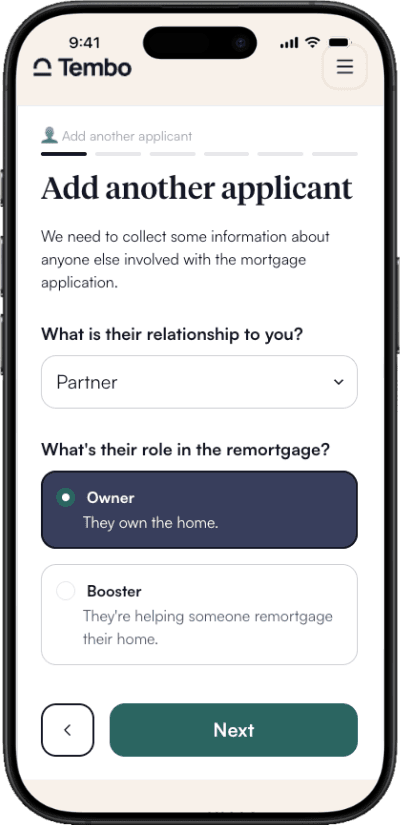
Tembo screenshot showing part of the onboarding form where you add another applicant's details – if you're buying with somebody else or with support of a 'booster' (typically a family member who helps you put up a larger deposit).

Signing up to an online mortgage broker is a great way to understand how much you can actually borrow and scan a wide range of deals without doing all the leg work yourself. Popular online mortgage brokers in the UK include Tembo, L&C Mortgages and Habito.

I signed up to the online broker Tembo and found it was an easy process – here’s a quick overview of the steps:

  1. Fill in a 10-15 minute form. This needed me to have information to hand about my income, outgoings, estimated deposit and credit usage.
  2. Get a Mortgage in Principle (MIP). It takes just a few moments to get a Mortgage in Principle which states the maximum you could borrow.
  3. View recommendations. After this, I was able to view my mortgage options in the app (and the best rate available), from a standard mortgage to low-deposit options and specialist schemes.
  4. Book an advice call. Following this, I could speak to an adviser, and kick off the rest of the process!

Step 4: Check schemes and government support

A broker can help you understand any first-time buyer government schemes or additional support that might help you get a mortgage. Examples include:

  • 5% deposit mortgages. Many banks offer 5% deposit mortgages as part of the Mortgage Guarantee Scheme, where the government providers lenders with a guarantee so they can help prospective homebuyers.
  • Lifetime ISA. An account where you can deposit up to £4,000 a year and the government will add a 25% bonus. It can only be used on properties worth £450,000 or less and popular accounts include Tembo, Moneybox and Plum.
  • Shared Ownership. A part-buy, part-rent scheme offered by the government. You buy a share of the home up to 75% then pay rent on the remaining share.
  • ‘Your First Home’ (pending). A newly announced government scheme where buyers deposit 2.5% on a new build property and the government provides a loan worth 20% of the property value. The full details will announced at the Autumn Budget.

A good online mortgage brokers will display different scheme options on their website or app based on your specific circumstances so you can see what’s right for you.

Step 5: Work out your budget

Once you have your Agreement in Principle from your mortgage broker, you have a good understanding of how much you can borrow and therefore your property budget. This might be more than you’re initially expecting. For example, the online broker Tembo claims it can increase the average user’s budget by £82,000 – a claim which stood up to my test when it increased my budget by £88,000 compared to a high-street bank’s mortgage calculator.

However, when deciding on your budget, it’s important to remember that you don’t have to borrow the maximum amount offered to you. Your monthly repayments should be a figure you’re comfortable with, especially given they could increase if interest rates rise.

Step 6: Choose your mortgage

When choosing your mortgage, it’s important to look at the repayment type and the repayment method.

Fixed-rate vs variable mortgage

Fixed-rate mortgages mean your interest rate is fixed for a set period of time – usually 2, 3, or 5 years, although this can be longer.

Meanwhile, variable-rate mortgages mean your monthly repayments can change. A tracker mortgage follows the Bank of England base rate and will move along with this. A standard variable rate (SVR) mortgage follows the ‘standard’ rate offered by your lender and this is usually much higher than other deals.

Most first-time buyers opt for the certainty of a fixed-rate mortgage as these are the least risky and typically cheapest. Once your fix ends, you can find a new one.

Repayment vs interest-only mortgage

Most people will be familiar with the repayment mortgage – this is where you pay back both interest and a portion of the amount you borrowed with your mortgage. This means you own the property once you finish making payments.

An interest-only mortgage is where you only pay off the interest charges on your loan. With this type of mortage, you usually need a separate plan for paying off your mortgage balance at the end, such as a pension lump sum or investments.

Step 7: Apply for your mortgage

Now it’s time to actually apply for your mortgage! Your mortgage adviser will be able to guide you through the process, but here’s a checklist of the documents you’ll need to hand when putting your mortgage application:

  • Photo ID (passport or driving licence)
  • Proof of address (e.g. a utility bill or bank statement from past 3 months)
  • Latest payslip (if you’re in permanent employment)
  • 2-3 years of tax statements (if you’re self-employed)
  • 3-6 months of current account statements
  • Details of your credit commitments
  • Evidence of your deposit (account statements if it’s saved or a gifted deposit letter and valid ID from your donor)

The lender will also run a full (hard) credit check to estimate the risk involved in lending to you.

Then, they will carry out a valuation to check the property is worth the price that you’d be paying for it.

If they are happy with the checks, you will recieve your formal mortgage offer. Once you’ve accepted, your solicitor will handle the next steps in buying your first home.

Bottom line

The key things to consider before getting a mortgage as a first-time buyer include saving for your deposit, checking and improving your credit file, signing up with a mortgage broker or adviser to scan the most suitable deals on the market, and getting a Mortgage in Principle to see how much you can borrow. Then you can choose a mortgage with the help of your adviser and apply.

Frequently asked questions

Are there any pitfalls first-time buyers should avoid when applying for a mortgage?

A key consideration is avoiding major financial changes in the 6 months before your application, such as taking out a credit card or loan or putting a large purchase on your credit card. You should also avoid going straight to a bank you're familiar with out of a sense of loyalty – it’s worth comparing mortgages using a broker so you find the best deal.

How does my income affect my mortgage options?

Income is the main way lenders assess your affordability (how much you can borrow with a mortgage). Most will offer to lend 4.5 times your income, but this can be as high as 5.5 or 6 times with certain first-time buyer schemes. It’s not the only factor though – lenders also look at your outgoings and financial commitments with a “stress test”.

How does my job status impact my mortgage options?

If you're in permanent employment, this shouldn't have any real impact on your mortgage options as a first-time buyer, unless you've very recently changed jobs – in which case lenders might prefer 3 or more months in a role for stability.

If you are self-employed or a contractor, you may need to provide additional forms of documentation to prove your income and access the same range of mortgage options.

How do interest rate changes impact mortgage payments for first-time buyers?

This depends on whether you’re on a fixed or variable rate. If you fix your mortgage – for example, for 2 or 5 years – the advertised rate won’t change and your monthly payment will remain the same for now. However, if your fix is ending or you are on a tracker mortgage, your payments will likely change if interest rates rise or fall.

Sources

Sophie Barber's headshot
Written by

Senior content marketing manager

Sophie Barber is a senior content marketing manager for Finder in the UK. She has over 5 years experience in writing and publishing clear, concise and informative articles that help consumers make informed decisions. See full bio

Sophie's expertise
Sophie has written 97 Finder guides across topics including:
  • Personal finance trends and statistics
  • Cost of living and money saving tips

More guides on Finder

Go to site