Buying solo can feel out of reach but, with the right support, it’s absolutely possible. In fact, the mortgage broker Tembo reported that the number of single borrowers increased by 18% in the second half of 2025 compared to the first half. Here are some of the key considerations, as well as the different schemes and support you can use to get on the property ladder.
How much can a single person borrow?
There’s a (very) general rule that you can borrow up to 4.5 times your income, and this is the same whether you’re buying solo or with another person. However, the amount you can borrow – especially as a first-time buyer – varies massively depending on your circumstances.
There are key factors that influence how much you can borrow as a single person:
Salary and income. Lenders will base the amount they offer to lend you on a multiple of your annual salary or income.
Monthly outgoings. Most lenders will do something called a “stress test” on your finances and this involves looking at your monthly expenses. They want to make sure you can afford repayments if interest rates rise.
Deposit size. A larger deposit generally means you need to borrow less, and you can unlock better interest rates as a result. It can be tricky to get a chunky deposit as a single buyer, but there are schemes to help.
Credit history. Lenders will also assess your credit history to check you are a reliable borrower – a strong credit file means you may be able to borrow more.
For most solo buyers, it’s recommended to use an independent mortgage broker to scan the entire market for current deals and work out your maximum property budget. Popular brokers include Tembo and L&C Mortgages.
It’s also worth noting that you may not want to borrow the maximum amount quoted to you, as this can mean higher monthly payments. Finder statistics show the average monthly mortgage payment is £1,355, but it’s important to end up with a payment you’re comfortable with.
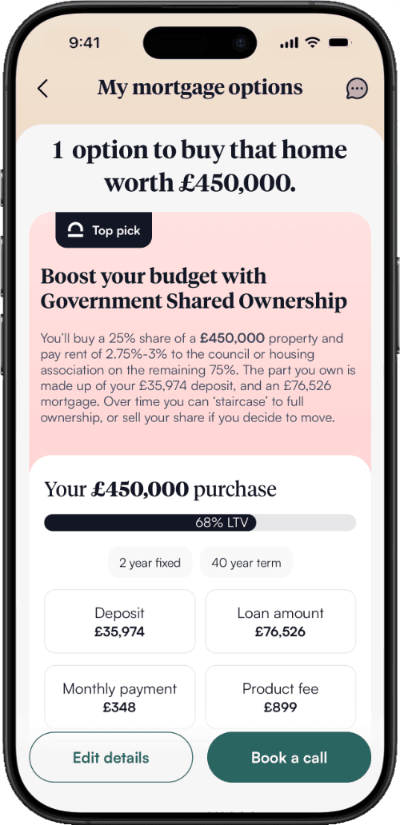
I used a digital broker's app to learn if I could get a mortgage on my own
"For a long time, I was certain that getting a mortgage was a million miles away, especially getting one by myself. However, as an existing Tembo user, I noticed you can check out your mortgage options through the app, so I thought I would give it a try to see just how far away I really was.
The process was straightforward and seamless, where I simply had to complete a form and input a few personal details, which took no longer than 5 minutes. In no time I was looking at the different homes that I could currently afford to get a mortgage on – which I was pleasantly surprised by!
Tembo did all the hard work, producing an easily digestible breakdown of the fees, loan amounts and rates involved with each mortgage option available to me. The app also gave me plenty of information about some relevant schemes and how those would work, which helped guide me towards the most suitable and sensible mortgage for my situation."
It can be harder to meet a lender’s affordability criteria as a single parent. You’re relying on a single income for a multiple person household and any regular outgoings – including childcare costs – are taken into account when a lender stress tests your finances.
However, it’s absolutely possible and there are schemes that can help you get onto the property ladder as a single parent. An online mortgage broker – like Tembo, Mojo Mortgages or Simply Lending – can help you find specialist mortgage options for your situation.
How does benefit income impact mortgage applications?
Lenders will still take benefit income into account when assessing your affordability, alongside other regular income such as a salary. It can be harder to get a mortgage if benefits make up a significant portion of your income, but there are options.
You may be able to increase your borrowing potential by having a strong credit score and a larger deposit. You may also be able to apply for government-backed schemes like Shared Ownership to assist your application.
Lenders have their own specific rules about who can borrow from them, but a mortgage broker can help you find providers experienced in dealing with more complex situations.
How can families support single borrowers?
There are several schemes that families can take part in to help their relatives buy solo:
Guarantor mortgages. A family member uses their savings or their property as security for your mortgage. They are liable if you can’t pay, and their savings or property can be used as collateral.
Joint Borrower Sole Proprietor mortgage (JBSP). Add a family member’s income to your mortgage to boost your borrowing power. You are still the sole owner of the property, but the mortgage is joint, so they’ll be required to step in if you can’t pay.
Deposit Boost. Offered by the mortgage broker Tembo, this is different to a traditional guarantor mortgage, as two separate mortgages are taken out so your family member is not liable for your loan. Your loved one releases equity from their property to gift you that money towards your deposit.
These come with benefits and risks, so it’s important to speak to a mortgage broker about the best option for you. Look for mortgage platforms, like Tembo, that specialise in boosting single applicant borrowing power with family help. On its website you can discover how much a JBSP could boost your borrowing in just 10-minutes, live interest rates, indicative repayments and all.
How to buy a house on your own
1. Save for a deposit
The first – and arguably the most difficult – step in buying a house on your own is saving up your deposit. Look for dedicated accounts that can help you. One of the most popular is the Lifetime ISA (LISA), which lets you deposit up to £4,000 each year, and the government will contribute 25% (up to a maximum of £1,000 a year).
The LISA does come with a penalty if you don’t use the funds for a house purchase and withdraw them before you’re 60, and there’s also a property threshold cap. If you’re unsure whether the LISA is a fit, there are alternatives. The mortgage broker and savings provider Tembo also has a specialised savings account for prospective home buyers with a competitive rate, called the HomeSaver.
The government has also announced plans for a new First-Time Buyer ISA, with the details still to be ironed out.
2. Look into schemes that can help
As well as the family-assisted schemes (guarantor mortgages, Joint Borrower Sole Proprietor mortgage and Deposit Boost) and Lifetime ISA mentioned earlier, you might want to look into the following schemes which can boost affordability:
Shared Ownership. A government-backed part-buy, part-rent scheme.
First Homes scheme. First-time buyers may be able to buy certain homes for 30% to 50% less than the market value.
5% deposit schemes. Low deposit mortgages, with some backed by the government’s Freedom to Buy scheme.
A good mortgage broker will explore these on your behalf and help you weigh up any suitable options.
3. Work out your borrowing power
Once you’ve got a substantial deposit saved and you’ve looked at the available help, the next step is seeing what you can feasibly borrow. Banks and building societies such Lloyds or Nationwide have affordability calculators, BUT the results will be based on that provider’s specific lending rules and their current deals only, so they won’t give you the full picture.
Instead, you can use an online mortgage broker to get a Mortgage in Principle (MIP). This lets you know how much you can actually borrow as a single applicant – giving you a budget for your home.
4. Find the right mortgage deal
The next step is choosing your mortgage deal and applying. If you’ve used a whole-market broker (e.g. Tembo or Habito) you should have a good idea of the best options. You’ll need to provide the relevant documents, such as proof of identity, address, income and bank statements.
Then, once you’ve done this, you can start the exciting process of finding your dream home (if you haven’t already), making an offer and going through the home-buying process!
Frequently asked questions
What’s the average deposit for a single person?
The average first-time buyer house price in May 2026 was £244,000. For a single person, this would mean putting down the amounts listed below with different deposit percentages. Note that deposit requirements vary hugely depending on where you live. Tembo's quarterly first-time buyer index breaks down average deposits from the UK's top 21 cities.
Deposit percentage
Deposit amount
Mortgage required
5%
£12,200
£231,800
10%
£24,400
£219,600
15%
£36,600
£207,400
20%
£48,800
£195,200
Can I get a sole mortgage if I’m married?
Yes, you can, but many lenders prefer married applicants to take out a joint mortgage so you might need a valid reason. This could include existing ownership of a property, one partner moving out, or your spouse having a poor credit score or no income.
It's worth nothing that any financial association – where two people share a financial product, whether that's a mortgage or a joint bank account – could impact your chances of applying for a new financial product if your partner has a poor credit score. This is because a bank would think you’d help them out if they were in dire straights.
What are my mortgage options as a single person if I have low income?
You might consider government schemes such as Shared Ownership or look at options like a Joint Borrower Sole Proprietor mortgage (JBSP), where a family member’s income can be added to your mortgage but you retain full ownership. A mortgage broker can help you boost your affordability by looking at specialist schemes – for example, Tembo says it can boost the average user's budget by £82,000.
What are my mortgage options as a single person if I’m self-employed?
You should have access to the same options, but you will need to provide comprehensive income evidence, such as up to 3 years of accounts and tax returns. A broker can help match you with lenders who specialise in self-employed and single income mortgages.
What are the credit score requirements for a solo mortgage?
There are no set requirements, but you should always aim to improve your credit report before applying for a mortgage. Having a score in the "good", "very good" or "excellent" tier will improve your access to mortgage deals and likelihood of being approved.
Should I get a fixed or variable rate mortgage as a solo buyer?
A fixed-rate mortgage is typically seen as the safer choice with a single income, as your payments are certain and won’t suddenly fluctuate. While variable rates can be cheaper initially, there’s always a chance they can go up significantly if interest rates rise.
Sources
Think carefully before securing debts against your home. Your home may be repossessed if you do not keep up repayments on your mortgage.
Sophie Barber is a senior content marketing manager for Finder in the UK. She has over 5 years experience in writing and publishing clear, concise and informative articles that help consumers make informed decisions.
See full bio
Sophie's expertise
Sophie
has written
98
Finder guides across topics including:
Want to know how to choose the right mortgage as a first-time buyer? Our guide will give you everything you need to know to find the help and advice you need.
Finder.com is an independent comparison platform and information service that aims to provide you with the tools you need to make better decisions. While we are independent, the offers that appear on this site are from companies from which Finder receives compensation. We may receive compensation from our partners for placement of their products or services. We may also receive compensation if you click on certain links posted on our site. While compensation arrangements may affect the order, position or placement of product information, it doesn't influence our assessment of those products. Please don't interpret the order in which products appear on our Site as any endorsement or recommendation from us. Finder compares a wide range of products, providers and services but we don't provide information on all available products, providers or services. Please appreciate that there may be other options available to you than the products, providers or services covered by our service.
We update our data regularly, but information can change between updates. Confirm details with the provider you're interested in before making a decision.