How do I calculate my mortgage affordability?

It can be a challenge to work out how much mortgage you'll be able to take on when buying your first home. This guide will help you understand how the process works.

Key takeaways

  • Mortgage affordability depends on more than salary – income, outgoings, commitments and job security all factor in.
  • Lenders typically cap borrowing at 4.5x annual income, but some first-time buyer mortgage options (like Lloyds’ First Time Buyer Boost) go up to 5.5x.
  • Lenders “stress test” your ability to cope with higher interest rates before approving a mortgage.
  • A bigger deposit reduces how much you need to borrow and can unlock better rates via a lower LTV.
  • Online calculators give useful rough estimates, while an Agreement in Principle with a soft credit check gives a much more accurate figure.

The average first-time buyer needed £45,860 for a 20% deposit in July 2026. In London, the average was more than twice as high. So buying a first home might feel like a distant dream for many people.

One of the first things you might want to do is to try to calculate how much you’ll be able to borrow and how much you’re comfortable repaying each month. The government’s MoneyHelper site has a great tool you can use to get a sense of benchmark figures based on your circumstances.

Ultimately, both you and the bank lending to you need to be comfortable that the mortgage you have in mind would be affordable. After all, nobody knows your personal situation better then you, and banks have to be experts at weighing up what’s affordable.

There are plenty of great resources available to help you if you know where to look. Lloyds, for example, has a helpful first-time buyers hub with both mortgage products and support to help you get a foot on the housing ladder.

What goes into lender affordability calculations?

Every lender is different and has its own criteria. But all lenders will look at your income, regular expenses, any existing debts you have and household circumstances, such as how many people are financially dependent on you.

Factors that lenders consider include:

  • Gross income (or net profit if you’re self-employed)
  • Any existing loans and credit commitments you have
  • Regular household spending, including rent, bills and groceries
  • Number of dependants
  • Childcare and other financial commitments
  • Your employment status and income stability
  • Your deposit and how much you want to borrow

Lenders will also assess whether you could continue to afford your mortgage if circumstances changed, such as an increase in interest rates. This is known as a mortgage stress test and helps them assess whether the proposed borrowing is sustainable.

What income is used to calculate mortgage affordability?

Gross income is used to calculate mortgage affordability, but it isn’t the only factor. Lenders will also evaluate your net income and any extra income you get on top of your salary.

If you’re self-employed, lenders may assess your income differently. They could consider factors such as your net profit, salary and dividends. It’s likely you’ll be asked to show your income for previous years as well.

The way different types of income are treated varies between lenders, so the amount you can borrow may differ depending on where you apply.

What outgoings are included in an affordability assessment?

When doing an affordability assessment, lenders generally look at your regular household expenditure to understand how much money you have available after you’ve paid your bills. This can include:

  • Rent or existing housing costs
  • Council tax
  • Utility bills
  • Food and household expenses
  • Transport costs
  • Childcare costs
  • Insurance
  • Loan and credit card repayments
  • Other regular financial commitments

Lenders look at these outgoings to help them determine whether your spending habits are proportionate to your income. If you’re regularly spending too much and have a lot of debt, it could impact the amount of money a bank is willing to lend you.

How do lenders calculate mortgage affordability?

Lenders look at how much you earn and how much you spend. This gives them an understanding of your finances so they can calculate how much you can borrow.

But there isn’t a single calculation that applies to everyone. Lenders use their own affordability criteria, and they may assess income and expenditure differently. So the same applicant could be offered quite different maximum mortgages from 2 different mortgage providers.

Some lenders also apply income multiples as part of their assessment. A common amount is 4.5x your income, but there are specialist schemes to help first-time buyers onto the housing ladder. As an example, Lloyds lends up to 5.5x your income with its First Time Buyer Boost scheme.

Example mortgage affordability calculation

We ran Lloyds’ first-time buyer mortgage calculator with the following inputs:

  • 2 joint appliants
  • Each earning £32,000
  • No kids
  • No credit card debt
  • One paying £100 per month towards a personal loan
  • Both paying £20 per month towards student loans

Maximum mortgage £352,000 (over 25 years). That’s 5.5 x £64,000 (the combined annual income).
How do interest rates affect mortgage affordability?

Outside of any fixed-rate periods, changing interest rates will affect the size of your monthly mortgage payments, and therefore the amount you might be able to borrow.

When rates are higher, the cost of servicing a mortgage will also be higher. This will mean higher monthly repayments, which could reduce the amount a lender considers affordable.

For example, if 2 mortgages have the same balance and term but different interest rates, the mortgage with the higher rate will normally have the higher monthly repayment.

Lenders will also look at if you could afford to continue paying your mortgage if interest rates increased. The Financial Conduct Authority (FCA) requires lenders to question whether you’d be able afford your mortgage repayments if rates rose. Specifically, until 2022, the Bank of England’s Financial Policy Committee recommended that borrowers should be able to comfortably cope with a three-percentage-point rise (e.g. from 4% to 7%) in rates during the first five years of their mortgage. MoneyHelper’s mortgage affordability calculator simulates a 3%, 4% and 5% rate rise for you, which is a handy way to model the impact on your bank balance each month.

Example mortgage affordability stress test

We ran MoneyHelper’s mortgage affordabilty calculator with the following inputs:

  • 2 joint appliants
  • Each earning £32,000
  • No kids
  • No credit card debt
  • One paying £100 per month towards a personal loan
  • Paying a combined £40 per month towards student loans
  • Paying a combined £350 per month on travel
  • Paying a combined £420 per month on household bills
  • Paying a combined £400 per month on food and essentials
  • Paying a combined £220 per month on entertainment/leisure
  • Paying a combined £420 per month towards holidayss

On a £202,540 mortgage over 25 years, the estimated monthly repayments was estimated based on a 4% interest rate, with additional estimates for 7%, 8% and 9%:

Interest rateMonthly repaymentLeft over
4%£1,069.08£1,588.92
7%£1,431.51£1,226.49
8%£1,567.24£1,094.76
9%£1,699.71£958.29

How accurate are mortgage affordability calculators?

Mortgage affordability calculators are as accurate as the information you put in them, but are designed to provide a quick estimate of how much you can borrow. Use a calculator as a starting point rather than a guarantee.

An “Agreement in Principle” is the next step up from a quick calculator. This will involve a “soft” search of your credit file (so it won’t impact your credit score). It’ll take 3-4 minutes longer but will give you a more accurate figure to work with.

How does your deposit affect mortgage affordability?

The larger your deposit, the less you need to borrow with a mortgage. A larger deposit can also mean a lower loan-to-value (LTV) ratio and can give you access to a wider range of mortgage options or lower interest rates.

It can be hard to save up for a large deposit, so some lenders allow first-time buyers to buy with a smaller deposit. For example, Lloyds has a “£5k Deposit mortgage” available for eligible first-time buyers, which is equivalent to around a 98% LTV on the maximum property value of £300,000. Most high street lenders also offer 95% LTV mortgages (meaning a 5% minimum deposit) since the UK government introduced the mortgage guarantee scheme.

How can first-time buyers improve their affordability?

First-time buyers can improve their affordability by paying off debt, saving a larger deposit and getting their finances in order.

It’s also worth reviewing your regular spending and creating a realistic household budget. If you can reduce spending then it’s likely you’ll have more money to save.

While it’s a good idea to reduce your spending, you need to be sustainable about it. Don’t cut essential spending just to improve your affordability assessment. You need to make sure a mortgage remains affordable for you in the long term and shouldn’t just focus on maximising the amount you can borrow now.

It’s also worth checking your credit score and report. If there’s anything on there that’s incorrect, you can take steps to get that sorted in advance of applying for a mortgage.

And one final thing, try to limit any new account or credit applications in the lead-up to applying for a mortgage, because multiple hard credit searches can impact your credit score.

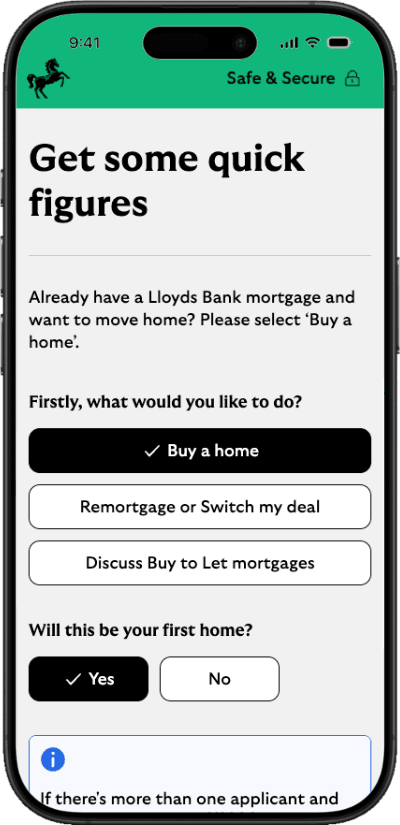
A smartphone showing the start screen of Lloyds' first-time buyer mortgage affordability calculator.
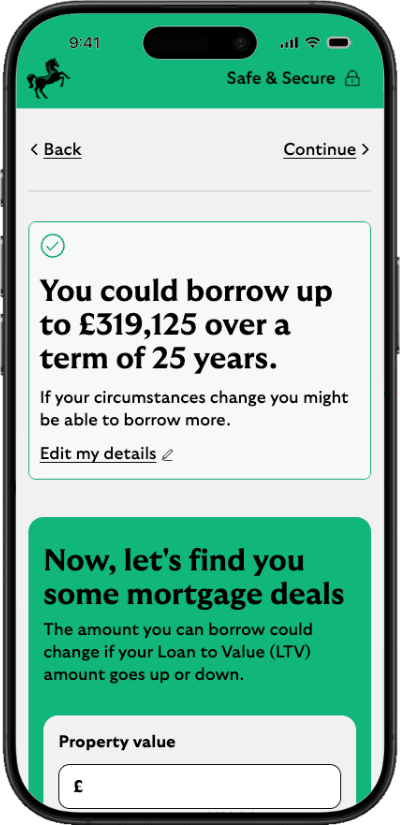
A smartphone showing the results screen of Lloyds' first-time buyer mortgage affordability calculator
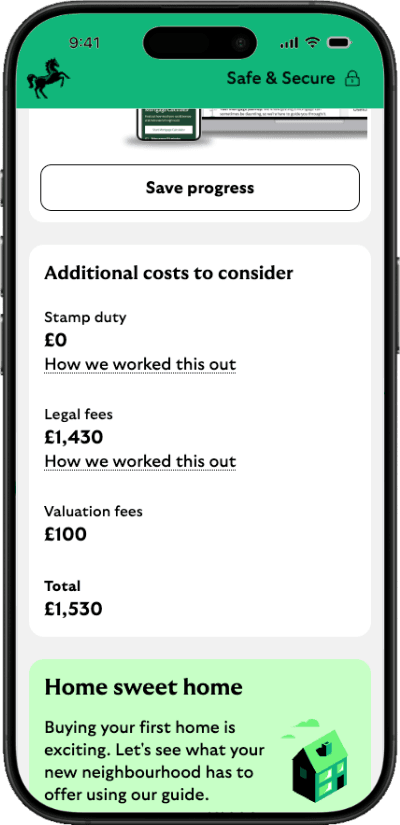
A smartphone showing other estimated costs (such as legal and valuation costs) on Lloyds' first-time buyer mortgage affordability calculator
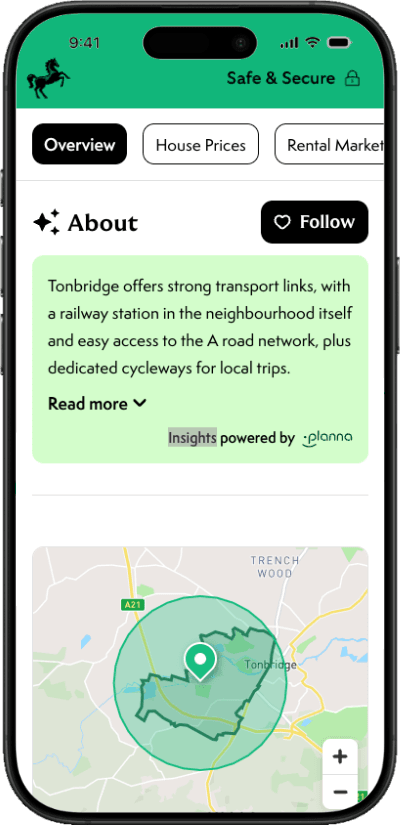
A smartphone showing Lloyds' neighbourhood guide tool which compares a specified neighbourhood against national averages on factors such as living costs and transport links.
Lloyds offers first-time buyers a handy suite of tools ranging from a quick calculator to get a sense of budget and affordability, through to a neighbourhood check tool which compares a specified neighbourhood against national averages on factors such as living costs and transport links

Bottom line

Mortgage affordability depends on more than just your salary. Lenders always look at your income, spending, debts, deposit and wider financial circumstances to determine how much they believe you can sustainably borrow.

You can use an affordability calculator to help you get an idea of how much you can borrow, but treat it as an estimate. Once you’re ready to apply, a lender or qualified mortgage adviser can provide a more detailed assessment to find the best mortgage for your circumstances.

Frequently asked questions

What income is used to calculate mortgage affordability?

Your salary, self-employed income, bonuses, commission, overtime and other regular sources of income are used to calculate how much you can afford to borrow. Lenders all have different criteria and lending limits.

Does my student loan count as a monthly loan repayment for mortgage affordability calculators?

Generally yes. Lloyds' first-time buyer calculator, for example, asks if you make any monthly payments towards loans, and you should declare your student loan payments here.

Does my deposit affect how much I can borrow?

Yes. A larger deposit generally means you need to borrow less and may give you access to a lower loan-to-value (LTV) ratio, which can potentially improve the mortgage rates available to you.

Lenders tend to structure their mortgage products with interest rate "bands" – charging higher rates on higher LTVs (since there's more risk). The interest rate is one of the main factors determining the size of your monthly repayment. Therefore, if you were putting down a 9.5% deposit but a lower rate was available from 10%, it could be really worth trying to find a little extra to reach the minimum deposit for that next rate band. It could make your mortgage overall more affordable and improve your likelihood of being approved.

Do existing debts affect mortgage affordability?

Yes, credit cards, personal loans, car finance, student loans, and other financial commitments can reduce the amount a lender may be willing to lend because these all have an impact on your monthly disposable income. It can be a good idea to pay these off before you apply for a mortgage, if possible.

Can I include my partner's income?

If you're a couple buying a house together, then lenders will usually consider both of your incomes and expenses to assess your affordability.

Are mortgage affordability calculators accurate?

A calculator is only as accurate as the information you provide. Even then it's just an estimate based on those numbers and a lender's own criteria. It gives you a good starting point but you'll need to make an application to know how much you can actually borrow.

What information do I need to calculate affordability?

You'll need information about your income, how large your deposit is, any existing debts you have, your monthly expenses and any other relevant financial commitments, such as how many dependants you have.

How can I improve my mortgage affordability?

You can try to improve your affordability by paying off debt, saving for a larger deposit, earning more money or reducing your expenses. It's important not to take on a mortgage that would put your finances under unnecessary pressure.

Does affordability mean I should borrow the maximum amount available?

No, you should always borrow an amount that you'll be able to continue paying back long into the future. The maximum amount a lender offers isn't necessarily the amount you should borrow.

Sources

Think carefully before securing debts against your home. Your home may be repossessed if you do not keep up repayments on your mortgage. Lending is subject to status.
Jason Loewenthal's headshot

Jason is a writer and editor. He worked as a senior subeditor for Finder for 5 years and in that time became familiar with a wide range of financial products and services. Before that, he worked for Australian Associated Press. He has a BA from Macquarie University in Australia. Jason loves to help other people find new ways to save money. See full bio

More guides on Finder

Go to site