Learn about the different categories of investment assets and how they can help diversify your portfolio.
Once you start thinking about investing, you’ll hear the term “asset class” come up a lot. Put simply, an asset class is a group of similar assets or investments. The difference between the main asset classes when building your portfolio will affect your investment returns and your risk level.
What are asset classes?
Asset classes are groups of assets that are similar. While US stocks, international stocks, blue-chip stocks, stocks from emerging markets like India, industrial stocks, technology stocks and mining stocks are all different stocks, they belong to the same class. This is because they are similar in the way they are bought and sold through an exchange, are regulated in the same way and all have similar tax implications. There are five main asset classes.
Equities
Equities include all stocks and funds listed on a public exchange like the S&P 500 or the NASDAQ. These are publicly listed companies, and when you buy shares in these companies, you own a portion of it. Equities are often considered to be the highest-risk asset class.
Types of stocks
When you buy stocks, you’re buying a share of ownership in a company. Also called equities, stocks are based on the company type, size, potential for growth and performance in the market. Your profits and losses depend on the success and failure of the company, as well as the influence of major trends in the stock market.
Income stocks. These pay regular dividends based on the company’s current or retained earnings. For investors, they provide high-yield income that’s often paid out quarterly. Big-name utility companies tend to be income stocks.
Growth stocks. These are growth stocks, such as tech startups. They rarely pay dividends. Instead, investors purchase them because they believe their capital will appreciate.
Value stocks. These are value ETFs than their peers, so they’re often cheaper than stocks with a higher PE. They can be growth or income stocks, and people buy them hoping the stock price will rebound and return to a more competitive PE.
Blue-chip stocks. These are shares in huge, financially fit corporations with a solid history of growth, and they usually pay dividends. Examples of blue-chip stocks are Johnson & Johnson, Visa and Walmart.
Master limited partnerships. MLPs are publicly traded companies organized as limited partnerships. They combine the liquidity of a public company with pass-through taxation, meaning the MLP itself doesn’t pay corporate income tax — profits, deductions and credits flow directly to investors, who report their share on a Schedule K-1 each year. Cash distributions themselves are often treated as a tax-deferred return of capital rather than immediate income, though the underlying partnership income is still taxed annually whether or not it’s distributed.(1)
Penny stocks. These are penny stocks. The SEC generally defines a penny stock as an equity security priced under $5 per share (excluding stocks listed on a national exchange like the NYSE or Nasdaq).(2) They’re known for their volatility.
Impact stocks. Impact stocks are shares in companies that are known for their environmental and social stewardship. Companies specializing in solar energy, low-income housing and sustainable agriculture are examples of impact stocks.
Fixed-income securities and debt
Fixed-income assets offer a fixed rate of return, like bonds. Bonds are essentially a form of loan used by both companies and governments when they need to borrow money. Investors who lend their money will earn a preset, fixed interest rate on that money.
Types of bonds
Bonds are a type of fixed-income investment that pay interest or dividends at set intervals and return your principal amount at the end of the term. They are issued by governments and companies at fixed rates, so when you buy a bond, you’re essentially lending the issuer money in exchange for interest payments. Bonds are generally less risky than stocks, but like any investment, your returns may vary, so there’s no guarantee you’ll make money.
Government bonds
There are two different types of government bonds: treasury bonds and municipal bonds. Both are used to generate money for cash flow, finance debt, fund investments and more. They are issued by the government, so they are the lowest risk, but they often have lower interest rates than the other types of bonds.
US Treasuries
These bonds are issued by the federal government through the US Department of the Treasury. There are four types of US treasury securities that range from short-term to long-term and have different risk levels and returns.
US Treasury Bills. Short-term securities that mature within 52 weeks.
US Treasury Notes. Intermediate-term securities that mature within 2 to 10 years of being issued.
US Treasury Bonds. Long-term securities that mature in 20 or 30 years and pay interest every six months.
Treasury Inflation-Protected Securities (TIPS). Notes and bonds whose principal is adjusted for inflation according to the Consumer Price Index. They are issued for terms of 5, 10 and 30 years, and pay interest every six months.(3)
Municipal bonds
Municipal bonds are issued by states, cities, counties and local governments. They are all used to finance capital expenditures, but the purpose and repayment plan will vary.
Revenue bonds. Often used to fund public projects like water treatment plants or toll roads, revenue bonds are repaid by the revenue generated from the project.
General obligation bonds. These bonds are not backed by revenue from a specific project and are repaid through general taxation and municipal revenue or funds.
Conduit bonds. These bonds are issued on behalf of private companies like non-profit colleges or hospitals and backed by the third party as opposed to the government.
Corporate bonds
Corporate bonds are issued by public companies in an effort to generate cash flow. Unlike stocks, you won’t own a share of the company but will instead be considered a creditor and will earn interest on top of your principal. These bonds usually offer higher returns than government bonds, but they’re also riskier — if the company fails, it may default on the debt.
Investment-grade bonds. These bonds have a high credit rating, meaning that the issuer is likely in a strong financial position with the ability to repay the investment.
High-yield bonds (junk bonds). These bonds have a lower credit rating but pay higher interest rates in exchange for the increased risk.
Convertible bonds. These bonds can be converted to a predetermined amount of common stock or cash.
Cash and money market
This is the lowest-risk asset class and includes deposits with banks via products like savings accounts and CDs, along with a few other cash-like or low-risk savings vehicles commonly grouped here for educational purposes.
Savings bonds. These debt securities are issued and backed by the US Department of the Treasury to help pay for the federal government’s borrowing needs.
Savings accounts. Most banks and credit unions offer savings accounts. You can make as many deposits as you like. The Federal Reserve eliminated the federal six-withdrawal-per-month limit on savings accounts in 2020, but many banks still enforce a similar cap as their own policy, so check with your bank about its withdrawal rules.
Money market accounts.money market accounts by offering the convenience and liquidity of a high-interest savings account, sometimes with checkwriting privileges, but often in exchange for higher initial deposit and balance requirements.
Certificates of deposit.Look to a CD for an insured savings account that holds a set amount of money for a fixed term, usually six months to five years. The issuing bank pays interest until the CD matures. You can cash in your CD for the principal plus the interest you earned or roll over your balance to a new CD.
529 plans. Also known as qualified tuition plans, 529s are savings plans sponsored by states, state agencies or educational institutions. Earnings grow tax-deferred and withdrawals are tax-free when used for qualified education expenses, such as tuition and board.
Cash-value life insurance. Permanent life insurance policies — like whole, universal and variable life insurance — are investment products that build value over time. They include a cash component that’s invested into a menu of options, usually mutual funds. When you die, your beneficiaries receive a death benefit plus any added cash value.
Annuities. Think of an annuity as a contract between you and an insurance company. The company promises to pay you regularly either right away — called an immediate annuity — or as a future deferred annuity. Annuities grow tax-deferred, and you won’t pay taxes on the income and investment gains until you withdraw the money. Many people buy fixed, variable or indexed annuities to help manage money in retirement.
Property
This includes property investments in residential homes and commercial property — like major offices or industrial buildings. This is known as unlisted property, as it’s not bought and sold on an exchange like stocks and bonds are. However, you can invest in listed property with a managed fund, investing in a range of properties. Although you access listed property on an exchange, it’s still considered part of the property asset class, rather than equities.
Types of real estate
Buying a home is among our major investments. But other investment options make up the real estate realm.
Rental real estate. This involves buying and operating a real estate property, such as a house or apartment building, so that you can collect the rent. Many investors go with this investment for its cashflow income.
Real estate investment trusts.REITs allow you to invest in large-scale, income-generating real estate, such as shopping malls, hotels, resorts and storage facilities. As the investor, you earn a share of the income that’s produced. Many REITs are registered with the SEC or publicly traded.
Farmland and timberland investments. Investors who want to hold a tangible asset can purchase ownership tree farms, managed natural forests and similar investments.
New fintech innovations that allow you to invest in real estate without the hassle of managing it include Fundrise and Arrived.
Alternative assets
Alternative assets are harder to identify, but they typically include assets that don’t fit into any of the above classes. For example, investments made into a private company — one that isn’t listed on an exchange — would be classed as an alternative asset. Another example is collectibles like antiques, art or a stamp collection.
Commodities like gold and other precious metals, grains and other agricultural products are sometimes included in the alternative asset class. Investors often buy precious metals like gold, silver and platinum to diversify their portfolios and as a hedge against inflation and financial instability. Their prices can still be volatile, but because they carry no credit risk, they behave differently than stocks and bonds. You can purchase these directly or through exchanges.
Additionally, currencies — and now cryptocurrencies — are sometimes classified as an asset class, and are traded on their own foreign exchange market.
Compare online trading accounts to start investing
The Finder Score crunches 147 key metrics we collected directly from 18+ brokers and assessed each provider’s performance based on eight different categories, weighing each metric based on the expertise and insights of Finder’s investment experts. We then scored and ranked each provider to determine the best brokerage accounts.
We update our best picks as products change, disappear or emerge in the market. We also regularly review and revise our selections to ensure our best provider lists reflect the most competitive available.
Paid non-client promotion. Finder does not invest money with providers on this page. If a brand is a referral partner, we're paid when you click or tap through to, open an account with or provide your contact information to the provider. Partnerships are not a recommendation for you to invest with any one company. Learn more about how we make money.
Finder is not an advisor or brokerage service. Information on this page is for educational purposes only and not a recommendation to invest with any one company, trade specific stocks or fund specific investments. All editorial opinions are our own.
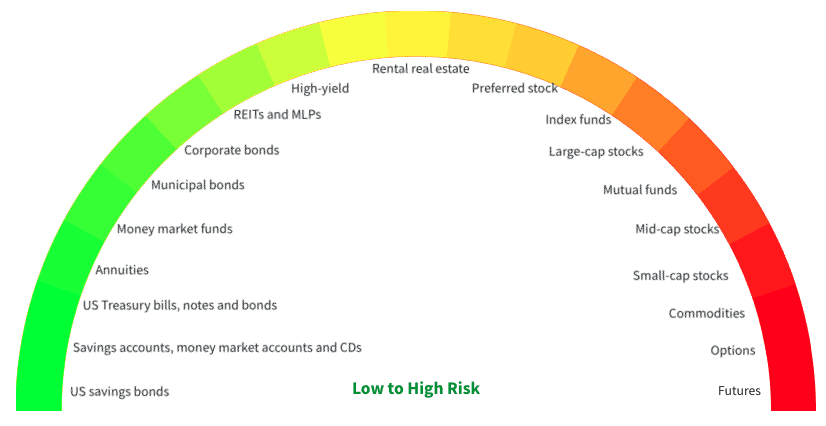
How risky is each asset class?
All investments carry some risk, but some are riskier than other. Cash and money market accounts tend to carry the lowest risk, while equities and alternatives are generally the riskiest.
Defensive vs. growth assets
Group these five asset classes further into either defensive or growth assets. Defensive assets are lower risk and often offer investors a level of guaranteed income. Growth assets are riskier and typically aim to achieve capital growth over the longer term rather than income over the short term. While returns are never guaranteed, it’s expected that high-risk growth assets will outperform lower-risk, defensive assets over the long term.
Defensive assets
Fixed income
Cash
Growth assets
Equities
Property
Alternative assets
Investing for income vs. capital growth
You could also divide the assets up depending on whether you’re investing for income or capital growth. Income assets provide ongoing income while you hold the asset. Capital growth assets may not provide any income for the short to medium term, but the investor hopes it will grow so when it’s sold to make a profit. One asset class can include both income and capital growth assets. Let’s look at stocks as an example. An established blue-chip stock like Coca Cola or IBM that profits every year and consistently pays a large dividend to its shareholders is classed as an income asset, as it offers value while you’re holding it. However, stock in a newly listed tech startup that pays no dividends are classed as a capital growth asset. Shareholder buys it with hopes it’s value will increase over the longer term.
What is an underlying asset?
You’ll often hear the term “underlying asset” in relation to some investment products like exchange-traded funds (ETFs), mutual funds and derivatives like options and futures. These products all track the value and performance of a particular set of assets, known as the underlying assets, often even if you don’t own that asset. Let’s look at ETFs, for example. These are types of funds that track the performance of a basket of assets — often stocks that belong to a market index or futures contracts. So a S&P 500 ETF will track the S&P 500 index, which is the value of the top 500 companies in the nation. If you invest in the ETF, you’ll get exposure to these 500 stocks (the underlying assets) without actually owning any of them directly.
Why should I invest in a range of asset classes?
Each asset class offers a different level of risk, and aren’t affected by the same market conditions. This means factors that might make stock prices fall or rise could have little impact on other asset classes like cash and property. Since they rise and fall at different times, investing in a range of asset classes can help make your portfolio less volatile.
Funds
An investment fund collects capital from a bunch of investors to buy stocks, bonds and securities. Usually managed by professionals, they give investors access to opportunities they may not have been able to invest in on their own.
Mutual funds.Mutual funds to invest in a variety of securities, such as stocks and bonds. Investors buy shares in mutual funds, and each share represents their part ownership in the fund and the income it generates. Four major categories are money market funds, bond funds, stock funds and target date funds.
Exchange-traded funds. Like mutual funds, ETFs are pooled investments that give investors an interest in a professionally managed portfolio. Unlike mutual funds, ETF shares trade directly on stock exchanges. Typically, an ETF is an index fund — it buys all the stocks and bonds in an index, or a curated list of investments. For example, the Dow Jones Industrial Average is an index consisting of 30 major companies. You might buy an ETF to diversify your portfolio and thereby decrease your risk. You can wait while the market grows, as opposed to buying and selling securities all the time. Because you’re not making many transactions, you’ll pay less in fees.
Private equity funds. Open to accredited investors like insurance companies, universities, and high-net-worth individuals, these funds require a high initial investment. They’re managed by private equity firms that typically buy a controlling interest in the portfolio company and work to increase its value over the span of 10 or so years. While most private equity funds have a long-term focus, some specialize in minority investments in startups and fast-growing companies.
Hedge funds. Also limited to uber-wealthy and institutional investors, hedge funds pool money to invest in a range of investments. However, they tend to take a riskier approach than mutual funds.
Index funds. An index fund is a type of mutual fund or ETF with a portfolio that’s made to match or track the returns of a market index, such as the S&P 500. It’s an indirect investment option that’s known for its low operating expenses and turnover.
How to find the right mix of assets for your portfolio
When designing your portfolio, take the following factors into consideration.
Your risk tolerance. If risky assets are going to keep you awake at night, it might be best to invest in asset classes that are lower risk.
Your income and growth goals. Why are you investing? Do you want to earn a regular income stream now or are you investing for well into the future?
Bottom line
Understanding the various asset classes can help you build the right portfolio. When you’re ready, compare your investment options and check out the online trading accounts that fit your investing profile and goals.
Alison Banney is the banking and investments editor at Finder. She has written about finance for over six years, with her work featured on sites including Yahoo Finance, Money Magazine and Dynamic Business. She has previously worked at Westpac, and has written for several other major banks including BCU, Greater Bank and Gateway Credit Union. Alison has a Bachelor of Communications from Newcastle University, with a double major in Journalism and Public Relations. She has ASIC RG146 compliance certificates for Financial Advice, Securities and Managed Investments and Superannuation. Outside of Finder, you’ll likely find her somewhere near the ocean.
See full bio
Moomoo pays up to $600 to switch, but Fidelity charges nothing to leave. See how these two very different brokers compare on fees, IRAs, crypto access and safety in 2026.
Discover the best robo-advisors of 2026. Compare fees, account minimums and features from top platforms that automate investing for beginners and pros.
We’ve rounded up stats on some of the most popular oil stocks, along with information on how they compare and how to invest.
Advertiser disclosure
Finder.com is an independent comparison platform and information service that aims to provide you with the tools you need to make better decisions. While we are independent, the offers that appear on this site are from companies from which Finder receives compensation. We may receive compensation from our partners for placement of their products or services. We may also receive compensation if you click on certain links posted on our site. While compensation arrangements may affect the order, position or placement of product information, it doesn't influence our assessment of those products. Please don't interpret the order in which products appear on our Site as any endorsement or recommendation from us. Finder compares a wide range of products, providers and services but we don't provide information on all available products, providers or services. Please appreciate that there may be other options available to you than the products, providers or services covered by our service.
We update our data regularly, but information can change between updates. Confirm details with the provider you're interested in before making a decision.