JP Morgan Self-Directed Investing Review


- Stock trade fee
- $0
- Minimum deposit
- $0
Our verdict
JP Morgan Self-Directed Investing offers $0 stock and ETF trades with no minimums, but lacks crypto and advanced tools.
JP Morgan Self-Directed Investing is the brokerage arm of Chase Bank, making it a convenient option for customers who want to manage their banking and investing in one place. The platform offers commission-free stock and ETF trades, no account minimums and access to investments such as mutual funds, options and fixed-income securities.
That said, the platform is better suited for beginner and long-term investors than active traders. It doesn’t offer direct crypto, futures or forex trading, and its cash sweep rate is far lower than what many competing brokers pay on uninvested cash.
Best for: Existing Chase customers, beginners and long-term investors.
Pros
-
Unlimited commission-free online trades
-
No minimum deposit or account minimum
-
Get the best of both worlds on the Chase Mobile® app or chase.com
-
Offers fractional shares
Cons
-
Low yield sweep account
-
Broker-assisted trades cost $20-$30
JP Morgan Self-Directed Investing at a glance
| Feature | Rating | Details |
|---|---|---|
| Investment options | ★★★★★ |
|
| Trading platforms and technology | ★★★★★ |
|
| Trading costs | ★★★★★ |
|
| Account fees | ★★★★★ |
|
| Account types and minimums | ★★★★★ |
|
| Features and amenities | ★★★★★ |
|
| Customer support | ★★★★★ | Contact customer service through your mobile app or by phone, but only during regular market hours. |
| Mobile app | ★★★★★ | Google Play app reviews: 4.8/5 based on over 1.98 million reviews Apple App Store app reviews: 4.8/5 based on over 8.9 million reviews |
| Cash sweep rates | ★★★★★ | Rates are 0.01% APY on JP Morgan Deposit Sweep accounts with no minimum amount required. |
To learn how our star ratings are calculated, read our methodology.
Who should choose JP Morgan Self-Directed Investing?
JP Morgan Self-Directed Investing is a solid fit for investors who want a straightforward brokerage account with access to stocks, ETFs and mutual funds, especially if they already bank with Chase. Typical users include:
- Chase customers who want to manage banking and investing in one place through the Chase app and website.
- Beginner investors who want a simple platform with $0 stock and ETF trades and no account minimums.
- Long-term investors who mostly buy and hold traditional investments rather than actively trading.
- Investors who want to buy fractional shares and start investing with smaller amounts of money — as little as $5.
That said, it’s probably not the best fit for traders who want direct crypto trading, futures, forex or more advanced charting tools.
What we like about JP Morgan Self-Directed Investing
One of the platform’s biggest advantages is its integration with Chase accounts inside the Chase mobile app. This way, you can manage all your banking, borrowing and investing needs all in one place and on the go — although this is only a real convenience for existing Chase customers.
We’re also happy to see that JP Morgan Self-Directed Investing offers fractional shares, which can be especially useful for newer investors or those with limited capital.
Where JP Morgan Self-Directed Investing falls short
JP Morgan Self-Directed Investing is best suited for traditional, long-term investors, but it comes up short if you want access to a wider range of assets or more advanced trading tools. You can’t trade crypto, futures or forex, and active traders may find the platform too limited.
It also offers a very low cash sweep rate. Uninvested cash earns just 0.01% APY, which is far below what many competing brokers offer. And while stock and ETF trades are commission-free, options trades still cost $0.65 per contract, and representative-assisted trades come with an added fee.
Investors looking for crypto trading, more advanced charting tools or a wider range of tradable assets may want to compare other brokerages.
JP Morgan Self-Directed Investing tools and features
Research, ratings and market insights
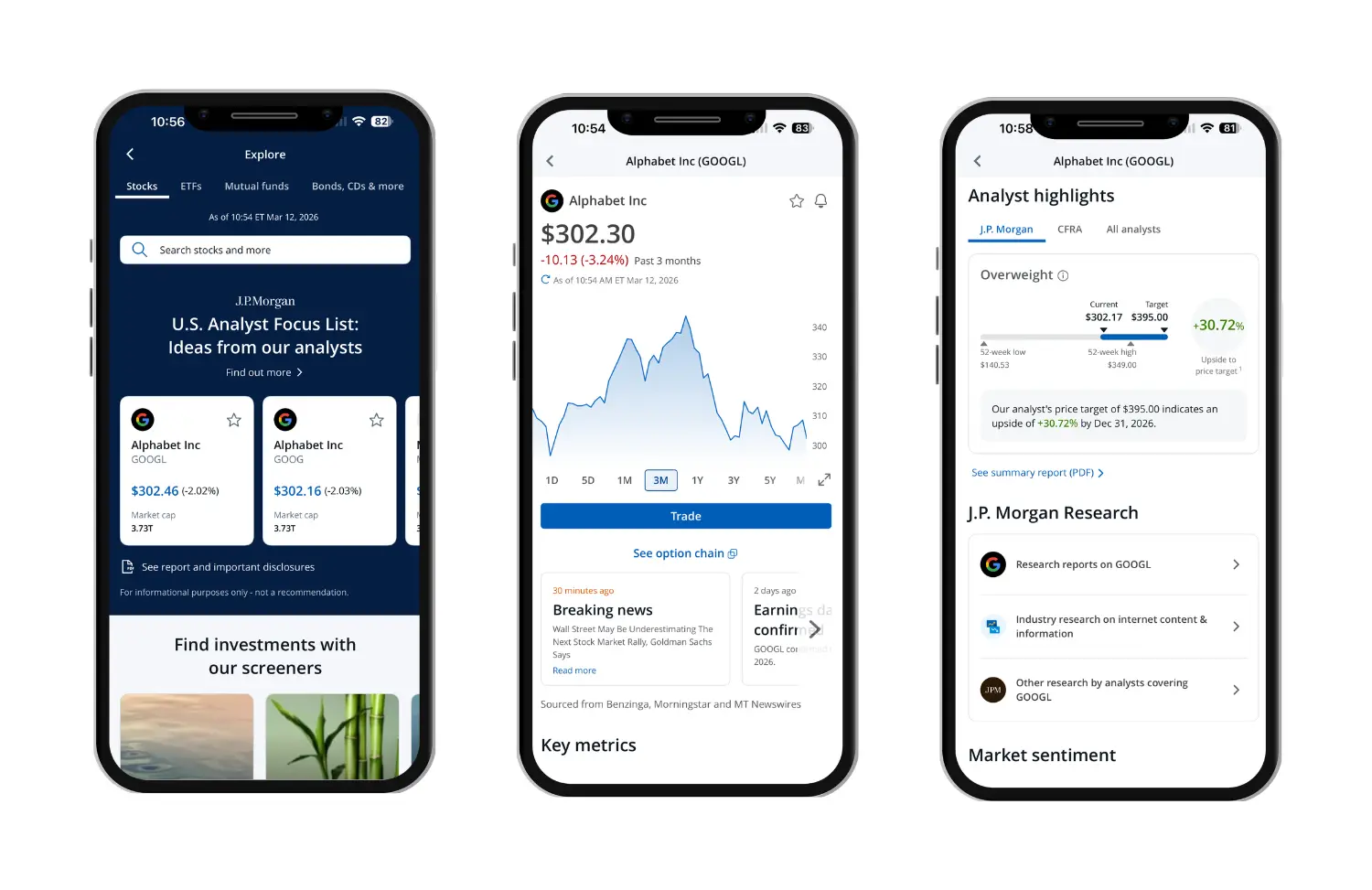
JP Morgan Self-Directed Investing gives users access to market research, analyst insights and other investing resources through the Chase platform. These tools can help investors evaluate stocks, ETFs and mutual funds before making a trade. You’ll find:
- News
- Key metrics, like market cap, today’s volume and price/earnings ratio
- Fundamentals, including Growth, Value, Income, Financial health and Momentum scores
- Ownership information
- Analyst price targets
- JP Morgan research
- Bullish and Bearish market sentiment summaries
- Earnings and estimates
- Dividend information
- Stock comparisons
Portfolio tracking and alerts
The platform also offers account performance tracking, investment comparison tools and market alerts to help users monitor holdings and keep up with changes in their portfolio.
Mobile experience
JP Morgan Self-Directed Investing is integrated into the Chase Mobile app and chase.com, making it easy for existing Chase customers to view banking and investing accounts in one place. That convenience is one of the platform’s biggest strengths, though active traders may find the mobile experience less robust than dedicated brokerage apps.
JP Morgan Self-Directed Investing fees
| Type of fee | Fee details |
|---|---|
| Minimum deposit | $0 |
| Minimum investment | $0 |
| Annual fee | $0 |
| Stock trading fee | $0 |
| Options trading fee | $0.65 per contract |
| Margin annual interest rate | Prime rate + 3.00% to Prime rate + 4.75% for accounts from $0 to $1 million |
| Outgoing account transfer fee | $75 |
| Inactivity fee | $0 |
| Wire transfer fee | $25 (Does not apply to internal transfers or to Chase Private Client) |
Is JP Morgan legit?
Yes, JP Morgan Self-Directed Investing is a legitimate investing account provided by JP Morgan Wealth Management, a division of JPMorgan Chase. JPMorgan Chase is a 225-year-old financial services company headquartered in New York City and has over $3.9 trillion in total assets and more than $900 billion in assets under supervision.
Investment products are offered through JP Morgan Securities LLC, a registered broker-dealer and investment advisor and member of the Financial Industry Regulatory Authority (FINRA) and the Securities Investor Protection Corporation (SIPC).
In addition, the JP Morgan Self-Directed Investing platform is considered safe and secure. Chase employs multiple authentication checks, account monitoring for suspicious activity and 128-bit encryption technology to protect your account and personal information.
Customer experience
| BBB accredited | No |
|---|---|
| BBB rating | A- |
| BBB customer reviews | 1.13 out of 5 stars, based on 868 customer reviews |
| Trustpilot score | 1.4 out of 5 stars, based on 37 customer reviews |
| Apple App Store Score | 4.8 out of 5 stars, based on 6,800 customer reviews |
| Google Play Score | 4 out of 5 stars, based on 30 customer reviews |
| Customer reviews verified as of | 02 January 2025 |
What do people on Reddit say?
However, some users say the platform feels more basic than dedicated brokerage apps. Common criticisms include limited trading tools, a relatively simple interface and fewer features for active traders compared with brokers like Fidelity, Schwab or Webull.
Several Reddit users also point out that the platform is better suited for buy-and-hold investing rather than frequent trading. While the integration with Chase is convenient, investors who want advanced charting, crypto trading or a wider range of asset classes often say they prefer using a traditional brokerage platform instead.
How to open a JP Morgan Self-Directed Investing account
- Sign in to your Chase account or create one.
- Select Investing → Self-Directed Investing.
- Choose your account type (individual, joint or IRA).
- Fund your account with a bank transfer.
Eligibility and required information
- At least 18 years old
- Valid Social Security number
- US citizen or lawful permanent resident with a physical address
Compare JP Morgan Self-Directed Investing to other platforms
Compare similar platforms by available asset types, trade fees and minimum deposit requirements. Select Go to site to sign up for an account.

8.4 Great
Available asset types
Stocks, Bonds, Options, Mutual funds, ETFs, Treasury Bills
Minimum deposit
$0
Signup bonus
Get up to $1,000

9 Excellent
Available asset types
Stocks, Options, Mutual funds, ETFs, Alternatives
Minimum deposit
$0
Signup bonus
Get up to $1,000 in stock

9.4 Excellent
Available asset types
Stocks, Bonds, Options, ETFs, Futures, Money market funds
Minimum deposit
$0
Signup bonus
Get 12 free shares by joining Webull
Finder Scores: What they mean

If you want peace of mind, this rating will give it to you. These products offer the best value and outcomes considering various product features, terms, conditions and price.

Well-balanced products that provide what you need, offering a healthy mix of competitive features at a good price. However, they're not quite the best in class.

Bottom line: You can find better, but these products still offer reasonable value and have the basics sorted.

These products may not offer much value in the long run, and there are better options available.
Frequently asked questions
Your reviews

Matt Finder
Investments editor and market analyst
You are about to post a question on finder.com:
- Do not enter personal information (eg. surname, phone number, bank details) as your question will be made public
- finder.com is a financial comparison and information service, not a bank or product provider
- We cannot provide you with personal advice or recommendations
- Your answer might already be waiting – check previous questions below to see if yours has already been asked
Finder only provides general advice and factual information, so consider your own circumstances, or seek advice before you decide to act on our content. By submitting a question, you're accepting our finder.com Terms of Use and Privacy and Cookies Policy.
This site is protected by reCAPTCHA and the Privacy Policy and Terms of Service apply.