Finder makes money from featured partners, but editorial opinions are our own.
Advertiser disclosure
Webull vs. Robinhood 2026: Which Is Better for You?
Both platforms have changed a lot in 2026. Here's how to choose between them.

Webull and Robinhood are two of the best mobile-first trading platforms available.
Both offer commission-free stocks, exchange-traded funds (ETFs) and equity options, fractional share trading and direct access to cryptocurrency. While Webull has more advanced trading tools and tradable assets, Robinhood’s user-friendly trading platform is one of the most intuitive trading apps I’ve reviewed.
In 2026, however, Robinhood has pushed much harder into active trading — meaning the gap between these two platforms has narrowed considerably.
These platforms are solid choices whichever way you go, but they cater to different types of investors.
Here’s how they compare.
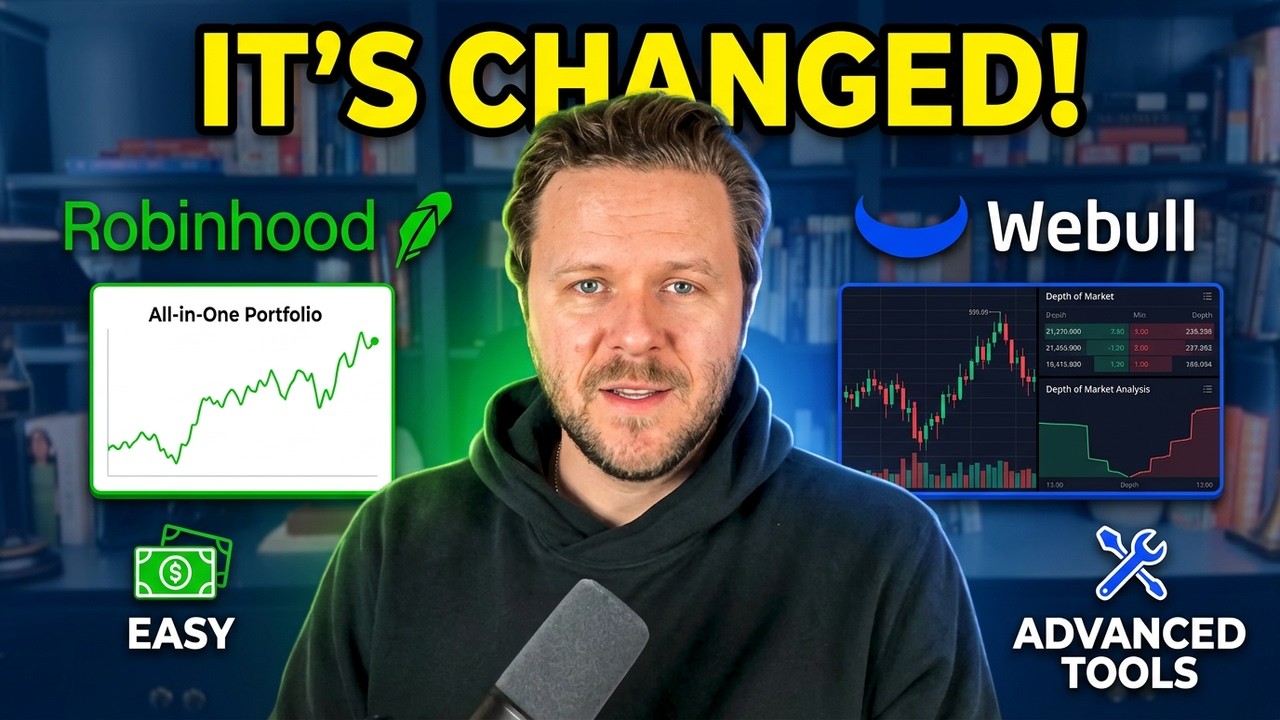
The biggest story this year is that Robinhood went hard after active traders. It now has Robinhood Legend, a dedicated desktop platform for stocks, options, futures and crypto. Robinhood also expanded futures and event contracts and rolled out AI-driven features through Cortex.
Webull, meanwhile, brought crypto trading back into the main app for US users (it had previously been housed in the separate Webull Pay app), added Webull Premium with Vega AI, and continued building out its trading stack.
So this is no longer just “simple app versus complex app.” Robinhood is more powerful than it used to be, and Webull is broader than it used to be.
 Webull |  Robinhood | |
| Finder Score |
|
|
| Account types | Individual, joint, traditional/Roth IRA | Individual, joint, custodial (UTMA), traditional/Roth IRA |
| Minimum to open | $0 | $0 |
| Annual fee | $0 | $0 |
| Stock trade fee | $0 | $0 |
| Investment options | Stocks, ETFs, options, index options, cryptocurrencies, futures, event contracts, money market funds, US Treasuries | Stocks, ETFs, options, index options, cryptocurrencies, futures, event contracts |
| Customer support | Live chat/phone support during business hours | 24/7 support, live chat/phone support |
| Mobile app reviews | Apple App Store: 4.7/5 stars based on over 333,390 reviews Google Play Store: 4.6/5 stars based on over 210,820 reviews | Apple App Store: 4.3/5 stars based on over 4.7 million reviews Google Play Store: 4.1/5 stars based on over 524,750 reviews |
| Bonus offer | Deposit/transfer match bonuses, free stock bonus, IRA match | Deposit/transfer match bonuses, IRA match |
| Learn more |
Check out Finder's picks for the best brokerage accounts
Compare top brokerage accounts and apps to help you maximize your investment.
| Webull | Robinhood | |
|---|---|---|
| Annual fee | $0 | $0 |
| Stock trade fee | $0 | $0 |
| Equity options trade fee | $0 | $0 |
| Index options trade fee | $0.50, or $0.40 with Webull Premium | $0.50, or $0.35 with Robinhood Gold |
| Options contract fee | $0 | $0 |
| Crypto trade fee | 1% spread | 0.4%–1% spread |
| Futures trade fee | $0.13–$1 depending on the contract; $0.25 off with Webull Premium | $0.75, or $0.50 with Robinhood Gold |
| ACATS fee | $75 | $100 |
| Inactivity fee | $0 | $0 |
| Webull | Robinhood | |
|---|---|---|
| Robo-advisor | Yes | Yes |
| Human financial advisor | No | No |
| Fractional shares | Yes | Yes |
| IRA match | 3.5% with Webull Premium, or 1% without | 3% with Robinhood Gold, or 1% without |
| Cash sweep rate | 3.35% APY with Webull Premium | 3.60% APY with Gold |
| IPO access | Yes | Yes |
| Instant buying power | Yes | Yes |
| Paper trading | Yes | No |
| 24/5 trading | No, extended hours only | Yes |
| Educational resources | Yes | Yes |
| AI tools | Yes – Vega AI | Yes – Cortex AI |
| Prediction markets/Event contracts | Yes – market and macro focused | Yes – broader (politics, sports, culture, crypto, economics) |
Webull and Robinhood offer distinct trading platforms tailored to different types of investors.
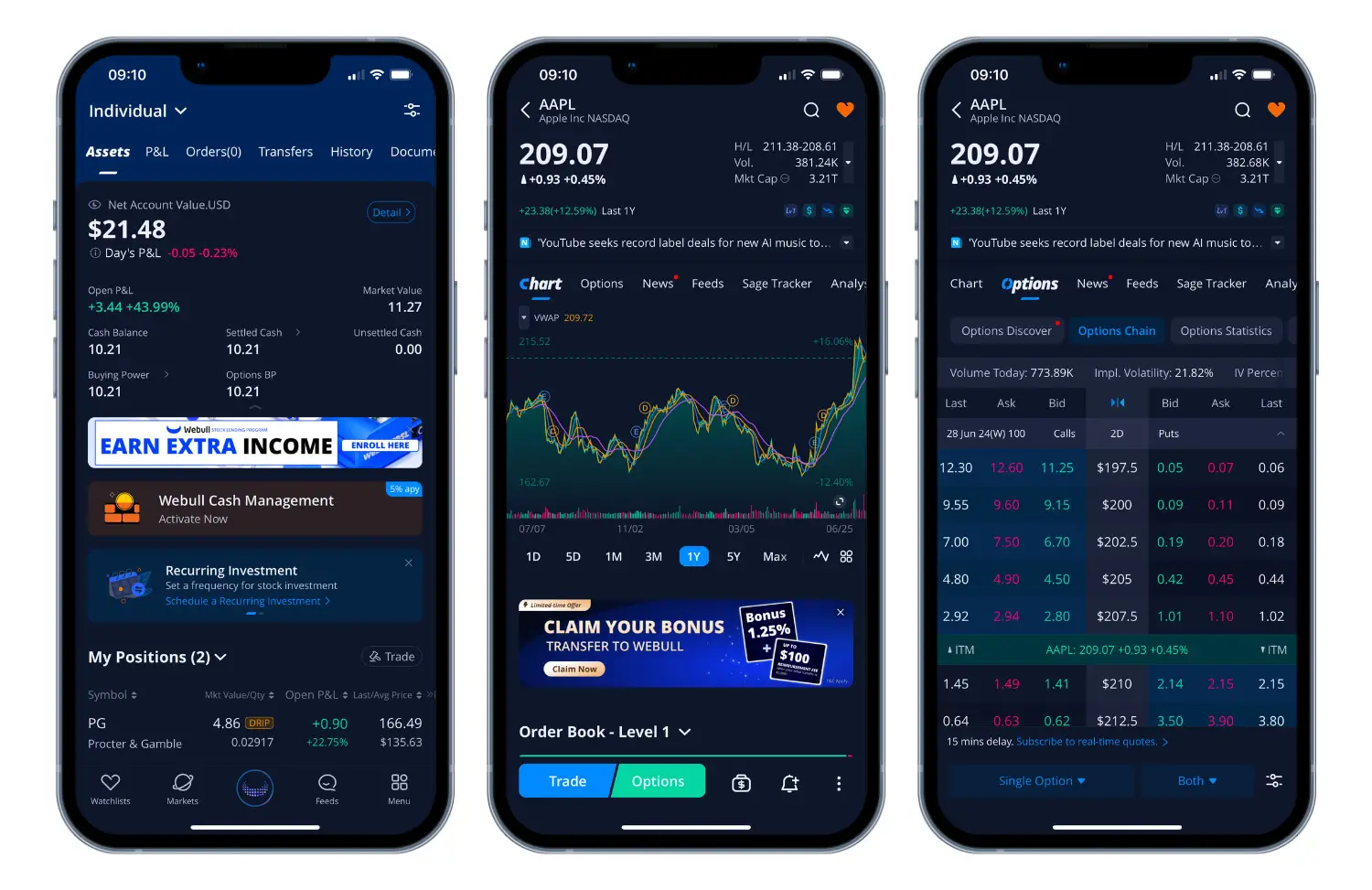
Webull is geared towards more experienced traders, providing advanced charting tools, technical indicators and customizable charts. It also offers paper trading, allowing users to practice strategies with virtual money. Webull provides in-depth market data, including real-time quotes, Level 2 market data (for a fee), financial calendars and news feeds, along with powerful screeners for identifying investment opportunities. Webull’s Vega AI adds a research layer that helps users track their watchlist, spot catalysts, interpret technical signals and get deeper insight into options trades and portfolio composition.
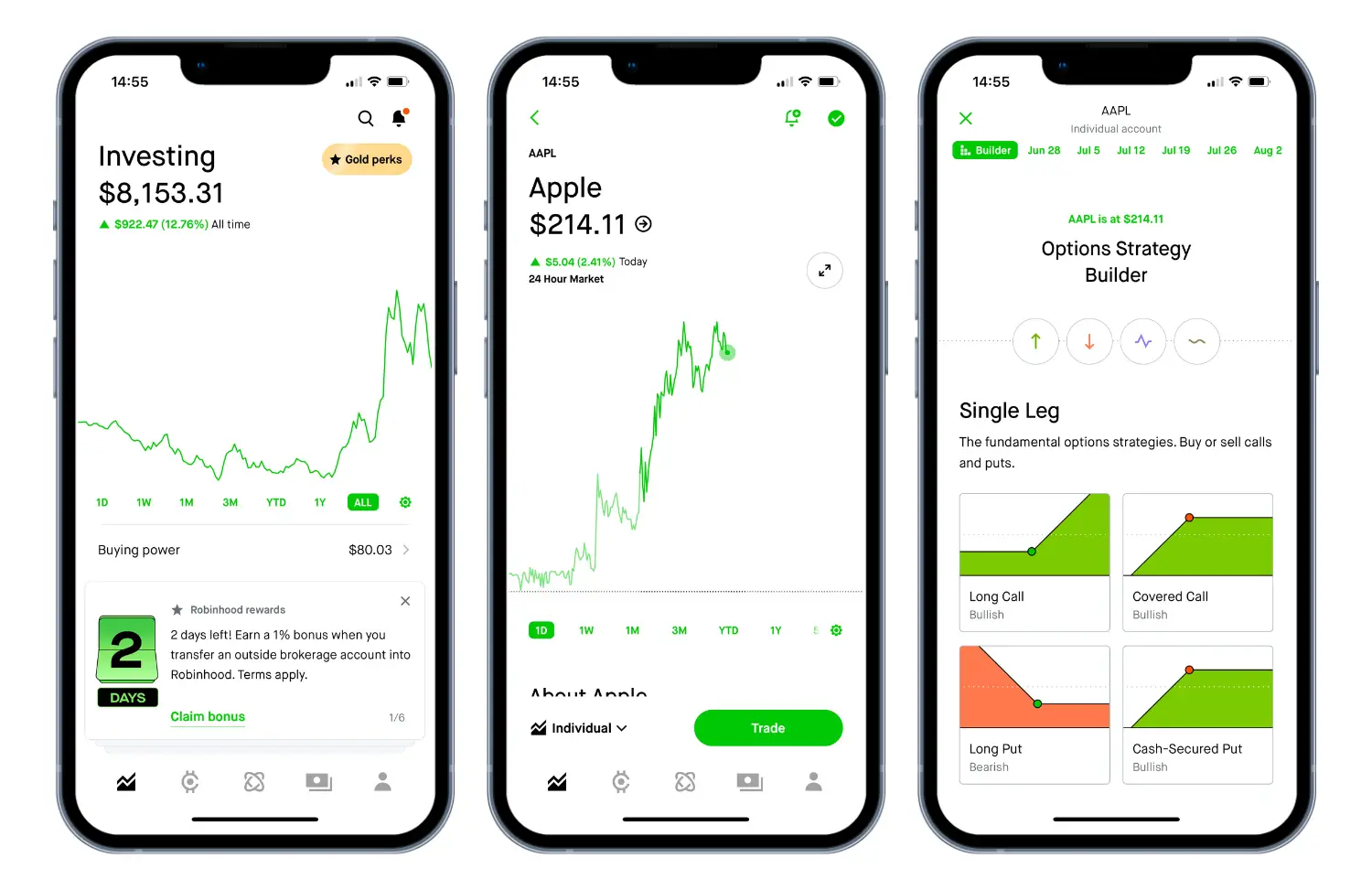
Robinhood is designed for simplicity and ease of use, making it ideal for beginners and intermediate traders and investors. It features a straightforward, user-friendly interface.
Robinhood Gold offers Morningstar research reports, and Robinhood Legend — its dedicated desktop trading platform — now makes Robinhood a credible option for active traders as well. Robinhood’s Cortex AI is integrated directly into the app and can help you research stocks, screen for ideas, analyze your portfolio, check dividends and connect to support. Cortex Digests also summarizes news and current market information.
It’s no longer fair to write Robinhood off as just the beginner app. That said, Webull still feels more purpose-built for traders who want depth and control.
Overall, Webull caters to traders seeking more sophisticated tools and data, whereas Robinhood appeals to those who prefer a simpler, more intuitive trading experience.
Webull and Robinhood are frontrunners among other stock trading apps. Both offer:
Neither offers access to human financial advisors, but both offer IRA match programs. Earn a 3.5% IRA contribution match when you subscribe to Webull Premium for $3.99 per month. Earn a 3% IRA contribution match with Robinhood Gold’s $5 per month subscription.
Robinhood is hard to beat if you want a low-cost, intuitive trading experience that simplifies investing. Robinhood makes it incredibly easy to sign up and start investing and offers some of the lowest fees among brokers we review.
Meanwhile, its educational content is straightforward and helpful for those just starting, and its IRA match program can incentivize beginners to start investing.
While Robinhood has closed the gap significantly with Robinhood Legend and its expanded futures and event contracts offering, Webull is still the stronger choice for advanced traders. Its platform is more tailored to active traders, offering advanced charts, deep financial analysis tools, a dedicated customizable desktop platform and a paper trading account to test your trading strategies. If trading tools and analysis are a big part of how you invest, Webull still feels deeper day to day.
Both Robinhood and Webull now offer prediction markets, but Robinhood’s is broader — spanning politics, sports, culture, crypto, economics and companies. Webull’s current lineup is more concentrated around market and macro events like index hourlies, crypto hourlies and Fed events. Robinhood has also moved deeper into the infrastructure behind prediction markets through a joint venture to operate a regulated exchange and clearinghouse, signaling this is a long-term strategic push rather than a side feature.
Crypto is worth calling out separately in 2026. Webull has brought crypto trading back into the main app for US users, having previously housed it in the separate Webull Pay app. However, coin transfers are temporarily unavailable on Webull. Robinhood still has the more complete crypto setup: it supports crypto trading, transfers in and out, and offers the Robinhood Wallet for users who want a self-custody option. If crypto functionality is a big priority, Robinhood currently has the edge.
For retirement investors, both platforms cover the basics — Traditional and Roth IRAs, and the ability to roll over old retirement money. The bigger difference is the incentive.
Webull Premium offers a 3.5% match on IRA contributions. Robinhood Gold offers a 3% match; non-Gold users get 1%. Both platforms also have a managed investing option — Robinhood has Robinhood Strategies, which blends algorithm-driven portfolio construction with ongoing human oversight, while Webull has Webull Advisors, which is fully automated. Note that Robinhood’s IRA match does not apply to managed IRAs through Strategies.
If you care most about the strongest IRA incentive, Webull has the edge on paper. If you want a more premium-feeling hands-off managed option, Robinhood Strategies may appeal.
Webull and Robinhood’s brokerage accounts are SIPC-insured up to $500,000, including $250,000 for cash claims. Security for their cash sweep programs and crypto varies a bit.
Cash deposited into Robinhood’s cash sweep program is eligible for FDIC insurance of up to $2.25 million, while Webull’s Cash Management account offers FDIC insurance of up to $2.5 million. In terms of cash sweep programs, Webull is the winner.
Most coins with Robinhood Crypto and Webull — through Bakkt Crypto Solutions — are held in cold storage. Both platforms offer two-factor authentication and are registered with FinCEN as a money services business. Both also carry crime insurance to help protect assets against potential loss, including cybersecurity breaches. Webull and Robinhood are tied here.
In June 2021, the Financial Industry Regulatory Authority (FINRA) fined Robinhood approximately $70 million, the largest financial penalty ever ordered by FINRA, for misleading customers regarding options trading and for outages experienced in March 2020.(1) Robinhood settled with FINRA, neither admitting nor denying the charges.
Likewise, in March 2023, FINRA fined Webull $3 million for not conducting proper due diligence before approving customers for options trading.(2) Webull settled with FINRA, neither admitting nor denying the charges.
These two are closer than they’ve ever been, so it really comes down to what matters most to you.
If you want an incredibly user-friendly platform with a broader all-in-one membership, Robinhood is hard to beat. It now has a credible active trading setup through Legend, the most complete crypto offering between the two, a broader prediction markets product, and AI assistance through Cortex built directly into the platform.
On the other hand, if you want deeper charting, paper trading, access to US Treasuries or money market funds, a more research-heavy trading experience through Vega AI, or the stronger IRA match (3.5% with Webull Premium vs. 3% with Robinhood Gold), Webull is the better option.
Robinhood is no longer just the beginner app. But if trading tools and analysis are the priority, Webull still feels deeper where it counts.
Both Webull and Robinhood have limited investment options. If you’re looking to build a more diversified portfolio, plenty of options are available.
Not every broker’s free Level 2 data offer is truly free. Here’s exactly what Moomoo, Webull, Fidelity, Schwab and others require in 2026.
An in-depth, fact-checked look at Moomoo’s fees, features, safety and limitations — everything you need before opening an account.
Compare 6 eToro alternatives — Robinhood, Public, Webull, Fidelity, SoFi and Moomoo — for the IRAs, mutual funds and professional-grade tools eToro doesn’t offer.
A comprehensive comparison of leading AI trading bots in 2026 for stock, crypto and forex automation.
Our top 10 beginner-friendly stocks and ETFs, and why we picked them — plus 7 more.
Cash sweep accounts let you earn interest on your uninvested cash. Learn how they work and how to choose the best one here.
Discover the best robo-advisors of 2026. Compare fees, account minimums and features from top platforms that automate investing for beginners and pros.
We’ve rounded up stats on some of the most popular graphene stocks, along with information on how they compare and how to invest.
We’ve rounded up stats on some of the most popular oil stocks, along with information on how they compare and how to invest.
A beginner-friendly investing platform with fractional shares and no commissions on stocks and ETFs.
