Is a travel credit card worth it?

Find out what the big fuss about travel credit cards is.

Three quarters of UK credit cards come with a foreign transaction fee of 2.75%-2.99%. On just £500-worth of holiday spending, that equates to £13.75-£14.95 in foreign transaction fees.

The good news is that some credit cards come with 0% foreign transaction fees – a perk that card issuers can offer in order to win over new customers.

So does that make it worth getting one? Well, it will primarily depend on how much you anticipate spending overseas. But it will also depend on the other costs and benefits of the card, and how you use it.

What would your travel credit card cost you?

If a credit card comes with a monthly or annual account fee, then it might cost you more than it saves. Santander’s World Elite Mastercard (representative 49.8% APR variable), for example, charges no foreign transaction fee, BUT has an account fee of £15 per month. If you’re after a credit card specifically to avoid fees on spending overseas, then opt for one with no monthly or annual account fee.

Similarly, if you don’t clear your full balance each time your card bill comes through, then you’ll be charged interest – which will quickly outweigh the savings on foreign transaction fees.

Could your travel credit card offer you other benefits?

It’s not all about the charges (and avoiding them). Some cards offer tangible benefits that can add to the value you’re getting. The cleanest example of this is cashback. Lloyds’ Ultra Credit Card (representative 16.9% APR variable) charges no foreign transaction fee and has no monthly/annual fee, but earns you cashback as you spend (1% in year one, and 0.25% after that). On £500-worth of holiday spending, not only would the Ultra help you avoid up to £14.95 of foreign transaction fees, it would actually earn you £5 in cashback, leaving you £19.95 better off compared to a more standard card.

If your credit card came with, say, travel accident insurance (which is the case with some American Express cards), then you might assign a value to that as well – though it can be harder to pin down! Cards with lots of perks usually have an annual fee, so you have to weigh up the value of the benefits vs the fees. But as a rule of thumb, Amex cards aren’t suitable for spending overseas, because there’s currently no Amex that charges 0% foreign transaction fees.

Calculating fee savings and cashback from a travel credit card

The calculator below helps quantify the benefit of a credit card with vs without a foreign transaction fee. It can also factor in the benefit of cashback at the same time.

Bear in mind that foreign transaction fees apply whenever you spend in a currency that’s not pounds Sterling, regardless of where in the world you are. So if you’re at home in the UK and spend money with a company that’s based overseas (perhaps booking a hotel that charges in Euros) you may incur a foreign transaction fee.

Calculate what the Lloyds Ultra Credit Card could save and earn you
£
(equivalent in GBP)
%
(this is commonly 2.99%)
%
(1% would mean £1 per £100 spent)

Use the fields above to estimate foreign transaction fees and cashback earned.

Example travel credit card calculations

Let’s compare 2 different credit cards with £750-worth of holiday spending.

Card A
  • 2.95% foreign transaction fee
  • 0% cashback
Card B
  • 0% foreign transaction fee
  • 1% cashback

Card A would cost you £22.13 in foreign transaction fees. Meanwhile Card B would cost £0 in foreign transaction fees and would earn £7.50 in cashback.

Overall you’d be £29.63 better off with Card B.

Travel credit cards: Dos and don’ts

Dos

  • DO choose a card with a 0% foreign transaction fee.
  • DO choose a card with no monthly/annual fee.
  • DO set up a direct debit to clear your full balance each billing period.
  • DO consider a card with additional benefits, like cashback.
  • DO consider additional cards (e.g. for a partner) if there’s no cost associated.
  • DO check your eligibility for a credit card before you apply.
  • DO pay in the local currency when spending abroad (otherwise it’ll be the merchant’s currency conversion fees that will apply).

Don’ts

  • DON’T carry a balance from month to month – you’ll likely pay more in interest than you save in fees.
  • DON’T opt for a card where the costs outweigh the savings.
  • DON’T opt for an Amex.
  • DON’T forget the primary account holder is solely responsible for paying off balance accrued by additional card holders.
  • DON’T withdraw cash using a credit card. This is generally best avoided as it can involve a fee and there’s usually no interest-free period (the “up to 56 days” typically won’t apply to cash withdrawals).

Can I earn cashback on a travel credit card?

Potentially, yes.

Let’s take the Lloyds Ultra Credit Card (representative 16.9% APR variable) as an example. The Lloyds Ultra Credit Card is one of a tiny group of credit cards that don’t charge an annual/monthly account fee and don’t charge a foreign transaction fee, but do pay cashback. The Lloyds Ultra Credit Card pays 1% cashback on every transaction for the first 12 months, then 0.25% after that. Crucially, the cashback is uncapped, and transactions at home OR abroad are eligible.

So say you spend £10,000 on your card in the first year, you’ll get £100 back for doing so.

Key considerations for cashback travel credit cards
  • What earn-rate will I get?
  • Is there a cap on the cashback I can earn?
  • What transactions are eligible?
  • Is the cashback outweighed by a monthly/annual account fee?
Chris's headshot
Case study: Chris is switching for cashback

"I always have a credit card with 0% foreign transaction fees in my wallet. Sometimes it doesn’t see any action for six months. But then when I’m planning a trip abroad I know it’s there, so it’s one less thing to think about! When I opened the account I set up a direct debit to clear the full balance each month, so I know I won’t be charged any interest either. It’s been a trusty old faithful for the last five years or so, but now that there are credit cards that pay cashback as well as charging no foreign transaction fees, I’m planning to switch."

Chris
Sussex

Bottom line

The more you spend overseas the more benefit you’ll get out of a travel credit card. However, if you choose one with no annual fee and pay off the full balance each month, then it needn’t cost you a penny – you’ll be better off no matter how much or how little you spend abroad.

The best travel credit cards on the market should get you a little extra on top as well – like cashback or perks. The Lloyds Ultra Credit Card (representative 16.9% APR variable) is a strong example – paying 1% cashback on purchases in year one on transactions at home or overseas.

Frequently asked questions

Are travel credit card benefits available to additional cardholders?

Yes, in most cases additional cardholders will also enjoy fee-free spending overseas, and – if there is rewards/cashback involved – their spending will also count. Note that issuing additional cards can incur a fee (often £12) and the primary account holder takes full responsibility for everybody's card use. The Lloyds Ultra Credit Card (representative 16.9% APR variable) is a travel credit card that lets you add up to 3 additional cardholders at no cost, and spend on additional cards is eligible for cashback.

Should I choose a travel card with an annual fee?

Usually the answer is No. Having an annual fee means you’re going to be spending money regardless of whether you use the card or not. Only settle for a fee if you're confident you'll get more in benefits than the fee will cost you.

Is a cashback card better than a travel credit card?

This will depend on how you use the card, and which would leave you better off after costs (like foreign transaction fees or an annual account fee) and benefits (like cashback) were accounted for. Some cards such as the Lloyds Ultra Credit Card (representative 16.9% APR variable) don't charge foreign transaction fees but do pay cashback (and all with no annual fee).

Do travel credit cards charge a fee for cash withdrawals abroad?

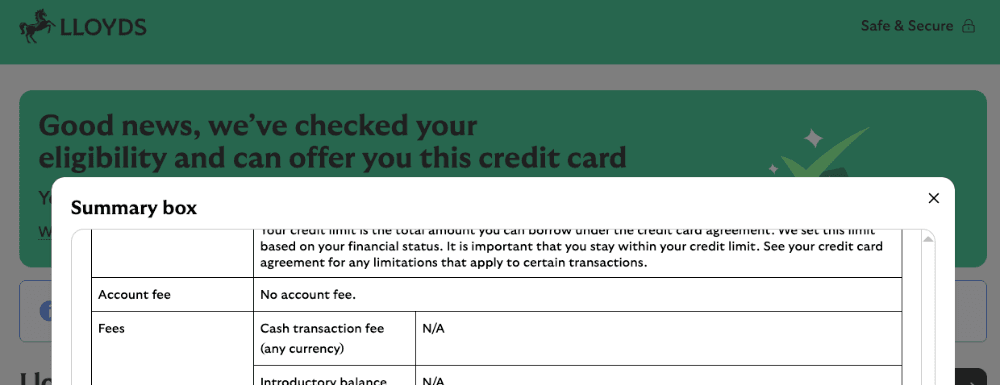
Some do, some don't. The "Summary box" is a useful breakdown of rates and fees that all credit card issuers must show you before you take out a credit card. It will tell you what fee applies to cash withdrawals and whether this varies according to currency.

A section of the Lloyds Ultra Credit Card summary box, showing the 0% fee for cash withdrawals in any currency.
A section of the Lloyds Ultra Credit Card summary box, showing the waived fee for cash withdrawals in any currency.
Finder gets UK credit card data from Defaqto. As of October 2026, the most common foreign transaction fee on UK consumer credit cards is 2.99%. 76.6% charge 2.75% or more.
Jason Loewenthal's headshot

Jason is a writer and editor. He worked as a senior subeditor for Finder for 5 years and in that time became familiar with a wide range of financial products and services. Before that, he worked for Australian Associated Press. He has a BA from Macquarie University in Australia. Jason loves to help other people find new ways to save money. See full bio

More guides on Finder

Go to site