Promoted for low fees + sign-up bonus

£20 welcome bonus
Pay like a local with excellent exchange rates
Send money in 29 currencies
Cashback on hotel bookings
Send money in 29 currencies
Cashback on hotel bookings



Cash is vital in Thailand. You’ll be using it for the majority of your transactions. As usual, avoid exchanging cash at airports and hotels as these usually offer bad rates. Baht notes are significantly more fragile and susceptible to tearing than British bank notes. Make sure yours are not damaged as some shop/restaurant owners won’t accept them and ripped bank notes can be seen as disrespectful to the king.
First things first – always notify your home bank before you head to Thailand to stop your card being blocked by anti-fraud software. When using your card, always choose to be charged in Thai baht to save yourself money. Why? Because the dynamic currency conversion (DCC), which allows you to see the cost of the transaction in your home currency, leaves you exposed to foreign banks’ poor exchange rates and additional hidden fees.
Most debit and credit cards will charge a currency conversion fee of around 2–3% when you make a purchase or withdraw cash, but if you do your research, you can find cards that will waive these fees when you’re abroad. Both debit and credit cards can now be used in many mid to high-end hotels, shops and restaurants in big cities, but you should still avoid using a credit card to withdraw cash as you will most likely be charged a fee and interest will be charged from the date of the transaction. Instead, use a debit card or prepaid travel card.
Compare UK debit cards with low transaction fees
Travel cards offer a safer way to withdraw cash and can be useful at helping with budgeting as you can only spend what is on the card. Using prepaid travel cards also means you can pre-load your exchange rate beforehand, offering you the chance to do so at times when rates are looking more promising rather than relying on live exchange rates which could be unfavourable at the time. Not all cards charge for for currency conversion, but these will certainly charge you at ATMs.
However, using a prepaid travel card is typically more expensive than using the cards you already have in your wallet. They often carry hidden fees such as inactivity costs, reload fees and issue fees. Not all travel cards support Thai baht – for those that don’t you’ll pay a currency conversion fee when you withdraw cash or purchase a good or service. For help deciding on which travel card to go for, check out our comparison.
Compare prepaid cards for travelling
Traveller’s cheques provide important security advantages over other forms of travel money. Each cheque has a unique serial number and can only be cashed with photo identification. However, using travellers cheques can be expensive, with institutions charging a commission of around 150THB to cash cheques. Because of this it’s usually best to get cheques in relatively large denominations to minimise fees. Alternatively, you’re often better off using a debit card or travel card which lets you make cheap or free ATM withdrawals.
It’s always best to check with your individual bank to check its withdrawal fees and to see if it has any arrangements with Thai banks which will offer more favourable charges. Some debit cards waive cash withdrawal fees abroad, but you should check whether the ATM itself will charge a fee. ATMs are available in any of Thailand’s cities and an increasing number of smaller towns.
Mastercard and Visa cards can be used to make cash withdrawals from the majority of ATMs in Thailand. The maximum withdrawal limit varies depending on the machine. Machines from banks with a presence in Britain such as HSBC have a higher daily withdrawal limit compared to ATMs from Thai banks.
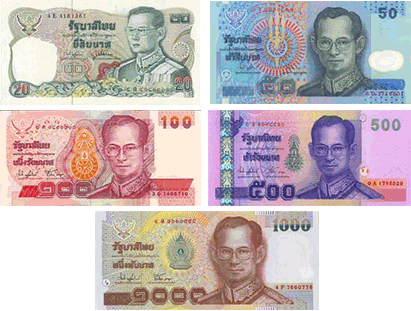
The official currency of Thailand is the baht. The currency is available in both coins and notes and comes in the following denominations – coins of 1, 2, 5 and 10 baht and notes of 20, 50, 100, 500 and 1,000 baht. There are currently 3 legally accepted editions of bank notes in Thailand, both with an image of the king on the back. Make sure you treat your money with care as bad treatment could be seen as disrespect to the king. See the different bank note denominations below to familiarise yourself with the currency, save confusion when spending and ensure you’re not being overcharged.
On a budget? Food, drink, accommodation and tourist activities all come at a fraction of the price to those found in the UK, making Thailand a popular destination for those who want to see the money stretch a bit further.
Those on a tight budget can easily live on around £20 to £25 a day and still enjoy amazing food, comfortable accommodation and the chance to spend extra cash on activities. A mid-range budget of around £40–£60 a day will afford you good quality restaurant meals and accommodation, the chance to enjoy a range or tourist attractions and to hire taxis.
| Bangkok | Budget | Mid-range | High-end |
|---|---|---|---|
 | Hostel dorm room £4–£15 per night | 3-star hotel £15–£40 per night | 5-star hotel £100+ per night |
 | Cheap street meal (pad Thai) 90p–£2 per person | Average restaurant meal £2–£7 per person | Western style steak meal £15+ per person |
 | Shopping at Chatuchak Market Free | Bangkok food tour £30-£45 per person | Private Thai cooking lesson £50+ per person |
*Prices are approximate and are subject to change.
When travelling to Thailand it’s always best to have a few ways to access your cash. Visa and Mastercard travel cards, debit cards and credit cards are becoming increasingly accepted for over-the-counter purchases in middle to high-end hotels, shops and restaurants, but carrying cash is always recommended as this will make up the majority of your spending. ATMs are readily available throughout Thailand’s larger cities and towns but when travelling to more remote locations it’s always best to bring enough cash to cover your stay.
Digital banking apps work in much the same way as conventional bank accounts do, coming with a debit card authorised by Visa or Mastercard which you can manage via your mobile phone, but the key advantage is that they don’t charge withdrawal or transaction fees.
To ensure you always have access to your digital banking apps, we’d recommend buying an e-sim for travelling to Thailand. This allows you to connect to a local network and avoid costly roaming charges to your UK network.
| Travel money option | Pros | Considerations |
|---|---|---|
| Debit cards for travel |
|
|
| Prepaid travel money cards |
|
|
| Credit cards for travel |
|
|
| Traveller’s cheques |
|
|
| Cash |
|
|
This table is a general summary of the travel money products in the market. Features and benefits can vary between cards.
While the value of the Baht has been increasing as the country develops and tourism expands, the country still remains a budget destination for British travellers.
| Year | Average annual exchange British pound (GBP) to Thai baht (THB) |
|---|---|
| 2020 | 40.1312 |
| 2021 | 43.9954 |
| 2022 | 43.2128 |
| 2023 | 43.253 |
| 2024 | 45.3209 |
| 2025 | 43.3029 |
Each of the travel money options discussed has its own benefits and drawbacks, but it’s worth remembering that in Thailand cash is king. When travelling around the country it’s always best to have a few ways to access your cash. Having more than one travel money option means you have a back up in case one card is lost, stolen or damaged.
Make sure you’re able to withdraw cash using a decent prepaid travel money card or no-fee debit or credit card and you should be able to handle all eventualities. It also pays to keep an eye out for ATMs operated by Thai banks that charge minimal local ATM operator fees.
Finally, if you’re going to visit some of Thailand’s more remote beauty spots, we strongly recommend you take enough cash with you to live on while you’re there, as there is no guarantee that you’ll have access to banks or ATMs.
Learn more about your options for spending travel money in Jamaica.
Find a wide selection of online foreign currency exchanges and retailers in our guide and comparison, and save on your travel cash.
We explore all of the features of a Caxton FX card. Read this review to get the low down on one of the UK’s most popular travel money cards.
From contactless payments using a smartwatch or fitness tracker to getting creative with what you use for your “wallet,” we rounded up six ways to carry your currency when traveling to avoid having your money stolen.
Find out the best way to take money to Japan, which currency and cards to take and how much money you’ll need.
Everything you need to know about withdrawing and spending money in Spain. What currency do I need? Do I need a travel card?
Learn more about the best card to use, if you should use a UK debit card and other ways to take spending money to Singapore.
Get your travel money sorted for your trip to Malaysia including what cards to take, how much money you’ll need and what currency to take with you.
Taking a travel card is less stressful than taking a regular bank card and there’s also savings to be had. Find out if a prepaid travel card is right for you before booking your trip abroad.
