If you’re deciding between Fidelity Investments and Robinhood, the right choice depends on what you actually need from a broker.
Fidelity is a full-service brokerage with an 80-year history, the widest investment menu of any major broker, dedicated active-trading platforms, and access to human financial advisors. It tends to fit investors who want everything in one place.
Robinhood started as a mobile-first commission-free broker and has expanded into IRAs with contribution and transfer matches, AI-assisted research through Cortex, a modern desktop trading platform (Legend), banking, and a credit card. It tends to fit investors who want a modern interface, IRA match incentives, or newer asset classes like futures and event contracts.
The answer to “which one’s better” isn’t universal — it depends on whether you prioritize breadth and traditional infrastructure or modern features and IRA incentives.
12:06
Here’s a side-by-side comparison to help you pick.
Robinhood Banking — Gold-only. Higher APY, debit card, FDIC up to $2.5 million
Credit card
Fidelity Rewards Visa Signature — 2% cash back, no annual fee
Robinhood Gold Visa — 3% cash back, Gold required
Crypto self-custody
Yes
Yes — non-custodial Web3 wallet
Educational resources
Extensive — Morningstar, Zacks, planning tools, learning center
Light on free tier. Morningstar and Level II data with Gold
How the trading platforms compare
Fidelity and Robinhood offer different trading platforms designed for different investors. Here’s how the two compare.
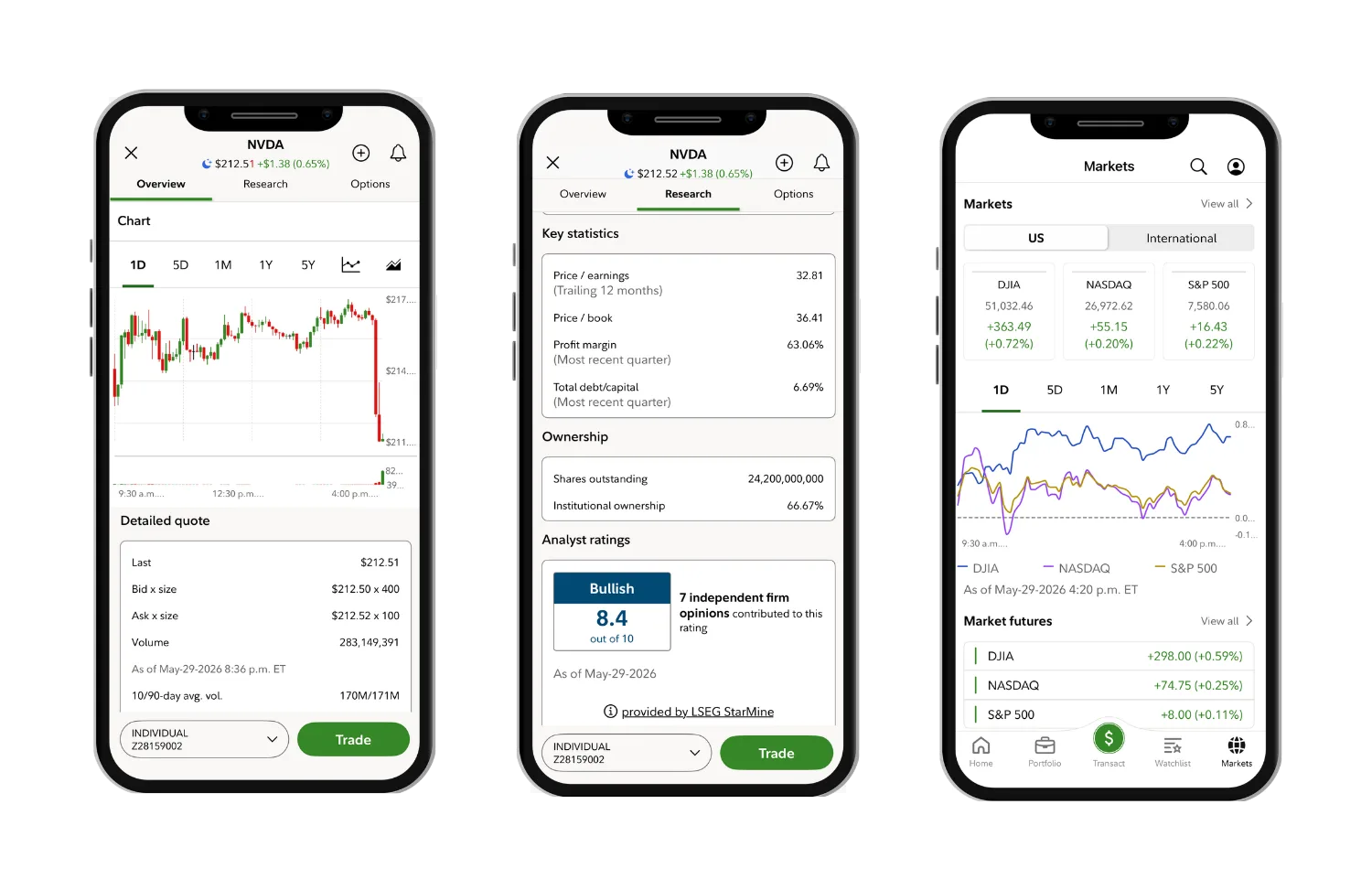
Fidelity offers depth across desktop, web, and mobile
Fidelity has long been the research leader among major brokers, and its 2025 launch of Fidelity Trader+ brought that depth to a modernized active-trading platform.
Trader+ comes in three flavors — desktop (multi-monitor, advanced charting with drawing tools), web (browser-based, one-click trading from chart), and mobile (a streamlined active-trading mode within the standard Fidelity app). All free with any account. The legacy Active Trader Pro platform remains available alongside Trader+ for now.
Beginners typically use the standard Fidelity app, which is dense but functional. Active traders gravitate toward Trader+. Long-term investors get access to fractional shares, 10,000+ mutual funds, direct bonds, CDs, and Fidelity’s four ZERO funds — index funds with a 0.00% expense ratio, available only at Fidelity.
Robinhood combines a clean mobile app with modern desktop and AI tools
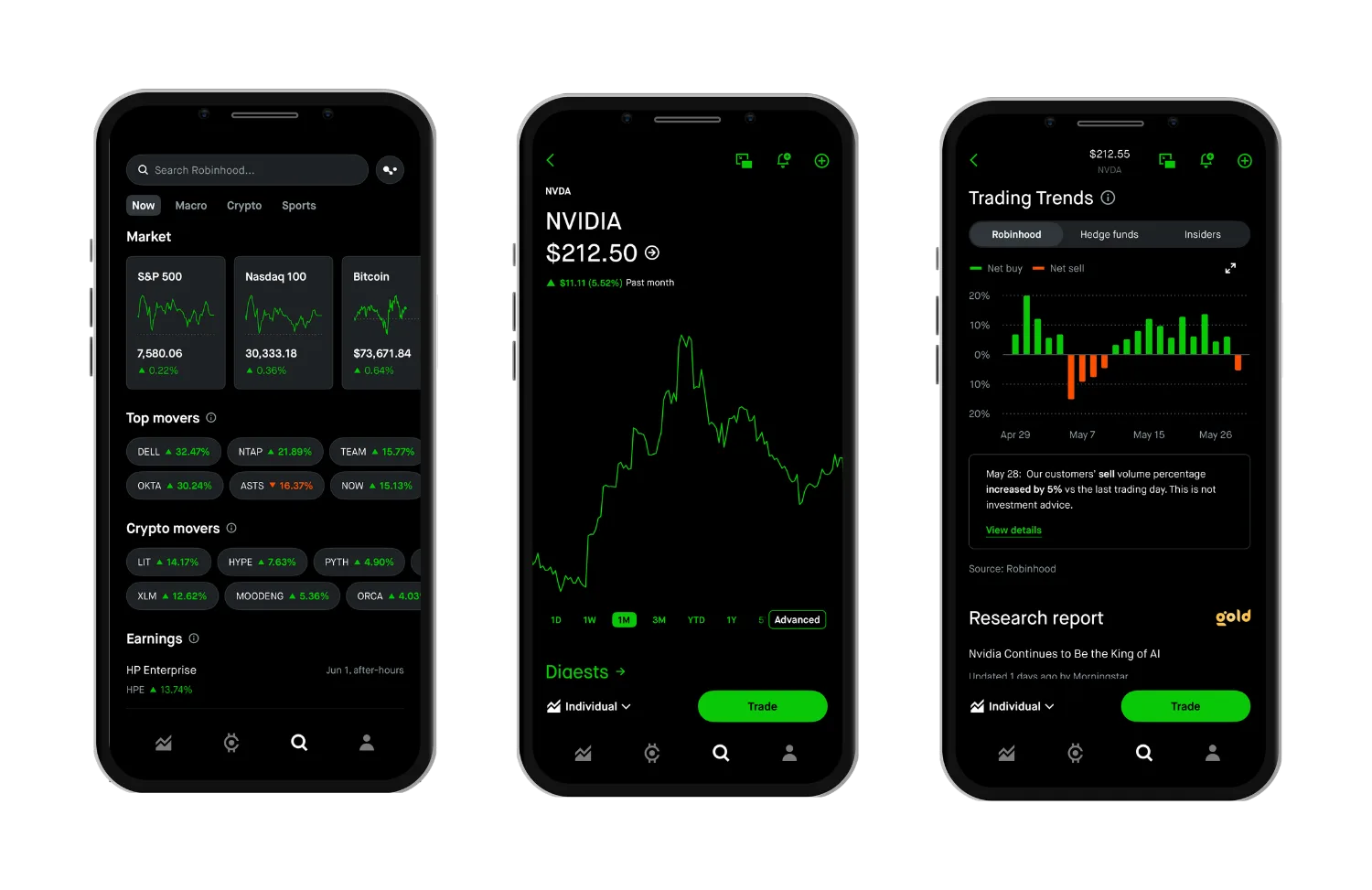
Robinhood’s mobile app is widely regarded as the cleanest in retail investing. Three taps to place a trade, two to check your portfolio. The platform is fast to download, set up, and fund.
For active traders, Robinhood Legend is a browser-based desktop platform that’s free for all customers — not just Gold subscribers. It offers eight charts per screen, 90+ technical indicators, drawing tools, real-time sub-second data, and one-click trading directly from charts.
Robinhood Gold subscribers also get access to Cortex, an AI assistant that breaks down portfolio movements, generates technical indicators, and lets you execute trades and conduct research through natural-language prompts. There’s no equivalent feature at Fidelity.
The trade-off: Robinhood’s free-tier research is light. Subscribers who want depth need Gold ($5/month) to access Morningstar reports, Level II data, and analyst ratings.
The similarities
Both Fidelity and Robinhood offer commission-free trading on stocks, ETFs, and options, as well as crypto trading. Neither has minimum balance requirements, account opening fees, or inactivity fees. Both provide 24/7 customer support, fractional shares, real-time price quotes, and high-yield cash sweep programs. Both also support extended-hours trading, margin trading, and IPO access.
Both platforms now allow crypto transfers in and out to external wallets — Fidelity added this capability in 2025. Self-custody is no longer a Robinhood-exclusive feature.
Which broker is better for beginners?
Robinhood for ease of use; Fidelity for depth as you learn.
Robinhood’s mobile-first design is the easiest entry point for first-time investors. Account setup takes minutes, the interface is intuitive, and there’s no minimum to start. The 1% IRA contribution match (free tier) and 1% IRA transfer match also give new investors meaningful incentives without requiring a Gold subscription.
Fidelity has more educational resources, planning tools, and a wider investment menu — useful as a beginner becomes more experienced. Fidelity’s free Planning & Guidance Center, retirement calculators, and access to general financial guidance through phone and branch support all help newer investors learn over time.
If you want the simplest possible starting point, Robinhood wins. If you want a broker you can grow into as your needs expand, Fidelity wins.
Which broker is better for advanced traders?
It depends on what you trade.
For options traders, Robinhood is meaningfully cheaper — no per-contract fee versus Fidelity’s $0.65 per contract. Robinhood also offers futures and event contracts, which Fidelity doesn’t.
For margin users, Robinhood has lower base margin rates (5.00% versus Fidelity’s 10.575%), and Gold subscribers get the first $1,000 of margin interest-free.
For research-driven traders or those trading mutual funds, bonds, CDs, or precious metals, Fidelity wins — its research depth, desktop tools (Trader+ and the legacy Active Trader Pro), and asset selection are unmatched among the two. Fidelity also supports OTC penny stock trading, which Robinhood doesn’t.
For traders who want AI-assisted analysis, Robinhood Cortex has no Fidelity equivalent.
Which one’s safer and more reliable?
Both brokers meet industry security standards, but they have different protection structures.
Cash sweep insurance
Fidelity provides FDIC coverage up to $6.25 million on cash swept to program banks.(1)
Robinhood offers FDIC insurance via its cash sweep program, providing up to $2.5 million in coverage for individual accounts and up to $5 million for joint accounts across a network of partner banks.(2)
Both use cash sweep programs that automatically transfer uninvested cash into deposits at partner banks, providing FDIC protection and earning interest. SPAXX (Fidelity’s default money market fund) is SIPC-protected rather than FDIC-insured but generally yields higher than the FDIC sweep alternative.
Account history
Both brokers have faced regulatory actions. Robinhood was fined $70 million by FINRA in 2021 for systemic supervisory failures and outages.(3) A Fidelity unit was fined $900,000 by FINRA in 2023 for due diligence lapses.(5) Fidelity’s 80-year operating history and $7+ trillion in managed assets provide a longer track record for risk-averse investors.
Cryptocurrency
Both platforms now support crypto transfers in and out to external wallets — Fidelity added this in 2025, removing what used to be a clear Robinhood advantage. Both use cold storage for most cryptocurrency holdings, provide two-factor authentication, are registered with FinCEN, and carry crime insurance.
Robinhood offers a non-custodial Web3 wallet for users who want full ownership of their crypto. Fidelity’s crypto selection is limited to five coins (Bitcoin, Ethereum, Litecoin, Solana, and FIDD), while Robinhood supports 65+ cryptocurrencies.
Fidelity vs. Robinhood: Which one’s better?
There’s no universal answer. The right choice depends on what you need from a broker.
Pick Fidelity if:
You want access to account types Robinhood doesn’t offer (SEP IRA, SIMPLE IRA, 529, HSA, custodial IRA)
You want to hold mutual funds — especially Fidelity’s ZERO funds at 0.00% expense ratio
You want direct access to bonds, CDs, or precious metals
You value comprehensive research tools, retirement planning resources, or access to financial advisors
You want a broker with a longer institutional history and in-person branch access
Pick Robinhood if:
You’re maxing or near-maxing your IRA every year — the 3% Gold match adds up to thousands of dollars over time
You’re transferring an IRA from another broker (the 1% transfer match has no cap and doesn’t require Gold)
You trade options, use margin, or want access to futures and event contracts
You want a modern, intuitive mobile and desktop trading experience
You want AI-assisted research through Cortex
You want access to 65+ cryptocurrencies
For investors who just need a taxable brokerage account and maybe an IRA — and aren’t doing anything that specifically favors one platform — both will work. The deciding factor often comes down to interface preference and whether the Robinhood Gold IRA match is meaningful for your contribution level.
Alternatives to Fidelity and Robinhood
If neither Fidelity nor Robinhood are right for you, consider these alternatives.
Webull: Webull targets seasoned traders with sophisticated charting tools, technical indicators, and customizable charts. It also offers paper trading for strategy practice with virtual funds and provides comprehensive market data, real-time quotes, Level 2 market data (at a cost), financial calendars, news feeds, and robust screeners.
Public: Public offers commission-free stock, ETF, and options trading, plus alternative assets like cryptocurrency, collectibles, and music royalties. Its app includes a social networking feature for users to connect and learn from each other, and Public doesn’t use Payment for Order Flow for stocks and ETFs.
Charles Schwab: Like Fidelity, Charles Schwab offers a full-service brokerage experience with extensive research, planning tools, and account types. A strong alternative for investors who want institutional infrastructure but prefer a different platform.
If you want peace of mind, this rating will give it to you. These products offer the best value and outcomes considering various product features, terms, conditions and price.
Well-balanced products that provide what you need, offering a healthy mix of competitive features at a good price. However, they're not quite the best in class.
Bottom line: You can find better, but these products still offer reasonable value and have the basics sorted.
These products may not offer much value in the long run, and there are better options available.
Paid non-client promotion. Finder does not invest money with providers on this page. If a brand is a referral partner, we're paid when you click or tap through to, open an account with or provide your contact information to the provider. Partnerships are not a recommendation for you to invest with any one company. Learn more about how we make money.
Finder is not an advisor or brokerage service. Information on this page is for educational purposes only and not a recommendation to invest with any one company, trade specific stocks or fund specific investments. All editorial opinions are our own.
Matt Miczulski is an investments editor and market analyst at Finder. With over 450 bylines, Matt dissects and reviews brokers and investing platforms to expose perks and pain points, explores investment products and concepts and covers market news, making investing more accessible and helping readers to make informed financial decisions.
Before joining Finder in 2021, Matt covered everything from finance news and banking to debt and travel for FinanceBuzz. His expertise and analysis on investing and other financial topics has been featured on Yahoo Finance, CBS, MSN, Best Company and Consolidated Credit, among others. Matt holds a BA in history from William Paterson University.
See full bio
Matt's expertise
Matt
has written
291
Finder guides across topics including:
Moomoo pays up to $600 to switch, but Fidelity charges nothing to leave. See how these two very different brokers compare on fees, IRAs, crypto access and safety in 2026.
Discover the best robo-advisors of 2026. Compare fees, account minimums and features from top platforms that automate investing for beginners and pros.
We’ve rounded up stats on some of the most popular oil stocks, along with information on how they compare and how to invest.
Advertiser disclosure
Finder.com is an independent comparison platform and information service that aims to provide you with the tools you need to make better decisions. While we are independent, the offers that appear on this site are from companies from which Finder receives compensation. We may receive compensation from our partners for placement of their products or services. We may also receive compensation if you click on certain links posted on our site. While compensation arrangements may affect the order, position or placement of product information, it doesn't influence our assessment of those products. Please don't interpret the order in which products appear on our Site as any endorsement or recommendation from us. Finder compares a wide range of products, providers and services but we don't provide information on all available products, providers or services. Please appreciate that there may be other options available to you than the products, providers or services covered by our service.
We update our data regularly, but information can change between updates. Confirm details with the provider you're interested in before making a decision.