Find out all the details covering the key concepts you should know about trading gold CFDs in the UK. We’ll explain how gold CFD trading works, why bother doing it in the first place, and how to manage your risk when trading.
CFDs and spread bets are complex instruments and come with a high risk of losing money rapidly due to leverage. The vast majority of retail client accounts lose money when trading in CFDs. You should consider whether you can afford to take the high risk of losing your money.
Thousands of years later and gold remains the primary macro battleground asset. Whether you’re hedging against inflation, exploiting geopolitical market shocks, or executing intraday technical setups – gold contracts for difference (CFDs) offer traders a flexible mechanism to go long or short on spot gold prices without taking physical delivery of heavy yellow bullion.
Some popular CFD trading platforms like Spreadex offer a few ways to trade the precious metal without building a vault in your garden. For example, you can trade spot prices with CFDs or place tax-free spread bets across futures markets.Trading commodities like gold can be rewarding but there are obviously some key risks and considerations to be aware of too.
How gold CFD trading works
A gold CFD is a derivative agreement between a trader (you) and a broker (your platform) to exchange the difference in the price of gold between when the contract opens and closes.
Gold CFDs directly track the underlying spot market price per troy ounce, which is universally quoted in US Dollars, using the exchange ticker symbol XAU/USD.
When trading gold CFDs in the UK, your order size is expressed in standardised contracts or lot sizes rather than a simple stake per point.
Gold CFD trading example: Going long on spot gold
Suppose spot gold is quoted at $2,600.00 / $2,600.40 (Bid/Ask), here’s what a long position might look like:
Position opening. Let’s say you anticipate a rise in gold due to unexpected inflation data and so you buy 10 spot gold CFD contracts (where 1 contract equals 1 troy ounce) at the Ask price of $2,600.40.
Total exposure. Your full market position value is actually $26,004.00 ($2,600.40 X 10).
Margin requirement. With the FCA retail leverage cap of 20:1 (5% margin), you only need to deposit $1,300.20 in funds (converted from your account’s GBP base currency).
Now, here’s what a winning or losing gold CFD trade could look like based on a positive or negative market movement:
Winning trade. Spot gold rises to $2,625.40. Closing your 10 contracts means a gross profit of $250, calculated as $2,625.40 – $2,600.40 X 10.
Losing trade. Spot gold drops to $2,580.40. Closing your position results in a loss of $200, calculated as $2,580.40 – $2,600.40 X 10.
Gold trading tip. Your final cash returns in GBP are subject to daily FX conversion charges and overnight financing fees if held past 22:00 UK time.
Why trade gold CFDs?
Here are a few examples of ways active UK traders using some of the best CFD platforms like Spreadex, Capital.com and IG utilise gold CFDs for several distinct strategic advantages over physical gold ownership:
Leverage efficiency. Margin trading allows you to gain full price exposure to spot gold while committing just 5% of the nominal position value, freeing up capital for other CFD trading strategies.
Two-way speculation. CFDs allow you to short the market just as easily as buying long, making them an ideal vehicle for trading macro downturns or sudden sell-offs.
Portfolio hedging. If you hold physical gold bullion, gold mining stocks, or a broad stock portfolio, holding a short gold CFD position can offset temporary market drawdowns without needing to liquidate any core underlying assets.
Tax loss offsetting. While financial spread betting is CGT-exempt, gold CFD losses can be declared to HMRC to offset capital gains made elsewhere in a personal or corporate account.
Where to trade gold CFDs: Top UK trading platforms compared
Choosing a platform for gold CFD trading requires looking at things such as the spread sizes, execution reliability, margin options, and customer support infrastructure during high-volatility.
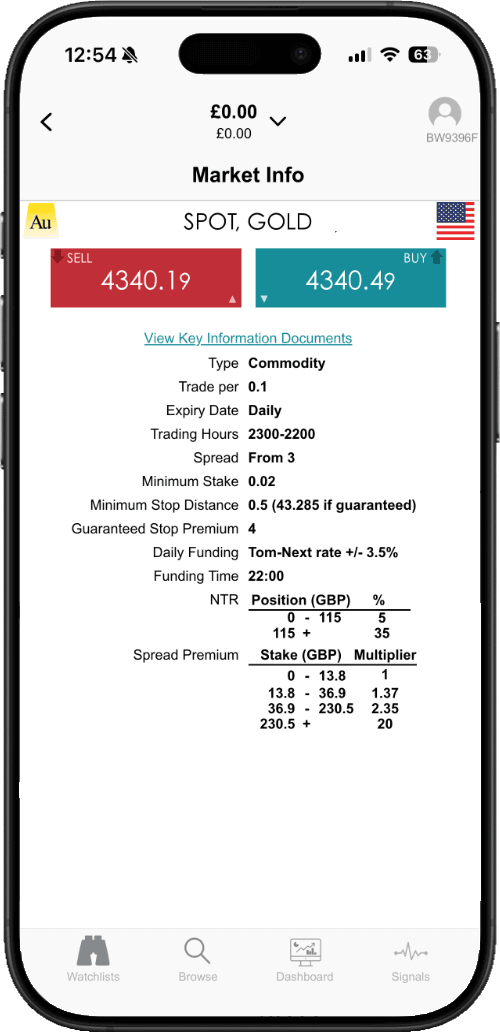
Basic mobile interface for retail traders (CFDs only)
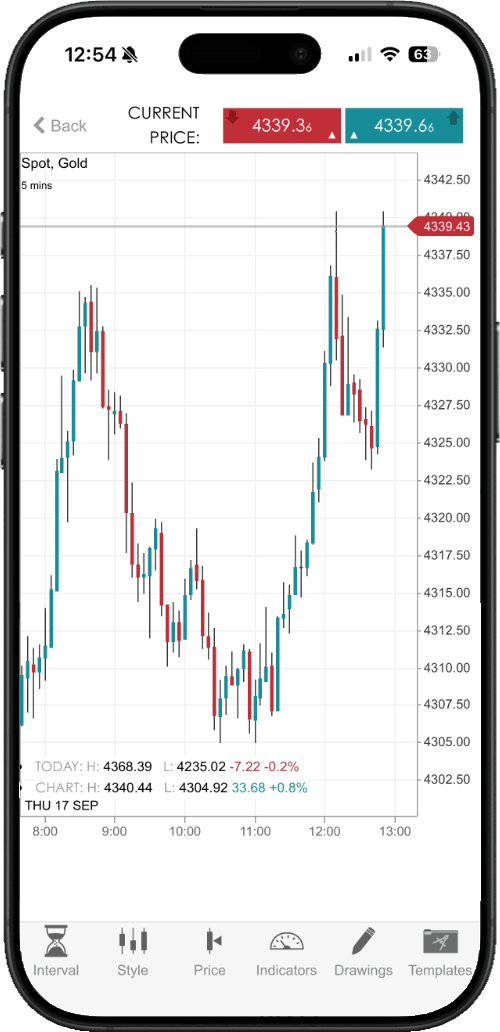
Spreadex presents market data in depth rather than summarising it, showing tiered spread premiums and NTR bands alongside the headline spread. It’s a lot of detail for one screen, though it does mean nothing is hidden behind a secondary menu.
Spot gold CFDs vs. gold futures CFDs vs. physical gold
Here’s an overview of these gold trading and investing methods to show you the key differences:
Feature
Spot gold CFD
Gold futures CFD
Physical gold bullion
Pricing mechanism
Real-time live cash spot price
Underlying exchange futures price
Spot price plus dealer premium
FCA leverage Cap
20:1 (5% margin)
20:1 (5% margin)
Unleveraged (100% cash)
Holding charges
Daily overnight swap rate (SONIA/SOFR + markup)
Rollover spread built into contract
Storage and insurance fees
Contract expiry
None (continuous)
Fixed monthly/quarterly expiry
None
UK tax treatment
Subject to CGT (losses offsettable)
Subject to CGT (losses offsettable)
CGT-exempt on legal tender coins (e.g. Royal Mint Britannias)
Best used for
Intraday momentum & swing trades
Multi-week macro positioning
Long-term wealth preservation
How to manage risk when trading gold CFDs
As a commodity, gold is intrinsically volatile, frequently serving up sharp price swings during Central Bank announcements, inflation updates, and geopolitical shifts.
Using trading risk management tools is an absolute must if you want to be a successful trader in the long run, below are some practical examples and strategies.
1. Guaranteed Stop-Loss Orders (GSLOs)
Standard stop-loss trading orders don’t protect against market gapping or rapid slippage during out-of-hours events.
A Guaranteed Stop-Loss Order (GSLO) forces your broker to liquidate your position at the exact price requested, regardless of liquidity gaps.
On platforms like Spreadex, GSLO premiums are charged as a small spread adjustment to keep things nice and simple.
2. Calculate your position sizing based on cash budget
Avoid opening positions based on maximum allowable margin. Instead, fix your risk exposure to a realistic limit, for example 1% or 2% of your total account equity per trade.
If you hold a £10,000 account balance and cap your risk at 1% (£100) on a gold trade with a 20-point stop-loss, your total risk position should not exceed the equivalent of £5 per point.
Since gold CFDs settle in USD, UK traders funding accounts in GBP incur foreign exchange (FX) conversion charges when closing gold trades. So, here are some tips to reduce any continuous FX friction:
Utilise a multi-currency CFD sub-account to maintain a USD for trading gold CFDs.
Switch to gold spread bets with a top spread betting broker like Spreadex or IG, where trades are denominated directly in GBP per point, bypassing FX fees altogether.
How to execute a gold CFD trade step-by-step
Here are some simple steps to follow to get set up with a broker and make your first gold CFD trade:
Complete account appropriateness checks. Regulated UK brokers must verify your trading experience, knowledge of leverage mechanics, and financial capability before letting you open a margin account.
Deposit trading capital. You can transfer funds via bank transfer or debit card. Ideally, maintain a free margin balance well above the minimum FCA requirement as a buffer.
Analyse gold spot liquidity hours. While gold trades 24/5, underlying liquidity is highest and variable spreads are tightest during the overlap of London and New York exchange operating hours (13:30 to 16:30 GMT).
Place an order. Select contract volume, consider a Guaranteed Stop-Loss Order, set target limit levels, and confirm execution using a desktop interface, app, or telephone dealing desk.
Gold CFD trading key takeaways
FCA leverage limits. Under FCA rules, retail leverage for major commodities like spot gold is capped at 20:1, requiring a minimum 5% margin deposit.
Tax mechanics. Unlike UK financial spread betting (which is CGT-free), gold CFD trading profits are subject to CGT but traders can offset losses against taxable gains from other investments.
Spot vs. futures CFDs. Spot gold CFDs allow continuous trading on real-time cash market prices, whereas gold futures CFDs allow longer holding periods without daily overnight swap charges.
Broker selection. Traders often prioritise platforms offering deep liquidity, the option of spread betting or trading gold CFDs, and tight spreads such as Spreadex, IG or Capital.com.
Frequently Asked Questions
What is the maximum allowable leverage for trading gold CFDs in the UK?
Under the current FCA regulation, retail leverage for trading major commodities like spot gold is capped at 20:1. This requires a minimum margin deposit of 5% of the total position value.
Professional-classified account holders like those using Spreadex Pro may access higher leverage subject to meeting strict regulatory criteria.
Are gold CFD trading profits subject to UK tax?
Yes. Gold CFDs are classified as financial derivatives by HMRC and are subject to Capital Gains Tax (CGT). However, unlike tax-free spread betting, any losses generated from gold CFD trading can be used to offset taxable capital gains from other investments.
What is the main structural difference between spot gold CFDs and gold spread betting?
Gold CFDs trade in standardised contract sizes denominated in the native currency of the asset (USD for spot gold), with profits subject to CGT rules.
Whereas financial spread betting allows you to speculate on the gold price movement using a fixed stake in pound sterling (£ per point), generating potential tax-free gains for UK tax residents.
How do overnight holding fees work on gold CFDs?
If a spot gold CFD trade remains open past 22:00 UK GMT, an overnight holding charge (swap fee) is applied to your account balance.
This fee is calculated using benchmark overnight interest rates (such as SOFR for USD) plus a standard broker admin markup.
Why do some active traders prefer brokers with phone dealing desks?
During extreme gold market volatility, web servers and trading apps across the industry can experience connectivity delays or order processing freezes.
Established trading platforms like Spreadex maintain dedicated telephone execution desks, allowing active traders to place, adjust, or liquidate large positions directly over the phone with experienced human dealers.
Sources
The offers compared on this page are chosen from a range of products we can track; we don't cover every product on the market...yet. Unless we've indicated otherwise, products are shown in no particular order or ranking. The terms "best", "top", "cheap" (and variations), aren't product ratings, although we always explain what's great about a product when we highlight it; this is subject to our terms of use. When making a big financial decision, it's wise to consider getting independent financial advice, and always consider your own financial circumstances when comparing products so you get what's right for you. Most of the data in Finder's comparison tables is provided by Defaqto. In other cases, Finder has sourced data directly from providers.
George is a deputy editor at Finder. He has previously written for The Motley Fool UK, Nasdaq, Freetrade, Investing in the Web, MoneyMagpie, Online Mortgage Advisor, Wealth, and Compare Forex Brokers.
He's focused on making personal finance and investing engaging for everyone. To do this he draws from previous work and his Level 4 Diploma for Financial Advisers (DipFA), sharing what he’s learnt. When he’s not geeking out about money, you’ll find him playing sports and staying active.
See full bio
George's expertise
George
has written
347
Finder guides across topics including:
Trading CFDs carries a high risk, as you trade on real-time movement of the financial market. Give yourself an understanding of these risks with our guide.
Find out how to short the UK’s flagship stock market index, the FTSE 100.
Advertiser disclosure
Finder.com is an independent comparison platform and information service that aims to provide you with the tools you need to make better decisions. While we are independent, the offers that appear on this site are from companies from which Finder receives compensation. We may receive compensation from our partners for placement of their products or services. We may also receive compensation if you click on certain links posted on our site. While compensation arrangements may affect the order, position or placement of product information, it doesn't influence our assessment of those products. Please don't interpret the order in which products appear on our Site as any endorsement or recommendation from us. Finder compares a wide range of products, providers and services but we don't provide information on all available products, providers or services. Please appreciate that there may be other options available to you than the products, providers or services covered by our service.
We update our data regularly, but information can change between updates. Confirm details with the provider you're interested in before making a decision.