Cryptocurrency coins and tokens
Know your altcoins from your tokens with our jargon-busing guide.

Estimated reading time: 2 min
Due to the potential for losses, the Financial Conduct Authority (FCA) considers this investment to be high risk.
1. You could lose all the money you invest
2. You should not expect to be protected if something goes wrong
3. You may not be able to sell your investment when you want to
4. Cryptoasset investments can be complex
5. Don't put all your eggs in one basket
If you are interested in learning more about how to protect yourself, visit the FCA's website here.
For further information about cryptoassets, visit the FCA's website here.
There are thousands of crypto coins and tokens in existence. Here are the main types, and their distinguishing characteristics, plus some of the best-known examples of each.
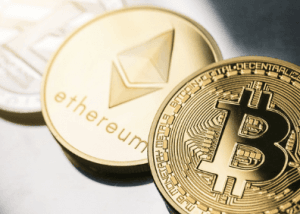
A cryptocurrency coin is the native currency of a blockchain (a distributed ledger maintained by multiple independent participants rather than one central authority). So Bitcoin is the native currency of the Bitcoin blockchain, for example.
It’s an encrypted digital currency meant to be used as a form of payment. It can be used to store value and pay for services, in much the same way that you would use physical money.
Quite simply a coin that’s not Bitcoin. An “alternative coin” to Bitcoin, as the name implies.
Despite not being Bitcoin, many altcoins are a “fork” of Bitcoin – developed by duplicating Bitcoin’s open-source protocol. Examples include Litecoin (LTC) and Dogecoin (DOGE).
However, there’s also a long list of other altcoins that haven’t been derived from the Bitcoin protocol and have instead had their own blockchain and protocol created from scratch. Some well-known examples include Ethereum (ETH) and Cardano (ADA).
A coin with a lot of buzz (but not necessarily any enduring value).
Sometimes meme coins are created specifically to enrich insiders – AKA a “pump and dump” play. These are best avoided, unless you’re absolutely sure you’ve got your timing right!
A coin with a value that’s tied to an asset – often a traditional currency. So Tether, for example, is a stablecoin whose value is tethered to the US Dollar.
In theory this makes a coin less speculative. The case of TerraUSD begs to differ: in 2022 TerraUSD was unable to maintain its peg to the US dollar, and soon collapsed to a tiny fraction of its intended value.
Stable coins may be backed by a real reserve of the asset they’re pegged to, but that’s not always the case.
A coin that’s all about keeping the details of transactions private. For example, Monero. So the sender, the recipient and the amount are all obscured as far as possible.
Privacy coins use cryptographic techniques to prove transactions are valid (so that the ledger is still accurate) but without revealing all the details. Nodes can still verify the ledger’s integrity even though amounts, senders, or recipients may be hidden.
Realistically, the are both legitimate and illicit reasons why senders and recipients might want privacy.
Tokens are used to represent digital assets that are fungible and tradeable, including everything from commodities to voting rights. However, rather than operating on their own blockchain, tokens are hosted by another platform, such as Ethereum.
While tokens are also a medium of exchange, they offer functionality above and beyond that of coins. Tokens give their holders the ability to take part in some kind of activity – for example, if you want to bet on the outcome of future events through decentralised prediction market Augur, you’ll need to use REP, the Augur platform’s native cryptocurrency token. Tokens can also offer value to buyers, for example through buybacks.
Tokens are usually created and distributed to the general public through Initial Coin Offerings (ICOs), which are a form of crowdfunding. Some of the best-known crypto tokens include EOS (EOS), Tron (TRX) and OMG Network (OMG), with Ethereum being the most popular platform for token development.
However, there are also plenty of other platforms which tokens can be built upon, including Omni, NEO, Waves and Qtum.
Coins are standalone cryptocurrencies based on their own blockchain. Tokens are built and hosted on existing blockchains.
Learn how and where to buy cryptocurrency by following our simple step-by-step guides and comparing 30+ crypto exchanges.
*Cryptocurrencies aren't regulated in the UK and there's no protection from the Financial Ombudsman or the Financial Services Compensation Scheme. Your capital is at risk. Capital gains tax on profits may apply.
Cryptocurrencies are speculative and investing in them involves significant risks - they're highly volatile, vulnerable to hacking and sensitive to secondary activity. The value of investments can fall as well as rise and you may get back less than you invested. Past performance is no guarantee of future results. This content shouldn't be interpreted as a recommendation to invest. Before you invest, you should get advice and decide whether the potential return outweighs the risks. Finder, or the author, may have holdings in the cryptocurrencies discussed.
This guide provides step-by-step instructions on how to buy , lists some exchanges where you can get it and provides daily price data on ().
This guide provides step-by-step instructions on how to buy , lists some exchanges where you can get it and provides daily price data on ([NB:VALUE NICHE_CODE=”GXFCY-FF” RECORD_TYPE=”CRYPTO_COIN” RECORD_ID=”E3647B39-061C-46DD-A75B-72DC6E9A658F” FIELD=”GENERAL.SYMBOL” DECORATOR=”GLOBAL.VALUE.TEXT”]).
This guide provides step-by-step instructions on how to buy , lists some exchanges where you can get it and provides daily price data on ([NB:VALUE NICHE_CODE=”GXFCY-FF” RECORD_TYPE=”CRYPTO_COIN” RECORD_ID=”E3647B39-061C-46DD-A75B-72DC6E9A658F” FIELD=”GENERAL.SYMBOL” DECORATOR=”GLOBAL.VALUE.TEXT”]).
This guide provides step-by-step instructions on how to buy World Liberty Financial, lists some exchanges where you can get it and provides daily price data on (WLFI).
Learn how to buy Solana in the UK with our simple step-by-step guide and tips on what to know before you get started.
If you’re looking to buy Bitcoin (BTC), we explain how to do it, where you can invest in Bitcoin, and what to watch out for; along with tips on whether now is good time to be investing in Bitcoin.
Your step-by-step guide on how to sell XRP (XRP) for both fiat currency and cryptocurrency, including detailed instructions for novice crypto traders.
What exactly is the difference between Bitcoin and Ethereum? A beginner’s guide to Bitcoin vs Ethereum.
Learn how to buy Cardano in the UK with our simple step-by-step guide and tips on what to know before you get started.
Learn how to buy Ethereum in the UK with our simple step-by-step guide and tips on what to know before you get started.