Investing in index funds is a popular choice for investors worldwide, especially beginners. In fact, there’s over £5 trillion invested in Vanguard’s index funds alone. In a nutshell, an index fund is a low-cost portfolio of shares or other assets (like bonds) that tracks an industry benchmark or market index.
How to invest in index funds in the UK
Here’s a simply step-by-step guide explaining how you can start investing in index funds:

Sign up for a provider. Check out our comparison table of platforms that offer funds to help you choose. You’ll need to provide personal details and proof of ID.
Fund your account. You need to put money in your account in order to make investments. Transfer money into your trading account by bank transfer or using your debit card.
Search for the index fund you want. You can often compare funds based on performance or browse the different ones available. Keep in mind, some platforms only offer exchange-traded funds (ETFs) which work in a very similar way.
Place a buy order. That’s it. You can now invest on a regular basis or make one-off investments in the fund.
We analysed all popular share dealing platforms in the UK using 35 data points and combined this with our expert insight from using the apps. The platforms we've selected as best for each category offer stand-out features or a unique combination of elements for a specific aspect of investing. If we show a "Promoted for" pick, it's been chosen from among our partners and is based on factors that include special features or offers, and the commission we receive. Keep in mind that our picks may not always be the best for you – it's important to compare for yourself. More details in our full methodology.
What are index funds?
Index funds are collections of stocks that are designed to reflect the companies that are listed in a specific index. By investing in an index fund, you get exposure to each stock in the fund, without having to go through the process of buying each stock individually.
Index funds are often passively managed, which basically means not much work goes into maintaining them. The benefit of this is that it can lead to lower investing costs which (should) get passed on to you. So, index funds provide a cheap and simple way for you to invest in a whole basket of stocks with minimal oversight.
How do index funds work?
When you invest in an index fund, you purchase a stake in all the companies that the fund holds. When stocks in a fund change, for example if a stock moves out of the index and another moves in, your holdings change too. Stocks move in and out of indices regularly, so your index fund will automatically rebalance and reshuffle to reflect any changes.
While you could get exposure to all of the stocks in an index by buying shares in each company, buying an index fund could save you time, effort and (potentially) money. Not only is it quicker to buy a fund, you also don’t have to worry about selling and buying stocks to reflect changes in the index.
Plus, if you wanted to buy shares in say, every company on the FTSE 100, you’d have to pay a commission for 100 trades, which could set you back hundreds of pounds. When you buy a fund, you pay a single, annual fund management charge.
What's a stock market index?
A stock index is a collection of stocks listed on one or more exchanges. In the UK, the most well-known stock index is the FTSE 100 (pronounced footsie one-hundred). “FTSE” stands for Financial Times Stock Exchange. In short, it’s the 100 biggest companies listed on the London Stock Exchange (LSE).
The most well-known stock market index would probably be the S&P 500 from the US. Stocks within the S&P 500 index are listed on both the New York Stock Exchange (NYSE) and the Nasdaq exchanges. A stock market index can provide a useful snapshot to investors of the overall performance of a particular market or collection of stocks.
4:57
What index should I invest in?
This is for you to decide. The best index for one person to invest in might not be the best for another. So, as with all investing, it’s a case researching and choosing the index (or indices) that best aligns with your investment goals, strategy, and risk appetite.
What we can do is give you an overview of some of the world’s leading stock indices popular amongst index fund investors, these include:
The FTSE 100(UK). This includes the 100 largest companies on the London Stock Exchange by market cap. They’re mainly large, well-established companies such as Aviva and NatWest.
The FTSE All-Share (UK). This includes all the companies in the FTSE 100 and FTSE 250 (the next 250 biggest after the FTSE 100), plus companies on the dedicated ‘Small Cap’ index. It represents 98-99% of UK stocks by market capitalisation.
The Dow Jones(US). Or, to give it its full name, the The Dow Jones Industrial Average. It’s made up of the 30 most-traded stocks on the New York Stock Exchange and the Nasdaq, such as American Express and Chevron.
The Nasdaq Composite(US). This tracks all 3,000+ stocks that are exclusively listed on the tech-heavy Nasdaq stock exchange, and includes Adobe, Microsoft and Netflix.
The Hang Seng(Hong Kong). This includes around 60 stocks from the Hong Kong Stock Exchange, one of the world’s biggest exchanges. Well-known names include Alibaba and Lenovo.
This is only the tip of the index iceberg. There are many more, so you’re bound to find one that suits you. And for every index, you’ll also have a choice of index funds to invest in. This choice will often come down to which ones are available via your chosen platform, and what the fund costs are.

Case study: Amy thought about dabbling in stock-picking but decided to invest in index funds instead
"I made my first investment when I was 19. The first investment I ever bought were shares in an index fund, the Vanguard FTSE All-World ETF (VWRA). At that time, I was greatly influenced by books on investing. Before I read those books, I thought stock-picking was simple. I even planned to purchase some shares of top companies like Tesla and Alphabet. However, as I read more, and my knowledge about investing grew, it soon dawned upon me that picking individual stocks was a demanding task. I had to read through financial statements, keep up with company news and value the stock. I didn’t have time for that. All of us lead busy lives.
The more I read, I came to find out about this passive investing strategy which was index fund investing. The gist of it was to make monthly purchases of a mutual fund or ETF that tracks an index, then hold it and let time work its magic. With little time on my hands, I figured out a passive investment strategy would work for me. Just set it and forget it, right? After some research and reading, I decided to go with VWRA which tracks the global stock market. That’s my story of how I started investing, and how I want to continue investing. Maybe I’ll stock-pick in the future, who knows?
If there’s one thing you’d tell a friend who’s thinking of getting this, what would it be?
Stop thinking about it and do it already."
Amy Radcliffe
Leeds
What is the average index fund return?
There isn’t a single overall average index fund return, because it varies by index. Plus, averages can be a bit misleading, disguising some big variations. Returns depend on the timeframe you’re looking at.
Nevertheless, holding an index fund or ETF for the long term is often the best strategy. Investment volatility typically evens itself out and results in positive returns over time, which is why we often bang on about the importance of investing for the long term.
The returns from an index fund won’t be quite the same as those of an actual index. But it should mirror it pretty closely (excluding fees).
Are index funds safe?
The value of your investments could fall, as with all investing. However, index funds are considered relatively low-risk, compared with buying shares in a company. One reasons is because of diversification. Index funds can be made up from many different investments. By investing in an index fund, you’re diversifying your portfolio. This means that you haven’t put all your eggs in one basket.
How much do index funds cost?
Index funds are a type of passive investment. Unlike with actively managed funds, they simply mimic movements of the underlying index.
The result of this is, typically, is much lower costs for index funds than for actively-managed funds. This is one of the things that makes them so popular, particularly since index funds often perform just as well (and sometimes better) that actively managed funds.
That doesn’t mean there are no costs at all. Typically, you’ll need to pay:
An annual management charge. These can have various names like an “ongoing charges figure” (OCF) or “total expense ratio” (TER) and is made up from the costs of managing your index fund along with the internal transactions like buying or selling investments.
Commission. Unless you use a broker with zero trading commissions, you’ll usually have to pay a fee to cover the brokerage costs of making your index fund investment.
A platform fee. This doesn’t actually relate to the fund itself, but to invest in a fund you’ll need to use a broker or online investment platform. It will often (though not always) charge a fee for holding your investment account.
Are index funds good for those new to investing?
Often, yes. Index funds can be a simple and straightforward option. They’re a solid building block for investors and can be easier for beginners to grasp. They don’t need much active involvement, so once you’ve picked an index fund, you can invest passively and don’t need to monitor on frequent basis. Assuming you’re planning to invest for the long-term (as all but very experienced investors should be) then index funds can be a good place to start.
While no investment is risk-free, funds can also be a lower-risk way to invest compared with buying shares or more complex investments. By investing in a fund, you’re spreading your money across a bunch of investments, which automatically diversifies your portfolio to a certain extent.
Our expert says: Is now a good time to invest in index funds?
"Timing the market is something that even experts struggle with, as it’s so hard to predict with any certainty what will happen next. That’s why you’ll see most seasoned investors preach about ‘time in the market’. Lots of people will be seeing stock markets and various index funds reaching all-time highs and be worried about ‘investing at the top’.
The truth is, most major stock markets have remained on a long-term trajectory upwards. So, as long as you’re investing with a long-term mindset, you shouldn’t be worried about recent highs. Because, your goal should be that these indices and benchmarks will be higher in 5 years time, not just tomorrow or next week."
Some investment providers don’t have index funds on their platform, so it’s worth making sure the one you choose to go with does have the funds you’re interested in. However, many platforms offer ETFs instead of index funds because these can be easier to access and trade.
Here are some examples of providers that will let you invest in index funds, ETFs, or both:
{"userFilters":[{"componentType":"MULTI-SELECT CHECKBOX","options":{"comparator":"contains","includeAllSelection":false,"defaultMatcher":"ANY","values":["8.95-10","6.95-8.94999","4.95-6.94999","0-4.94999"],"fields":[{"label":"[[FINDER_SCORE_BADGE|9+]] Excellent: 9+","value":"8.95-10","comparator":"range"},{"label":"[[FINDER_SCORE_BADGE|7+]] Great: 7+","value":"6.95-8.94999","comparator":"range"},{"label":"[[FINDER_SCORE_BADGE|5+]] Standard: 5+","value":"4.95-6.94999","comparator":"range"},{"label":"[[FINDER_SCORE_BADGE|0+]] Basic: 0+","value":"0-4.94999","comparator":"range"}]},"dataSelector":{"recordType":"PRODUCT","fieldCode":"FINDER_SCORE.FINDER_SCORE"},"dataType":"NUMBER","label":"Finder Score","queryParameter":"finderScore"},{"config":{"MULTISELECT":true,"VALUES":"Good for beginners,Easy to use,Low fees,Insightful tools,Ethical investing,Good for intermediate,Good for expert"},"dataSelector":{"recordType":"product","fieldCode":"DESCRIPTIONS.GOOD_FOR_CATEGORIES"},"dataType":"TEXT","label":"What's important to you?","order":1},{"config":{"MULTISELECT":true,"VALUES":"UK - London Stock Exchange (LSE),US - NASDAQ,US - New York Stock Exchange - (NYSE),Europe - Euronext,Canada - Toronto Stock Exchange (TSX),Germany - Deutsche B\u00f6rse,China - Shanghai Stock Exchange (SSE),China - Shenzen Stock Exchange (SZSE),Japan - Japan Exchange Group (JPX),India - Bombay Stock Exchange (BSE)"},"dataSelector":{"recordType":"product","fieldCode":"INVESTING.EXCHANGES"},"dataType":"TEXT","label":"Which countries' stocks do you plan to trade?","order":2},{"dataSelector":{"recordType":"UI_FILTER_COMPONENT","fieldCode":"SPECIAL_OFFERS"},"dataType":"BOOLEAN","label":"Special offers","componentType":"SpecialOffersFilter","config":{"VALUES":"1","fields":[{"value":"exclusive_only","label":"Finder Rewards & exclusives"},{"value":"all_offers_no_rewards","label":"All offers"}]},"options":{"comparator":"eq"}},{"config":{},"dataSelector":{"recordType":"product","fieldCode":"GENERAL.PROVIDER_ID"},"dataType":"UUID","label":"Looking for a particular platform?","order":4},{"config":{"MULTISELECT":true,"VALUES":"Share dealing account,Stocks and shares ISA,SIPP,Personal pension,Lifetime ISA,Robo advisor,Business"},"dataSelector":{"recordType":"product","fieldCode":"GENERAL.ACCOUNT_TYPE"},"dataType":"TEXT","label":"Need a specific account type?","order":null},{"config":{},"dataSelector":{"recordType":"product","fieldCode":"INVESTING.FRACTIONAL_SHARES"},"dataType":"BOOLEAN","label":"Do you want to invest in fractional shares?","order":null},{"config":{},"dataSelector":{"recordType":"product","fieldCode":"INVESTING.MANAGED_PORTFOLIOS_ON_OFFER"},"dataType":"BOOLEAN","label":"Do you want to invest in ready-made portfolios?","order":null}],"niche":{"currencySymbol":"GBP","decimalPoint":".","decimalPlaces":"2","thousandsSeparator":",","filterBoundsMap":{"product.DESCRIPTIONS.GOOD_FOR_CATEGORIES":null,"product.INVESTING.EXCHANGES":null,"product.GENERAL.PROVIDER_ID":null,"product.GENERAL.ACCOUNT_TYPE":null,"product.INVESTING.FRACTIONAL_SHARES":null,"product.INVESTING.MANAGED_PORTFOLIOS_ON_OFFER":null}},"prefilled":false,"experimental":false}
We currently don't have that product, but here are others to consider:
How we picked these
Finder Score for trading platforms
To make comparing even easier we came up with the Finder Score. Costs, features, ease and range of investments across 30+ platforms are all weighted and scaled to produce a score out of 10. The higher the score the better the platform – simple.
All investing should be regarded as longer term. The value of your investments can go up and down, and you may get back less than you invest. Past performance is no guarantee of future results. If you’re not sure which investments are right for you, please seek out a financial adviser. Capital at risk.
Should I invest in index ETFs or index funds?
ETFs are a type of fund that’s traded on a stock exchange. You can get index-tracking ETFs, which are very similar to index funds except for a few things. Here are the key differences between ETFs and index funds:
ETFs are listed on stock exchanges. You buy and sell stakes in ETFs in the same way as shares.
They’re priced differently. The price you pay for an ETF can fluctuate throughout trading hours. Whereas, the price of an index fund is calculated once at the close of the trading day, when the net asset value (NAV) is assessed.
Fees and changes. You may not have to pay a commission for index funds, while you might with ETFs.
Index funds tend to do pretty well, compared with other types of investments. There are loads to choose from, and often providers will have pre-made lists with a selection of their favourites.
Here are some of the key benefits of investing in index funds:
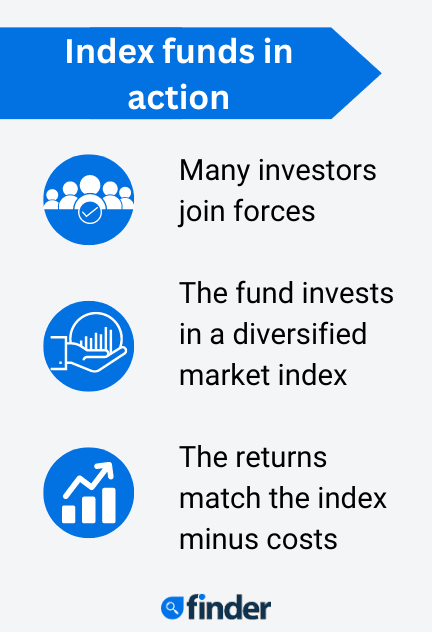
Index funds can be cheap. As they are passive, they don’t need as much legwork, which means they cost less than active funds.
Easy to trade. You don’t have to spend time buying and selling shares, saving you a bit of time.
They diversify your portfolio. This is a fancy way of saying that you get exposure to a range of different companies in one go.
Someone else does the work. Usually, people choose to go with index funds because they can pay someone else (aka the fund manager) to do the hard work. This is great if you’re a less experienced investor.
What are the downsides of investing in index funds?
Despite their benefits, there are a couple of downsides of investing in index funds. In particular:
You’ll never beat the market. Index funds can only perform as well as the underlying index. Because there’s no active management, you have no chance of beating the returns of the index. That said, historic performance of passive vs active funds suggest the former typically fare at least as well as the latter, and often better.
You have no say over the specific stocks you invest in. You can’t pick and choose the stocks that are included by adding in companies that you like the look of, or removing any that you have an aversion to. For that, you’d need to invest directly in stocks.
Pros and cons of investing in index funds
Pros
Get exposure to a bundle of stocks with a single investment
Often a cheap way to invest
Investing in passive index funds can be less time-consuming
Cons
You'll never beat the market
You don't get any choice or control of stocks in an index fund
Most index funds are market-cap weighted, so the bulk of your investment goes to the top stocks
Bottom line
As the name suggests, index funds are made up of the companies listed within a given index. So, the performance and returns closely mimic the performance of the index being tracked. Investing in index funds can give you exposure to multiple stocks in one fell swoop. Plus, they tend to be much cheaper than actively managed funds.
Index funds and index-tracking ETFs are often considered one of the best investments for beginners because they’re straightforward, cheap, and diversified. Even for more experienced investors, choosing to invest in an index fund can provide a solid foundation for you to build from with the rest of your portfolio.
All investing should be regarded as longer term. The value of your investments can go up and down, and you may get back less than you invest. Past performance is no guarantee of future results. If you’re not sure which investments are right for you, please seek out a financial adviser. Capital at risk.
Frequently asked questions
It’s not a case of better or worse, the two are simply different and will suit different types of investor. Individual stocks tend to be more volatile than funds – which include multiple assets – because your risk isn’t spread in the same way. As such, they’re typically best suited to more experienced investors that want nuanced control of their investments. Index funds are a lower (though not zero) risk and more straightforward investment, so are well suited to beginners. That said, many experienced investors will include index funds as part of their overall investment portfolio.
Not by default. You’ll be liable to pay capital gains tax or dividend tax on your profits if you exceed the capital gains tax or dividend tax allowances for the tax year. You could invest in index funds tax-free if you choose to invest via a stocks and shares ISA.
Yes, index funds can pay dividends – look for one that says it offers income, rather than one which “accumulates” (which usually means that any dividend or interest payments are automatically reinvested). You can often choose between reinvesting your dividends (which allows for compounding) or withdrawing them as cash.
You can. On your chosen provider’s fund page, search “fossil” or “fossil fuel” free and take a look at the results you get. Keep an eye out for “fossil fuel screened”. You can also check out our guide to ESG investing, which includes a list of ESG funds.
In the UK, the most popular index is the FTSE 100, which tracks the performance of the 100 biggest companies listed on the London Stock Exchange (by market capitalisation).
These three terms are often used interchangeably to mean the same thing, and indeed index funds and tracker funds are essentially the same thing. Index funds “track” an index, after all. Passive funds are slightly different as this is a more umbrella term for funds where the fund manager doesn’t take an active role in selecting what assets to include. Index funds are a type of passive fund, but this umbrella can also include ETFs, for example.
Was this content helpful to you?
Thank you for your feedback!
To make sure you get accurate and helpful information, this guide has been edited by
David Gregory
as part of our
fact-checking process.
George is a deputy editor at Finder. He has previously written for The Motley Fool UK, Nasdaq, Freetrade, Investing in the Web, MoneyMagpie, Online Mortgage Advisor, Wealth, and Compare Forex Brokers.
He's focused on making personal finance and investing engaging for everyone. To do this he draws from previous work and his Level 4 Diploma for Financial Advisers (DipFA), sharing what he’s learnt. When he’s not geeking out about money, you’ll find him playing sports and staying active.
See full bio
George's expertise
George
has written
278
Finder guides across topics including:
Ceri Stanaway is a researcher, writer and editor with more than 15 years’ experience, including a long stint at independent publisher Which?. She’s helped people find the best products and services, and avoid the pitfalls, across topics ranging from broadband to insurance. Outside of work, you can often find her sampling the fares in local cafes.
See full bio
The FTSE 100 is the UK’s most famous stock index. Here’s how you can invest in it today.
Advertiser disclosure
Finder.com is an independent comparison platform and information service that aims to provide you with the tools you need to make better decisions. While we are independent, the offers that appear on this site are from companies from which Finder receives compensation. We may receive compensation from our partners for placement of their products or services. We may also receive compensation if you click on certain links posted on our site. While compensation arrangements may affect the order, position or placement of product information, it doesn't influence our assessment of those products. Please don't interpret the order in which products appear on our Site as any endorsement or recommendation from us. Finder compares a wide range of products, providers and services but we don't provide information on all available products, providers or services. Please appreciate that there may be other options available to you than the products, providers or services covered by our service.
We update our data regularly, but information can change between updates. Confirm details with the provider you're interested in before making a decision.
How likely would you be to recommend Finder to a friend or colleague?
0
1
2
3
4
5
6
7
8
9
10
Very UnlikelyExtremely Likely
Required
Thank you for your feedback.
Our goal is to create the best possible product, and your thoughts, ideas and suggestions play a major role in helping us identify opportunities to improve.