Best bank accounts for kids UK 2026 (with a £20 pocket money bonus!)
Looking for a new home for your child's pocket money? Here's what you need to know about the best bank accounts for children including current accounts.
There are two types of spending accounts for children: prepaid cards and children’s current accounts.
With a child’s current account, you can set up a standing order instead of withdrawing from an ATM to give your kids their pocket money and you can show them how banking works in real life. They’ll appreciate the trust you place in them and love the feeling of adulthood and independence that having a bank account conveys. A prepaid card is similar but often comes with a monthly fee and you load money on to your child’s account using an app.
The UK’s best children’s bank accounts for 2026 ranked by expert score
Rank
Product
Finder score
1
Starling Teen Bank Account (16/17 yrs)
9.8/10
2
Monzo Under 16s
9.3/10
3
Nationwide Building Society FlexOne
9.3/10
4
Lloyds Bank Smart Start Spending Account
8.8/10
5
Santander 123 Mini Current Account
7.8/10
How do bank accounts for kids work?
Children’s bank accounts basically work like adults’ bank accounts: they come with a debit card and can be used to make payments and withdraw cash. They can be a useful alternative to cash for pocket money and help you teach your kids how to budget.
Standard children’s current accounts can be opened for kids from 11 to 18 years old. Some banks also offer separate “teen” bank accounts, that can be opened by 16-18-year-olds.
What’s the difference between children’s and adults’ bank accounts?
Your child’s account won’t be especially different from your own, but there may be some extra restrictions to look out for, such as:
Withdrawal limits. Some accounts only allow relatively low daily withdrawals, or may require a parent’s signature to authorise transfers over certain amounts.
No overdraft. You’ll like this: bank accounts for kids don’t offer overdrafts, so there’s no way your child can go into debt.
Age limits. Aside from the age limit to open the account, there may be specific ones to use certain account features, such as the app or Google Pay or Apple Pay.
Benefits and interest. Many current accounts for children come with tailored benefits, such as debit cards with personalised designs or discounts. Some will also pay interest on the account balance, giving a little boost to your child’s money.
Like most adults’ current accounts, current accounts for kids usually have no monthly fees and allow fee-free card payments and ATM withdrawals. However, there’s usually a foreign currency transaction fee for using the card abroad.
Some children’s accounts give you the choice of a cash card or a debit card so you can decide which one your child is ready for. Cash cards can only be used to withdraw money from an ATM, while debit cards can also be used in shops and online.”
Alternatives to children’s bank accounts
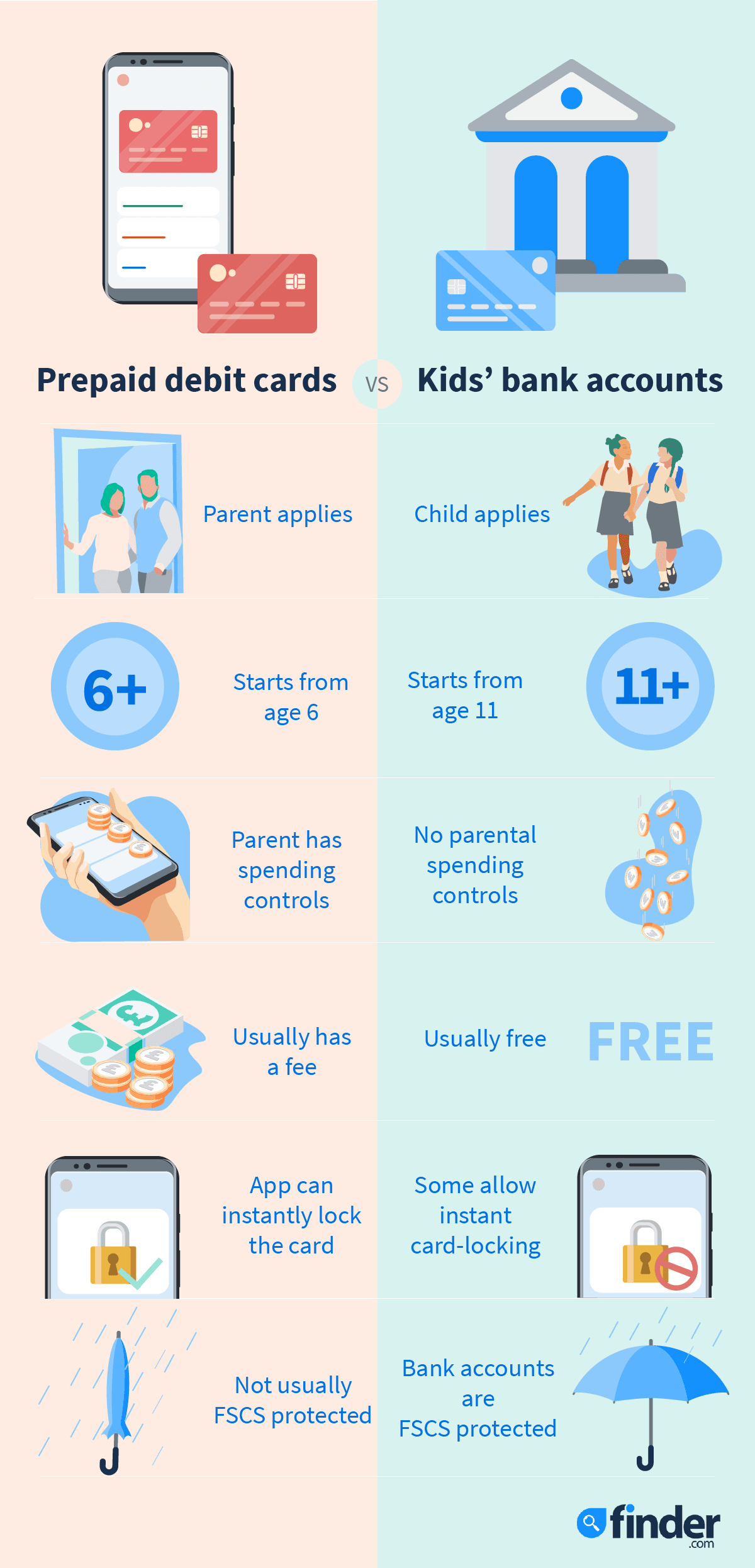
Prepaid cards are the main alternative to children’s current accounts. While also offering an account and a (prepaid) debit card to hold money and make payments, there are some substantial differences:
Prepaid cards are digital-only. They’re usually provided by fintech companies, not by traditional banks, and you can do everything online (which can be an advantage or a disadvantage depending on how you prefer to bank).
They often come with a monthly fee. Unlike current accounts, which are usually free.
Expect a slick app with great features. Your kids will love it and will probably learn how to use it better than you.
They offer much more control. With prepaid cards, parents are able to see how and when kids spend their money and can sometimes set personalised limits.
Kids as young as six can get one. If you want to start their money education from a really early age.
All in all, the deal with prepaid cards is that you have way more options and control, in return for a monthly fee. For this reason, they’re probably more suitable for young kids than for teenagers, whom you can (usually) trust with more independence.
The main prepaid cards for kids are gohenry, nimbl and Osper. Click on the one you’re interested in to read our dedicated review and learn more about what it offers, how it works and how much it costs, or you can learn more about the best debit and prepaid cards for kids.
Are prepaid cards safe for children?
As a parent you may have some concerns that a prepaid card and digital app may leave your young child vulnerable to financial scams, spending on inappropriate items or activities you may not want to expose them to, such as gambling.
However, cards from providers like gohenry and Rooster Card automatically place blocks on products and services designated as being for ‘over 18s’.
Rooster card blocks vendors classified by a Visa-developed scheme as being in any of the following categories:
Nightlife
Alcohol
Tobacco
Fuel
Gambling
Airlines
Money transfers
While this filtering system isn’t completely fool-proof (for example, it may allow an under-18 to buy alcohol from a vendor classified as a ‘general retailer’, as opposed to an ‘off licence’) it’s certainly sophisticated.
These safeguards should help offer parents reassurance that their children will have the ability to learn about personal finance while staying safe.
How to find the best bank account for your child
Comparing bank accounts is always tricky, and the features you may want to look at when choosing an account for your child aren’t necessarily the same you’d value for your own account. To help you out, here’s our children’s current account comparison checklist:
Current account, prepaid card or savings account? That’s the first thing to figure out. The choice will depend on your child’s age, on what you’re planning to do with the account and on how much control you want to retain.
Interest rate. It’s a nice incentive to teach your kids why it’s important to save money, so it’s a good idea to look for an account that offers it. Most savings accounts’ rates will beat the rates offered by current accounts, but on the other hand, a current account gives your child more freedom and immediate access to the money.
App. Realistically, by the time your child becomes an adult, most banking operations will be done online. A slick, secure and well-functioning mobile app is an essential feature of any bank account these days.
Eligibility and limits. Make sure your child is old enough to qualify for the account and that you’re aware of any other limitations.
Costs and fees. Don’t forget to read the small print and make sure you know if, when and how much your child will be charged.
Related products. Some children’s current accounts automatically come with a savings account. It’s worth checking it out to see if it makes for a good deal.
Are there any tax implications to opening a children’s bank account?
In most cases, children don’t need to pay taxes on the interest they earn on their savings accounts, because they don’t earn any money. However, taxes will apply if:
They earn more than their personal allowance, say, from a fund in their name. The personal tax allowance for 2025-26 is £12,570.
They earn more than £100 a year in interest from money given by their parents or legal guardians. The thinking behind this is to stop parents using their children as a tax-free extra allowance. This rule does not apply if the money is given by another relative or a friend.
How to open a children’s bank account
Standard children’s current accounts can be opened for kids from 11 to 18 years old. Specific steps vary by institution, but this is generally how you can open one:
Compare accounts at various banks and building societies until you find the one you that’s right for you and the child.
Gather your financial documents, including your driver’s licence and passport, so they’re readily available when you go to apply.
Apply for the account either in person, online or over the phone. Most children’s bank accounts require you to visit a local a branch to get started, but a handful of institutions let you apply online.
Fund your account by making your initial deposit.
Activate the child’s debit card when it comes in the mail.
Documentation needed to open a children’s bank account
Opening a bank account for your child is easy, but you will need to supply a couple of important pieces of documentation before your kid can start making deposits. What documents you’ll need may vary from bank to bank, but will likely include some combination of:
Your driver’s licence
Your passport details
Your child’s ID document
Your child’s birth certificate
Proof of address
Frequently asked questions
No, bank accounts for kids don’t offer any overdraft facility.
Up to a certain age, which can depend on the bank, a parent or legal guardian will have to open the account. In some cases, they may also need a personal account with the same bank.
Usually, the account automatically turns into a standard adults’ current account.
It depends on the bank. While some banks will let you open an account online, others will require you to visit your nearest branch in person to prove your identity. If you’re able to open an account online, you may be asked to upload photos proving yours and your child’s identity.
Even though a kid’s bank account is in the child’s name, the parent has full access to the account as a joint owner. This means that they can deposit and withdraw funds as they wish. The only exception is if the bank account is jointly owned by another family member, such as a grandparent or aunt or uncle.
Generally, the child must be under the age of 18 to have a children’s bank account, but this can vary.
Also, different banks offer different ways to open accounts depending on age – for example, the Santander 123 Mini Current Account must be opened in a branch and managed by an adult for children aged 12 and under, but kids aged 13-17 can apply online to open the account themselves. Meanwhile, the Revolut child account is aimed at children aged from 6 to 17, and needs to be opened by a parent who must already have their own Revolut bank account (for adults).
Sources
We show offers we can track - that's not every product on the market...yet. Unless we've said otherwise, products are in no particular order. The terms "best", "top", "cheap" (and variations of these) aren't ratings, though we always explain what's great about a product when we highlight it. This is subject to our terms of use. When you make major financial decisions, consider getting independent financial advice. Always consider your own circumstances when you compare products so you get what's right for you. Most of the data in Finder's comparison tables is provided by Defaqto. In other cases, Finder has sourced data directly from providers.
Was this content helpful to you?
Thank you for your feedback!
To make sure you get accurate and helpful information, this guide has been reviewed by
Rachel Wait, a member of Finder's
Editorial Review Board.
Matthew Boyle is a banking and mortgages publisher at Finder. He has a 7-year history of publishing helpful guides to assist consumers in making better decisions. In his spare time, you will find him walking in the Norfolk countryside admiring the local wildlife.
See full bio
Matthew's expertise
Matthew
has written
212
Finder guides across topics including:
Helping first-time buyers apply for a mortgage
Comparing bank accounts and highlighting useful features
In this guide we walkthrough 5 fun, safe and practical “side hustles” your kids can start this summer to supercharge their pocket money. (Paid content)
If you’re tired of using cash for your kids’ pocket money or want to put money aside for when they’ll go to uni, NatWest has dedicated account options for both cases.
This guide looks at how Halifax’s child accounts work, whether they make a good choice to teach kids about personal finance, and and how to open one.
Advertiser disclosure
Finder.com is an independent comparison platform and information service that aims to provide you with the tools you need to make better decisions. While we are independent, the offers that appear on this site are from companies from which Finder receives compensation. We may receive compensation from our partners for placement of their products or services. We may also receive compensation if you click on certain links posted on our site. While compensation arrangements may affect the order, position or placement of product information, it doesn't influence our assessment of those products. Please don't interpret the order in which products appear on our Site as any endorsement or recommendation from us. Finder compares a wide range of products, providers and services but we don't provide information on all available products, providers or services. Please appreciate that there may be other options available to you than the products, providers or services covered by our service.
We update our data regularly, but information can change between updates. Confirm details with the provider you're interested in before making a decision.