
Start building your crypto portfolio with confidence on Coinbase. Join over 100 million customers from around the world to buy, sell or trade more than 240+ cryptoassets today.
Get started
Capital at risk.
Capital at risk.

Estimated reading time: 2 min
Due to the potential for losses, the Financial Conduct Authority (FCA) considers this investment to be high risk.
1. You could lose all the money you invest
2. You should not expect to be protected if something goes wrong
3. You may not be able to sell your investment when you want to
4. Cryptoasset investments can be complex
5. Don't put all your eggs in one basket
If you are interested in learning more about how to protect yourself, visit the FCA's website here.
For further information about cryptoassets, visit the FCA's website here.
Paid for by:

Cryptocurrency has transformed how people move money and value globally – because it’s fast, secure, and often without intermediaries.
Whether you’re paying a friend, transferring to your own wallet, or receiving funds for work, understanding how to send and receive crypto safely is crucial.
Start building your crypto portfolio with confidence on Coinbase. Join over 100 million customers from around the world to buy, sell or trade more than 240+ cryptoassets today.
There are plenty of reasons to move crypto from one wallet to another, it’s not all about trading. Here are some of the most common ones:
“No matter your reason, sending and receiving crypto properly ensures you keep total control of your assets and avoid costly mistakes.”
The process for sending or receiving cryptocurrencies should be similar on most platforms and it can be fairly straightforward.
To give you an example, we’re going to explain how you can do it on the Coinbase app in just a few simple steps:
Log in to Coinbase. 👤
Head into your Coinbase account via the app or desktop platform.
Choose your asset. ✅
Navigate to your crypto portfolio and select the asset you want to send.
Select transfer and send. 📲
Tap or click “Transfer”, then “Send crypto”.
Enter the details. 📝
Put in the recipient’s wallet address carefully, this is the most crucial step.
Select your amount to send. ✉️
Choose the amount you want to send and double-check the network.
Review and confirm. 🎉
Check all the details and confirm the transaction.
Look at your portfolio. 🗂️
Go to your Coinbase wallet and hit “Transfer” or select the cryptocurrency you wish to receive first and then tap or click “Receive crypto”.
Pick your crypto. ✨
Select the asset you want to receive (Bitcoin or Ethereum, for example).
Choose the network. 👍
Select the network to receive on, Coinbase shows an estimated transaction time next to each (if you’re unsure, Coinbase has a “learn more” link).
Generate an address. 📍
Coinbase will then generate your wallet address (and QR code).
Share the address. 💬
Copy the address and share it with the sender.
Wait for the transfer to complete. ✅
Coinbase will notify you once the crypto has arrived.
Start building your crypto portfolio with confidence on Coinbase. Join over 100 million customers from around the world to buy, sell or trade more than 240+ cryptoassets today.
Here are some useful tips to help make these transactions work as smoothly as possible:
Even experienced crypto users can slip up. Here’s what to watch for:
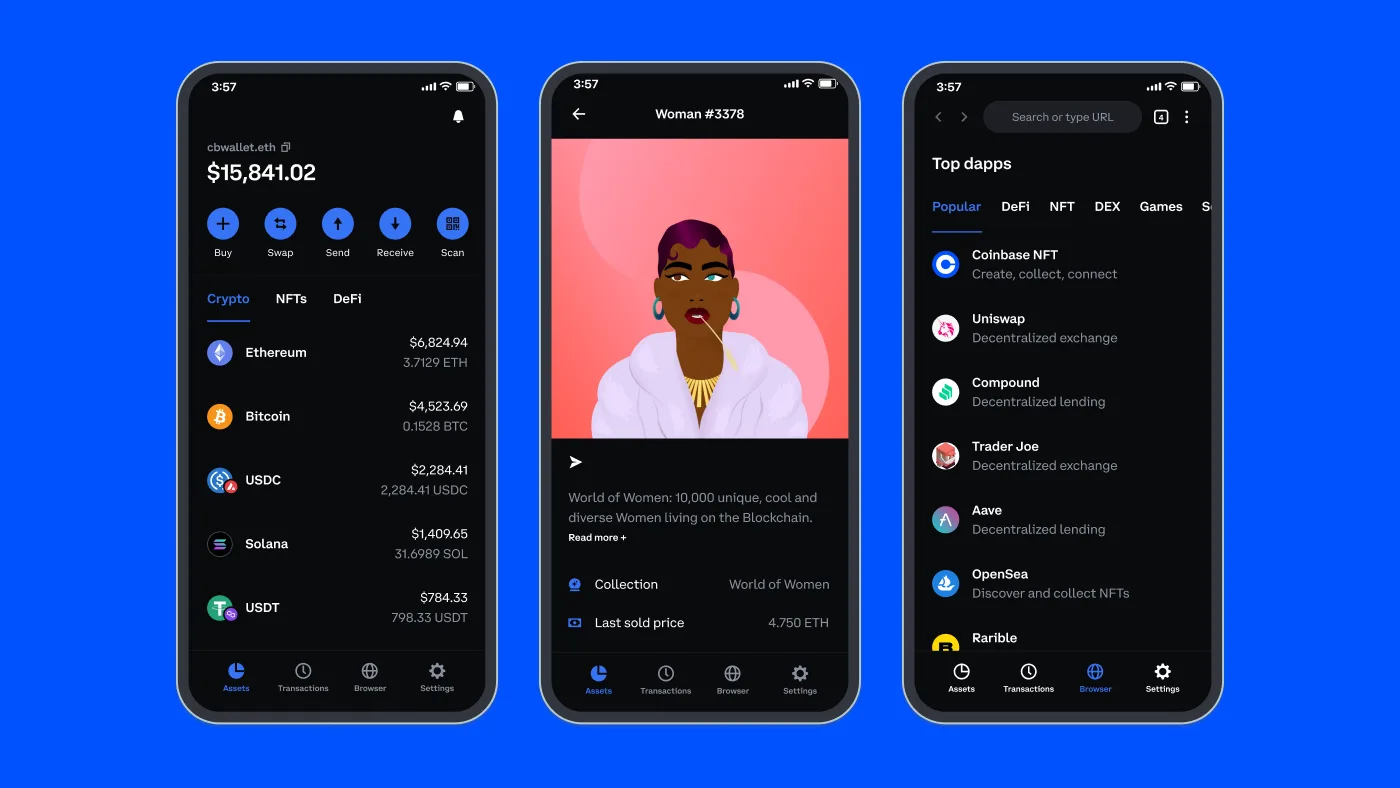
Here’s why millions of users across the world choose Coinbase:
“When it comes to sending and receiving cryptocurrency, Coinbase UK offers the perfect balance of simplicity, security, and reliability – making it ideal for both beginners and experienced investors.”
You can check out our full Coinbase review to find out more details and discover why it’s one of the most trusted¹ cryptocurrency exchanges available to UK crypto enthusiasts.

Coinbase: Your crypto gateway
Begin your crypto journey with Coinbase’s straightforward platform and enjoy access to essential cryptocurrency features. When you’re ready to go further, you can explore Coinbase Advanced to access lower fees and more sophisticated trading tools.
Don’t invest unless you’re prepared to lose all the money you invest. This is a high-risk investment and you should not expect to be protected if something goes wrong. Take 2 mins to learn more.
*Cryptocurrencies aren't regulated in the UK and there's no protection from the Financial Ombudsman or the Financial Services Compensation Scheme. Your capital is at risk. Capital gains tax on profits may apply.
Cryptocurrencies are speculative and investing in them involves significant risks - they're highly volatile, vulnerable to hacking and sensitive to secondary activity. The value of investments can fall as well as rise and you may get back less than you invested. Past performance is no guarantee of future results. This content shouldn't be interpreted as a recommendation to invest. Before you invest, you should get advice and decide whether the potential return outweighs the risks. Finder, or the author, may have holdings in the cryptocurrencies discussed.
Crypto.com is doubling down on the UK market with a fresh focus – its new “Level-Up” programme.
After a brief period of absence, Bitpanda’s much-anticipated return to the UK is finally upon us, with investors and crypto enthusiasts alike eagerly awaiting this relaunch. And after seeing what Bitpanda has to offer the UK market, it’s easy to see why.
A Bitcoin halving is when the rewards for mining Bitcoin are cut in half. Find out more about this event including when and how often it happens, and what it means for Bitcoin’s value.
Find out how many people in the UK own cryptocurrency, how this varies across age groups and other crypto statistics.
Can cryptocurrency be used to build a peer-to-peer bank for everyone? BABB is certainly trying, so we took a look at how it’s supposed to work.
A comprehensive overview of cryptocurrency stablecoins, including how they work, what they’re used for and why they’re important.
Want to buy cryptocurrency using your bank account but don’t know how? Find out everything you need to know in this comprehensive guide.
From Bitcoin to Shit Coin, every term you will come across on your cryptocurrency journey can be found in Finder’s A to Z: Ultimate Cryptocurrency Glossary.
Discover blockchain: what it is, how it works and who is exploring it in the UK.
