On the hunt for a kids’ debit card that won’t charge you a monthly fee? We compare the best debit cards designed for children and their parents to showcase the best no-fee options. We chose the best cards based on features that matter most to families, like parental controls, savings goals and learning tools. Every card on this list charges no monthly fee and is designed to help your child spend and save safely, and each has FDIC insurance on deposits.
Cash App is a financial services platform, not a bank. Banking services are provided by Cash App’s bank partner(s). Direct Deposit provided by Cash App, a Block,Inc. brand. Prepaid debit cards issued by Sutton Bank, Member FDIC. See Terms and Conditions. *Teens aged 13 to 17 can join with approval from eligible parent or guardian. To view the eligibility requirements for sponsoring a teen, please visit the Sponsored Accounts section of the Cash App Terms of Service. **Cash App will pass through a portion of the interest paid on your savings balance held in an account for the benefit of Cash App customers at Wells Fargo Bank, N.A., Member FDIC. To earn the highest interest rate on your Cash App savings balance, you need to (a) have a Cash App Card or sponsor one or more sponsored accounts and receive at least $300 in paycheck direct deposits each month; or (b) have a sponsored account with sponsor approval to earn interest. Exceptions may apply. Savings yield rate is subject to change. ***Brokerage services provided by Cash App Investing LLC, member FINRA / SIPC, subsidiary of Block, Inc. See our BrokerCheck. Bitcoin services are not licensable activity in all U.S. states and territories. Block, Inc. operates in New York as Block of Delaware and is licensed to engage in virtual currency business activity by the New York State Department of Financial Services. Investing and bitcoin are non-deposit, non-bank products that are not FDIC insured and involve risk, including monetary loss. Cash App Investing does not trade bitcoin and Block, Inc. is not a member of FINRA or SIPC. For additional information, see the Bitcoin and Cash App Investing disclosures. Additional fees for securities may apply such as regulatory fees and fees to transfer securities externally. Please see our House Rules for more information. Fractional shares investing may involve additional risks such as non-transferability. For additional information regarding the unique risks and limitations of fractional shares, please see the Investing Customer Account Agreement. ***Cash App waives ATM fees for all in-network withdrawals when you deposit at least $300 monthly into Cash App.
No credit check, security deposit or interest charges
Up to 3% cashback
Build positive credit history before 18
7 Best free kids’ debit cards at a glance
These debit cards for kids and teens have no monthly fees, and we specifically chose them for their standout features, safety controls and extra perks.
With no monthly or overdraft fees at all, Modak Makers has earned itself a spot as one of the best free kids’ cards. The MoCard offers rewards, chores and allowance tracking, and multiple reload options. The crown jewel of Modak is the Mobucks, which are cash-redeemable rewards earned by completing in-app or parent-set challenges. Challenges can be chores, physical exercises or completing a study session. With the Parent Portal, parents can manage and view the account and reload the card in multiple ways, including Apple Pay, Google Pay, direct deposit, ACH or direct card transfers. But just know that the MoCard can’t be used at ATMs, some reload options have extra fees and parents can’t set custom spending limits.
Pros
No monthly or overdraft fees
Mobucks rewards
No age restrictions
Multiple reload options
Parent Portal to manage account
Cons
Can’t be used at ATMs
No custom spending limits
$0.50 + 3% reload fee via Apple Pay, Google Pay or credit card
Step is a free app and secured Visa card with no monthly fees, overdraft charges or credit checks. You can only spend what’s in your account, helping build credit safely. Earn up to 3% in savings rewards and early direct deposit with $500/month in direct deposits. Step also offers cashback deals, referral bonuses, savings round-ups and more. There’s no age limit — minors just need an adult sponsor. For more perks, Step Black offers up to 8% cashback for $4.99/month (or $0 with qualifying direct deposits).
For teens over age 13, the Current Teen Debit Card has an automatic savings feature that rounds up purchases to the nearest dollar to be sent to your teen’s savings. Teens can also create their own savings goals, track chores and allowances and even negotiate chore compensation. Parents can track teen spending, set spending limits, set up recurring deposits, block transactions and transfer funds. But to open this account, parents must open a personal Current checking account, which also has no monthly fees.
The Capital One TEEN Money Checking account is available for ages eight and up. It has no monthly fees, opening deposits or overdraft fees. Unlike most kids’ bank accounts, Capital One offers Zelle integration with the TEEN Money Checking account, so teens 13 and up can use it with adult consent and registration. Additionally, this account earns up to 0.1% APY on all balances and comes with savings tools, plus parents can lower spending limits and get fee-free access to over 70,000 ATMs nationwide. Parents don’t have to be existing Cap One customers to get this account, which only requires an adult co-owner. However, TEEN Money Checking doesn’t come with chore or allowance features.
Pros
$0 monthly fees
Teens 13+ can use Zelle
Earns 0.1% APY on all balances
Savings tools
Doesn’t require parents to be existing Cap One customers
There is a Chase kids’ account, aptly named Chase First Banking. It’s actually powered by Greenlight, is for kids ages 6 to 17 and there’s no monthly fee. The Chase kids’ debit card has strong parental controls, allowing parents to set limits on how much their child spends in one place, opt in for alerts when kids use their Chase card and set ATM withdrawal limits. In the Chase app, parents can track chores and allowances, and transfer funds from their linked Chase account. But to open a Chase First Banking account, parents must have a regular Chase checking account, and you can only link one parent account at a time.
Pros
No monthly fee
ATM withdrawal spending limits
Chore and allowance tracking in Chase’s app
Large age range
Cons
Parents must have a Chase personal checking account
The Axos First Checking account is built for teens aged 13 to 17 and makes a solid first step into banking. It earns 0.10% APY on all balances and comes with no monthly fees or overdraft charges, which keeps things simple for both teens and parents. Axos sets daily limits: $100 for ATM withdrawals and $500 for debit card purchases. Teens get access to a massive network of 91,000+ ATMs, plus up to $12 in monthly ATM fee reimbursements. While it’s a strong fee-free option, it’s light on extras. It doesn’t offer built-in tools for chore tracking, budgeting goals or money lessons.
Fidelity Youth Account: Best for investing for teens
The Fidelity Youth Account is a brokerage account that comes with a debit card for teens aged 13 to 17. It’s free to maintain, as there are no monthly fees or minimum opening deposit requirements. Teens can invest in stocks, exchange-traded funds (ETFs) and mutual funds with as little as $1 — with parental supervision. Another major perk is that Fidelity automatically places your teen’s uninvested cash into a money market fund that can earn 3.93%. But just know that while parents can view all investment activity, they can’t approve or prevent transactions.
Pros
No monthly fee
Invest in stocks, ETFs and mutual funds
Unlimited domestic ATM reimbursements for Visa, Plus or Star ATMs
Uninvested funds earn 3.93%
Cons
Parents can’t deny transactions
Parents must have or sign up for a Fidelity account
Methodology: How we chose the best no-fee kids’ debit cards
Finder’s experts regularly review top kids’ bank accounts, debit cards and prepaid cards from various providers to find the best options in the market.
Finder’s banking experts research over 45 kids’ cards before narrowing down the best free accounts. We consider these five factors:

$0 monthly fee
Available in most US states
No strict membership requirements
Strong parental controls
Accounts that kids can keep using after they turn 18
Expert insight
"You can start talking to kids about money as early as age five. At that age, they understand trade-offs like choosing between two toys, which is the perfect way to explain saving, spending and making choices. I’ve worked with parents who used clear jars labeled Spend, Save and Give to help young kids visualize where their money goes. It becomes second nature over time.
For a debit card, age 10 to 13 is usually a good window, depending on maturity. We’ve observed parents tie card access to allowance or chores, helping kids manage their spending while parents keep oversight. Look for cards with spending alerts, parental controls and the ability to lock the card remotely. It’s not just about the card — it’s about building trust and discipline in real time.
Parental controls. Look for spending limits, alerts, fast reload options, chore and allowance features, the ability to turn the card on and off and so on. Some kids’ banking apps, such as Greenlight, offer extra safety features such as suspicious activity alerts, identity theft coverage, car crash detection and family location sharing (for a monthly fee).
App quality. A good interface can make it easier for you to manage the accounts as the parent and easier for kids to use while they’re learning about online banking.
Cost. Many kids’ debit cards have monthly fees, but a few from Capital One, Chase and Modak don’t charge a monthly fee. Also, look out for reload fees, ATM charges or inactivity fees.
Age limits. Some cards are only for teens, others allow younger kids with supervision, which is common with traditional banks. Fintechs like Greenlight and Modak often don’t have age requirements for kids, just requiring the parent to be the account’s custodian.
"Parents don’t need to have a flawless plan or scripted talking points — it’s more effective to let your child’s questions lead the way.
For instance, my four-year-old son once asked me if we pay for his activities. I used that as a starting point to explain that we pay for nearly everything in our lives — our home, his school, the water we drink and bathe in and even his activities. I added that the only thing we don’t pay for is the air we breathe. By connecting the concept of money to concrete examples from his everyday life, I was able to make an abstract idea easier for him to grasp. Starting these conversations early, guided by a child’s natural curiosity, can lay a strong foundation for financial understanding.
Minors can’t get debit cards on their own in most states. To open an account for your child, you’ll need to be on the account with them, usually as a joint owner or custodian.
Knowing that you’ll share ownership of the account can provide a lot of peace of mind. Additionally, all the best kids’ cards we chose have FDIC insurance coverage, meaning deposits are protected by federal deposit insurance up to the typical amount of $250,000.
Most other kids’ debit cards offer strong parental controls, such as the ability to lock the card with an app, set up a PIN for the debit card and block restricted merchants (such as alcohol and lottery purchases). Many also offer custom spending and ATM withdrawal limits.
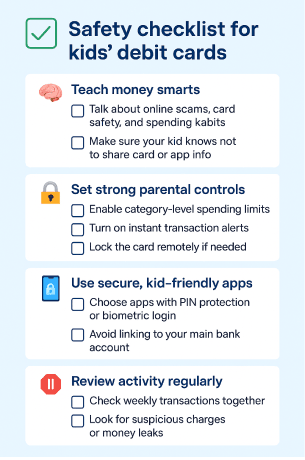
Image sourceFinder.com
What happens to a kid’s checking account once they turn 18?
It depends on the kids’ bank account you choose. With some kid checking accounts, teens are able to keep the account open until a certain age and then are required to upgrade to a standard account.
For example, with the Capital One TEEN Money account, teens have the option to upgrade to a regular Capital One 360 Checking account (also with no monthly fees). If they don’t want to upgrade to a regular 360 Checking account, the TEEN Money account can remain active.
Another example is the Fidelity Youth Account. Once the kid turns 18, that account must be converted to a standard Fidelity brokerage account.
Bottom line
There are plenty of free debit cards for kids that can help them learn essential financial skills, such as budgeting, saving and even investing, all without annoying monthly fees. Whether you’re looking for full parental control or a more flexible teen-friendly setup, one of these picks can help your child get started with money the smart way.
Yes. Several options, like Modak, Capital One MONEY and Chase First Banking, charge no monthly or overdraft fees. Just watch for ATM fees or reload charges.
Do I need to open a new bank account to use these cards?
It depends. Some kid debit cards, like Chase First Banking, require the parent to have a Chase checking account. Others, like the Capital One TEEN Money account, let you link external accounts, and fintechs like Modak and Greenlight work as standalone apps that connect to your existing bank account.
Can kids under 13 get a debit card?
Yes, many providers like Modak and the Chase kids’ account allow kids as young as six with a parent or guardian as a joint account holder.
What happens when my kid turns 18?
Most providers let you convert the account to an adult checking account.
Bethany Hickey is the banking editor and personal finance expert at Finder, specializing in banking, lending, insurance, and crypto.
Bethany’s expertise in personal finance has garnered recognition from esteemed media outlets, such as Nasdaq, MSN, Yahoo Finance, GOBankingRates, SuperMoney, AOL and Newsweek. Her articles offer practical financial strategies to Americans, empowering them to make decisions that meet their financial goals. Her past work includes articles on generational spending and saving habits, lending, budgeting and managing debt.
Before joining Finder, she was a content manager where she wrote hundreds of articles and news pieces on auto financing and credit repair for CarsDirect, Auto Credit Express and The Car Connection, among others.
Bethany holds a BA in English from the University of Michigan-Flint, and was poetry editor for the university’s Qua Literary and Fine Arts Magazine.
See full bio
Bethany's expertise
Bethany
has written
492
Finder guides across topics including:
Compare top credit cards for teens and how they work when you’re a minor.
Advertiser disclosure
Finder.com is an independent comparison platform and information service that aims to provide you with the tools you need to make better decisions. While we are independent, the offers that appear on this site are from companies from which Finder receives compensation. We may receive compensation from our partners for placement of their products or services. We may also receive compensation if you click on certain links posted on our site. While compensation arrangements may affect the order, position or placement of product information, it doesn't influence our assessment of those products. Please don't interpret the order in which products appear on our Site as any endorsement or recommendation from us. Finder compares a wide range of products, providers and services but we don't provide information on all available products, providers or services. Please appreciate that there may be other options available to you than the products, providers or services covered by our service.
We update our data regularly, but information can change between updates. Confirm details with the provider you're interested in before making a decision.
How likely would you be to recommend Finder to a friend or colleague?
0
1
2
3
4
5
6
7
8
9
10
Very UnlikelyExtremely Likely
Required
Thank you for your feedback.
Our goal is to create the best possible product, and your thoughts, ideas and suggestions play a major role in helping us identify opportunities to improve.