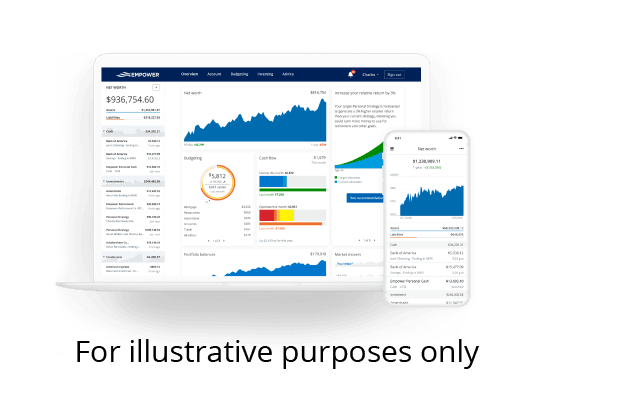
You can typically link bank accounts like checking and savings, credit cards, investment portfolios, crypto accounts, subscription services, bills and loans to view them all in one app. With your account information in one place, you can view transactions, net worth, investments and balances across your different accounts in a centralized platform.
How do financial aggregators work?
Most aggregator apps use intermediary services to link your accounts to the app. One example of these intermediary services that you’ve probably heard of is Plaid. Plaid is a financial technology company that serves as a “bridge” between your banks and the financial apps you want to link together.
These bridge services, which also include Finicity, TrueLayer and MX, are not banks. They do not hold any of your money, and you don’t even have to make an account with these platforms. These intermediary services work behind-the-scenes to transfer data between your accounts and the financial aggregator service.
After you link your accounts to the aggregation platform, it will compile your data to display it, sometimes in pie graphs or categorized lists. Additionally, these apps usually have tools to budget and categorize your spending.
Image: Empower
3 top financial aggregator examples
There are plenty more than just three financial aggregator apps, but here are some popular ones:
Empower Personal Cash.Empower is an app aggregator for $0 per month, this one lets you sync bank accounts, loans and investments. You can track your income, expenses and transactions, and organize everything with labels and set savings goals.
Origin. The Origin app offers bank account and investment linking, portfolio creation, tax filing, estate planning, credit score tracking and more. Costs $12.99 per month, or you can try it for one year for just $1. Also allows for one joint owner at no extra cost.
Monarch. An app that lets you track bank accounts, subscription services, expenses and credit cards. Also offers two budgeting options called Flex Budgeting and Category Budgeting. Costs $14.99 per month, and allows for a joint owner at no extra cost.
Are account aggregators safe?
For the most part, yes, financial aggregation apps are just as safe as a typical banking app. And we make that comparison because aggregators typically use bank-level security features, including an advanced encryption standard (AES) and two-factor authentication (2FA).
AES involves scrambling your financial and personal data, and turning it into mathematical algorithms. To the naked eye, encrypted information looks like a bunch of random letters, and to decode it you need a cipher.
With 2FA, which you’re likely familiar with, it requires some extra steps beyond just your username and password to log in. For example, logging in may require you to verify your email address, phone number, enter a pin or even a facial scan.
With a combination of encryption and 2FA, banking apps and financial aggregator apps are generally safe and secure. Just be sure to never share your passwords or pins with anyone, and consider making different passwords for each of your accounts.
Pros of financial aggregator apps
If you’re someone who doesn’t put all their eggs in one basket, then an aggregation app could be a great tool to get an overview of your financial health.
One login. By linking your various accounts to the single aggregation app, you can log into the app to view your linked accounts in one place.
Budgeting. Similar to a budgeting app, a financial aggregation app can make it easier to see where you stand across your bank and investment accounts, which can help you manage your overall budget.
Analytics. The majority of financial aggregation apps offer tools like net worth calculators, savings goals, credit score tracking, estate planning and more.
Real-time data. Most aggregation apps offer real-time data through syncing software like Plaid, Finicity and MX, offering up-to-date transactions and information.
Bank-level security. Financial aggregation apps typically utilize bank-level security tools, such as 256- bit encryption and two-factor authentication.
Cons of financial aggregator apps
These apps might not be worth it to everyone, since their cost could overextend your budget and just create more hassle than you need.
Cost. Most financial aggregation apps are not free, typically costing around $10 per month.
Security. If you’re not careful with your passcodes or don’t set up 2FA, then a financial aggregation app could pose a risk by being a centralized point where your financial accounts are. In other words, an aggregation app could be a single point of entry to the majority of your accounts.
Information overload. Having all your accounts and transactions in one place could be great, but it could also create a mess to sort through, and make it difficult to pinpoint relevant information.
Bridge services. There’s a chance that your accounts may not be able to sync to the financial aggregation app. While Plaid, Finicity, TrueLayer and MX do allow syncing of data with thousands of financial institutions, it doesn’t include every bank and credit union in the US.
Bottom line: Should I aggregate my bank accounts?
If you find yourself struggling to manage multiple bank accounts, investment accounts, credit cards and loans, then a financial aggregation app could be a big help. These platforms could sync all of your accounts and display them in one place.
On the other hand, if you only have a few accounts and already have a nice handle on your budget, investment planning and spending, then a financial aggregation app might just end up being an extra cost.
Bethany Hickey is the banking editor and personal finance expert at Finder, specializing in banking, lending, insurance, and crypto.
Bethany’s expertise in personal finance has garnered recognition from esteemed media outlets, such as Nasdaq, MSN, Yahoo Finance, GOBankingRates, SuperMoney, AOL and Newsweek. Her articles offer practical financial strategies to Americans, empowering them to make decisions that meet their financial goals. Her past work includes articles on generational spending and saving habits, lending, budgeting and managing debt.
Before joining Finder, she was a content manager where she wrote hundreds of articles and news pieces on auto financing and credit repair for CarsDirect, Auto Credit Express and The Car Connection, among others.
Bethany holds a BA in English from the University of Michigan-Flint, and was poetry editor for the university’s Qua Literary and Fine Arts Magazine.
See full bio
Bethany's expertise
Bethany
has written
464
Finder guides across topics including:
Finder.com is an independent comparison platform and information service that aims to provide you with the tools you need to make better decisions. While we are independent, the offers that appear on this site are from companies from which Finder receives compensation. We may receive compensation from our partners for placement of their products or services. We may also receive compensation if you click on certain links posted on our site. While compensation arrangements may affect the order, position or placement of product information, it doesn't influence our assessment of those products. Please don't interpret the order in which products appear on our Site as any endorsement or recommendation from us. Finder compares a wide range of products, providers and services but we don't provide information on all available products, providers or services. Please appreciate that there may be other options available to you than the products, providers or services covered by our service.
We update our data regularly, but information can change between updates. Confirm details with the provider you're interested in before making a decision.