Related: Guide to investing for the future
Private equity vs venture capital: A side-by-side comparison
Both are forms of private investment, but they differ in focus, strategy and the stage at which they connect with companies.

Whether a business is established or just starting out, an infusion of capital can make all the difference to its growth. A company that needs funding to grow might turn to a private equity or venture capital firm. However, private equity and venture capital are not the same. They differ in their methods and the types of companies they target. Understanding the difference is crucial.
| Venture Capital | Private Equity | |
|---|---|---|
| Risk level | High/moderate risk | Low/moderate risk |
| Type of investment | Equity and convertible debt | Equity with leverage |
| Typical industries | Varies | Varies |
| Types of companies | Startups and early-stage companies | Mid to later-stage businesses |
| Typical capital investment | Around $10 million | Several million to billions |
| Equity stake | Minority stake | Majority stake |
| Typical hold period | 10 years (possible 2-year extension) | 10 years (possible 2-year extension) |
| Average returns | Around 10% internal rate of return (IRR) | Over 11% (net of assets) |
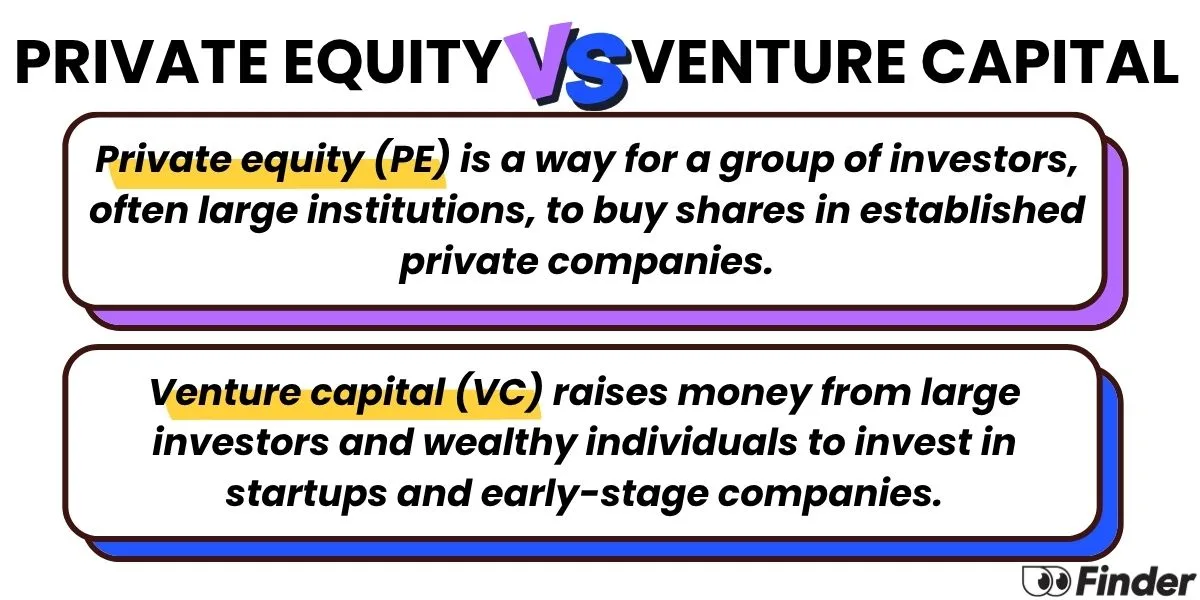
Private equity (PE) is a pooled investment vehicle that enables a group of investors, usually large institutional investors, to purchase equity in private companies. While some PE firms involve minority stakes, they frequently acquire a majority stake in the business.
In buyout scenarios, once the investment is made, the PE fund can take an active role in the management and direction of the business to help increase its profitability. The idea is to invest in companies with growth potential, so the companies and investors can work together to improve the business with the end goal of selling the company for a profit or taking the company public to realize returns.
Venture capital (VC) is a form of private investment that raises capital from institutional investors, financial institutions and high-net-worth individuals. VC firms invest in startups and early-stage companies with growth potential. In addition to capital, VC firms can also offer strategic guidance and technical or managerial support.
For their investment, venture capitalists typically receive a minority ownership stake in the company. That means while they take part in the rewards, they can also incur significant losses if the company fails. Thus, VC is considered a high-risk form of investing, but it can also have major rewards if the company is successful.
While private equity and venture capital opportunities have traditionally only been available to accredited investors, platforms like Wealthsimple, FrontFundr and Equivesto have broadened access for regular investors.
There are several key differences between private equity versus venture capital.
Both private equity and venture capital are a way for companies to grow by adding capital. However, a few key factors differentiate private equity and venture capital. Investor objective, equity stake and investment size all play major roles in distinguishing one investment type from the other.
Before committing to an investment, consult a financial advisor for personalized advice regarding your portfolio.
Related: Guide to investing for the future

Learn how to buy SpaceX stock in Canada and see stock performance history over time.

We break down which companies hold Ethereum, why they’re doing it and what ETH treasuries mean for markets and investors.

Want to invest in the Euro Stoxx 50 in Canada? Explore investment platforms and popular Euro Stoxx 50 index funds.

Learn how the best AI trading can help you manage your investments.
Where to invest your money in the short-term with low risk and high yield.
Futures trading can be rewarding, but it’s not for everyone. Learn the steps to trade futures, including examples and fees to consider.
Use this calculator to find out how much you can grow your money.
Invest in companies that work to address environmental and social issues, and adhere to sustainable corporate governance requirements.
Get actionable tips on how to prepare for your ideal retirement.
ETFs and mutual funds both hold baskets of investments, but pricing minimums and trading costs vary.
Check out these real estate investment options from REITs and rentals to mutual funds, house flipping and more.
Bonds are fixed-income assets that earn interest. But bonds may underperform other asset classes in the long run.
