
Blog
Does the Pumpkin Spice Latte Craze Pay Off for Starbucks Investors?
Do Starbucks investors stand to gain from the Pumpkin Spice Latte hype? We dove into the history of SBUX stock to find out.


Stocking up on candy this fall is a less-than-sweet experience in the US and Canada, thanks to prices rising more than twice as fast as the overall inflation rate in both countries.
Why is getting your seasonal sugar fix so expensive? Supply chain complications, unlucky weather and tightening regulations account for most of the increase.
We take a closer look at the culprits behind candy price hikes and how to spend less without foregoing holiday treats altogether.
According to data from the Federal Reserve Bank of St. Louis, candy and chewing gum prices rose 7.7% (not adjusted for seasonality) between September 2025 and September 2026—more than double the 3.7% overall US inflation rate.
Up north, Statistics Canada reported a 6.5% annual increase in the price of confectionery goods between August 2025 and August 2026, more than double the 3% overall Canadian inflation rate that month. That being said, year-over-year confectionery prices actually dipped 2.9% the following month in September 2026.
The picture looks similarly grim when comparing the cost increases of candy versus groceries, generally. The Consumer Price Index (CPI) shows food costs in US cities rose 1.8% year over year, while Canadian CPI data puts the figure at 1.7% for store-bought food.
So, as tough as it’s getting to restock American pantries for everyday meals, the price of sweets has actually risen more than four times faster this past year.
The trend isn’t limited to 2026. Since February 2020, just before the COVID-19 pandemic hit, candy prices have risen a whopping 49.4% in the US and 27.4% in Canada.
For reference, food inflation rates over the same period were 31.8% and 32%, respectively—a pretty noticeable difference in the US, though less so in Canada.
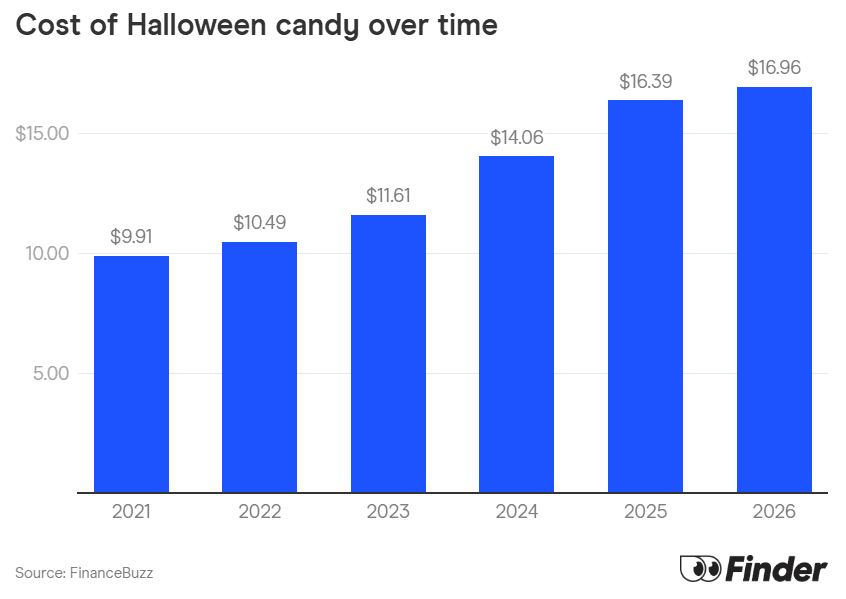
What are America’s favorites? Based on ounces sold last October, Reese’s Peanut Butter Cups, Peanut M&M’s and Hershey’s Milk are the most popular candies, according to Instacart order data. FinanceBuzz puts the average cost of a 100-piece bag of candy at $16.96 USD, up $7.05 from 2021.
Believe it or not, there’s a lot more to putting candy on the shelves than “Charlie and the Chocolate Factory” would suggest.
The confectionery industry is made up of a complex web of factors including growers, retailers, weather and import regulations, any of which can impact the shelf price of candy for better or for worse.
Around one-third of the world’s cocoa comes from the Ivory Coast (Côte d’Ivoire), and Brazil, Mexico and Guatemala provide most of the sugar imported to the US and Canada.
Unfortunately, Mother Nature has seemed bent on cutting human sugar consumption lately. Incredibly hot, dry weather reduced soil moisture and cocoa bean size in the Ivory Coast in 2022. Heavy rainfall in 2023 delayed transportation and triggered plant illnesses that decimated cocoa trees.
Unfulfilled contracts were rolled over to subsequent years, impacting cocoa import agreements with other nations, which are sometimes arranged up to 12 months in advance.
Brazil hardly fared better, with fires and port overcrowding limiting the nation’s ability to meet heightened sugar demand following the impact of stormy weather on other major producers like India and Thailand.
Mexico similarly suffered from droughts affecting sugar growth from 2022 to 2024, although supply has since rebounded to close the gap with demand.
Prior to 2014, the US imported the lion’s share of its sugar from Mexico under a privileged duty-free, quota-free agreement.
Following allegations from the American Sugar Coalition that the agreement was harming domestic production, a price floor was applied to Mexican sugar imports.
Additionally, growing awareness of sustainability and labor practices in the 1990s and 2000s has led a number of countries and suppliers to take steps to improve wages and working conditions for industry workers.
One such example is the Living Income Differential (LID), a premium on cocoa exports introduced by the governments of Ghana and the Ivory Coast beginning in the 2020/2021 harvest season. The LID still exists today, though there is some debate about its effectiveness.
Looming on the horizon is the European Union’s Deforestation Regulation (EUDR), set to take effect at the end of this year, which will heighten traceability and transparency requirements for producers of cocoa and other commodities, which could further drive up prices.
Chocolate and candy may become premium treats as supply lines continue to adapt to market shifts, evolving regulations and unpredictable acts of nature.
But there are still ways to save money when loading up on goodies this year:
Shopping carefully and switching up your usual holiday favorites with less-expensive alternatives makes it easier to satisfy your sweet tooth without overspending.
Does the Pumpkin Spice Latte Craze Pay Off for Starbucks Investors?
Do Starbucks investors stand to gain from the Pumpkin Spice Latte hype? We dove into the history of SBUX stock to find out.

Gear up to study with these three ways to save money on back-to-school supplies, plus find out how to get a jump on next year’s costs.

We explore 6 ways to slash everyday expenses and put more in your pocket.

SPONSORED: A low-cost business banking package can provide the tools your growing company needs to succeed in 2026.

We asked popular chatbots if AI is a smart investment. Here’s what ChatGPT, Perplexity, Gemini, Claude and Grok had to say.

6 ways to free up room in your budget without support from high-interest loans
If you’re experiencing financial hardship, here’s how to free up resources without turning to high-interest debt.

Do Starbucks investors stand to gain from the Pumpkin Spice Latte hype? We dove into the history of SBUX stock to find out.
Gear up to study with these three ways to save money on back-to-school supplies, plus find out how to get a jump on next year’s costs.
We explore 6 ways to slash everyday expenses and put more in your pocket.
We asked popular chatbots if AI is a smart investment. Here’s what ChatGPT, Perplexity, Gemini, Claude and Grok had to say.
If you’re experiencing financial hardship, here’s how to free up resources without turning to high-interest debt.
We explore SpaceX’s plans for growth and other investments that may rise with the tide when the company goes public.
From stocks and bonds to crypto and real estate, how do you know which investments are right for you? The key is in knowing your investment style.
Shrewd wealth builders use these three strategies to keep the tax man from reaching deeper into their pockets.
Explore some of the biggest money mistakes that may be keeping you in the hole, so you can finally start digging out.
