EQ Bank is a leading Canadian online bank known for offering low fees and competitive interest rates. In this EQ Bank review, we break down what you need to know about its accounts and services, rates, safety, fees, pros and cons and more. We’ve also selected some featured EQ Bank products.
What is EQ Bank?
EQ Bank was launched in 2016 by Equitable Bank and is headquartered in Toronto. It operates entirely online, so there are no branches or locations you can visit for in-person service. Low overhead costs translate into lower fees — EQ Bank is known for being affordable and offering very competitive interest rates.
EQ Bank offers a range of personal banking and investment accounts including a chequing account, savings account, joint accounts, US dollar account, TFSAs, RSPs and GICs.
It offers international money transfers via Wise, a third party service. EQ Bank also hosts a mortgage marketplace where you can browse 2,000+ products from various lenders.
Summary of EQ Bank accounts
| Account | Monthly fee | Interest rate | |
|---|---|---|---|
| EQ Bank Notice Savings Account | $0 | 2.50% - 3.00% | |
| EQ Bank Personal Account | $0 | Earn 3.00% | |
| EQ Bank TFSA | $0 | 1.75% | |
| EQ Bank RSP | $0 | 1.75% | |
| EQ Bank US Dollar Account | $0 | 2.75% | Learn more |
Summary: EQ Bank details
- EQ Bank transit number (or branch number): 80002
- EQ Bank institution number (or routing number): 623
- EQ Bank phone number: 1-844-437-2265 (or 1-416-551-3449 if outside of North America)
Your EQ Bank account number is a unique nine-digit number you can find under your account details after logging into the EQ Bank app or online portal.
Other EQ Bank accounts
Bwyond the Personal chequing account, Notice Savings account and GIC account, EQ Bank also offers these accounts:
EQ Bank TFSA
Open an EQ Bank TFSA (Tax Free Savings Account), and earn 1.75% on your balance. Grow your funds tax free, pay no monthly fees and make free withdrawals whenever you want. You can also set up recurring deposits from your EQ Bank Personal Account or any other bank account.
EQ Bank US Dollar Account
Earn 3.00% on funds held in an EQ Bank US Dollar Account, which comes with a competitive exchange rate and zero monthly fees. Use the currency conversion calculator built into EQ’s online banking portal to get the latest CAD/USD exchange rate. Like other EQ Bank accounts, US Dollar Account balances are insured by the CDIC.
EQ Bank RSP Savings Account
With a EQ Bank RSP, you can save for retirement by earning a competitive 1.75% rate on your balance. Set up recurring deposits to ensure that your funds grow consistently. Money can be deposited and grown in RSPs tax free. You’re only taxed when you make withdrawals.
EQ Bank GIC
To purchase an EQ Bank GIC, you will need to open an EQ Bank savings account. You will also have to deposit a minimum of $100 to get started. Here are the types of EQ GICs available.
Types of EQ Bank GICs
Short-term EQ Bank GICs: Three to nine months
Short-term EQ GICs range from three to nine months in duration. There are a number of advantages as well as a few drawbacks with these GICs. The most important advantage is that you only have to surrender your deposit for a short period of time. This means they are not as much of a financial burden as the mid-range and longer-term GICs. These GICs are perfect for people who are trying to make short-term gains in a risk-free way.
Mid-range EQ Bank GICs
EQ Bank’s mid-range GICs have a duration of from one to three years. These GICs come with interest rates that are higher than the short-term GICs, and you do not need a large amount of money to open one. In fact, you can get started with as little as $100.
This means that almost anyone can open an account. However, mid-range GICs are better suited to people who want to make a significant return as opposed to short-term passive income. So, it is better to start with at least $500 to $1,000 if you want to open a mid-range GIC from EQ Bank.
Long-term EQ Bank GICs
Long-term GICs are EQ Bank’s highest-returning GICs. EQ’s long-term GICs have a duration of either four or five years, and the high interest rates offered by these GICs make them ideal for people who want to make as much money as possible with their investment.
Registered EQ Bank GICs
EQ also offers registered GICs, which can be held in TFSA or RSP accounts.
Why should I invest in an EQ Bank GIC?
There following are some of the key advantages of EQ GICs:
- You can get one with only $100
- EQ Bank has many different options in terms of GIC lengths
- They have high interest rates compared to many competitor GICs
- EQ is a member of the Canadian Deposit Insurance Corporation (CDIC), so your funds are covered by deposit insurance, subject to maximum coverage limits
What should I look out for with an EQ Bank GIC?
There is nothing that you really need to look out for regarding EQ GICs. They are safe investment vehicles that will generate good returns. The only real downside is that they are not the highest-returning GICs on the market, even if they are guaranteed investments.
How do I purchase an EQ GIC?
To purchase an Equitable Bank GIC, you will need to open an EQ savings account. You will also have to deposit a minimum of $100 to get started.
EQ Bank International Money Transfers
EQ Bank customers can send money transfers to over 80 countries in 49 currencies through their online banking portals powered by Wise, a third party international money transfer service. Wise offers competitive transfer fees, zero-markup exchange rates and high sending limits, so you can get your money where it needs to go.
EQ Bank mortgage marketplace
EQ Bank offers a marketplace where you can explore 2,000+ mortgage products offered by EQ and many other Canadian lenders. EQ Bank customers can get exclusive rates, quick pre-qualification and assistance from professional mortgage brokers. It’s completely free, but you have to be an EQ Bank customer to use the service.
How does EQ Bank compare to other banks?
Many Canadian banks offer GICs, TFSAs and savings accounts. However, EQ Bank actually offers some of the best GICs available on the market and high interest rates. Some banks, such as Implicity Financial and Oaken Financial, sometimes offer rates that are higher than EQ Bank GIC rates, so while EQ Bank GIC is not the absolute best value, it compares favourably to most of its competitors – especially to those of the Big Five banks.
EQ Bank Pros and cons
Pros
- Easy application. The online application is quick and easy to fill out.
- No monthly fees. Enjoy zero monthly account maintenance fees.
- Competitive interest rates. EQ Bank interest rates are some of the most competitive on the market for savings and chequing accounts. For example, the EQ Bank Notice Savings Account comes with an ongoing rate between 2.5% and 3%.
- Free ATM withdrawals. Although EQ Bank does not have its own ATM network, it does offer free ATM withdrawals from any ATM across Canada and will reimburse you the ATM fee if you’re charged one on the spot.
- Deposit insurance. Deposits in EQ Bank accounts are insured up to $100,000 by the CDIC.
- Low minimum for EQ GICs. Start investing in GICs with as little as $100 (compared to $1,000 for some other digital banks).
- Free transfers. Send money to/from your Personal account with free Interac e-Trasfers, EFTs, bill payments and mobile cheque deposits.
- Prepaid card. The EQ Bank Card can be used to withdraw cash after you transfer money to the card directly from your chequing or savings account.
- Cheap international money transfers. You’ll be able to make cheap international transfers from your account using third-party service, Wise.
- User friendly mobile app. Easily check your balance and manage your money with the EQ Bank app for Android and iOS devices.
Cons
- Slow bank-to-bank withdrawals. You may need to wait several business days to complete bank-to-bank transfers.
- Maximum cumulative balance. You can only hold up to $250,000 in your EQ Bank accounts, including any Personal Accounts and Notice Savings Accounts (or up to $500,000 for joint account holders).
- No physical locations. It’s not possible to visit a physical location to get in-person service.
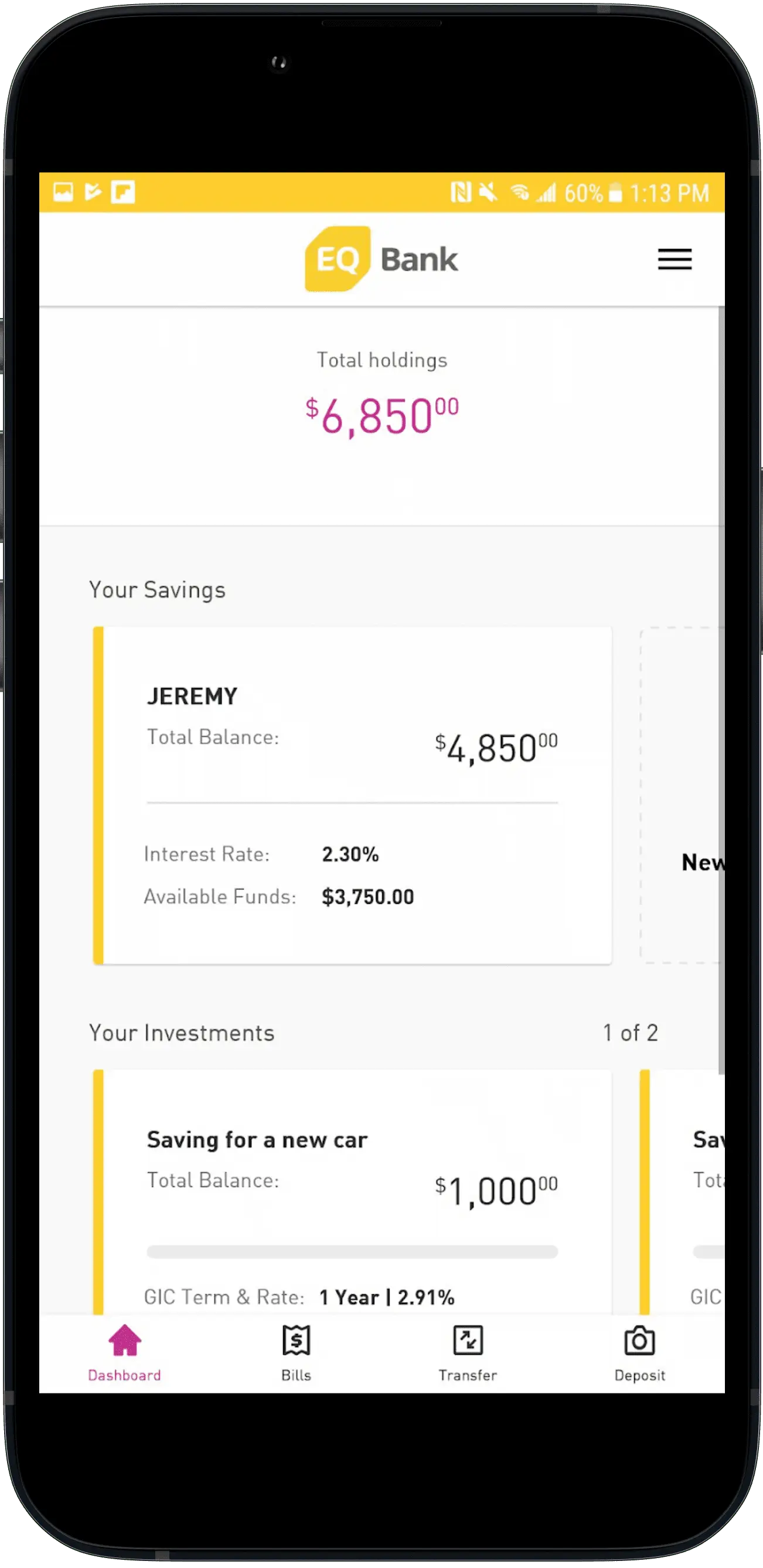
EQ Bank app

The EQ Bank mobile app is available for download on Google Play and the Apple App Store.
| Google Play app reviews |
4.3 –
★★★★★ 13.8K reviews |
| Apple App Store app reviews |
4.8 –
★★★★★ 62K reviews |
How do I open an EQ Bank account?
- Click Go to site on below to get started.
- Complete the application with details such as your name, email address, Social Insurance Number and birth date. You need a phone number to apply, because EQ Bank uses 2-step verification (sends a code to your phone to verify your identity) when you log in.
- Verify your ID, and deposit funds into your account via Interac e-Transfer, EFT or mobile cheque deposit using the EQ Bank mobile app.
Get started now with the EQ Bank Personal Account:
Eligibility
To open an EQ Bank account, you must satisfy the following requirements:
- Be at least the age of majority in your province or territory (18 or 19 years old)
- Be a Canadian resident
- Have a Social Insurance Number (SIN)
Is EQ Bank safe?
Deposits held in EQ Bank accounts are insured by the Canada Deposit Insurance Corporation (CDIC). This means that, in the unlikely event the bank fails, your deposits will be insured up to $100,000.
The platform follows a number of industry-standard best practices for protecting your data and money including data encryption, strong password requirements, security questions and regularly monitoring the platform for fraud.
The EQ Bank Mobile and Online Banking Security Guarantee states that you’ll be 100% reimbursed for losses from unauthorized account activity, provided you’ve met all your responsibilities.
How can I contact EQ Bank customer service?
EQ Bank customer service can be reached by phone 7 days a week from 8:00AM to midnight. You can also get help online from a chatbot, or reach EQ Bank by letter mail.
How do digital banks, like EQ Bank, compare to traditional banks for Canadians?
Like EQ Banks, there are many digital banking options in Canada that compete with the traditional Big Banks, and we wanted to know what Canadians thought about all of these different options.
In our recent Finder: Consumer Sentiment Survey March 2026, we asked Canadians what type of financial providers they would consider opening an account with among the Big 5 Banks (RBC, TD, BMO, Scotiabank and CIBC), other brick-and-mortar banks (e.g. National Bank and ATB), digital banks or fintechs (e.g. Tangerine, Simplii Financial, EQ Bank or KOHO) and credit unions (e.g. Coast Capital, Meridian and Vancity).
It turns out that a little less than half of Canadians (40.91%) would consider opening an account with digital banks and fintechs like EQ Bank. That said, the majority of Canadians (68.06%) still prefer banking with Canada’s Big Banks as opposed to alternative financial institutions.
What type of financial providers would you consider opening a bank account with?
| Selection | Response |
|---|---|
| Big 5 Banks | 68.06% |
| Other brick-and-mortar banks | 16.27% |
| Digital banks or fintechs | 40.91% |
| Credit unions | 18.38% |
Bottom line
EQ Bank offers convenient account options, very competitive interest rates, low fees and unlimited free transfers. But you may want to look elsewhere if you want in-person service or access to a full suite of banking products and services. Check out our banking hub for more useful guides and resources.
BMO Performance Chequing Account
- Earn up to $1,100 in cash bonuses from BMO
- Exclusive: Get an extra $175 reward from Finder + a $25 BMO referral boost
- Get up to 5.00% promo interest with a linked savings account
FAQs about EQ Bank
-
No. EQ Bank does not have a debit card, but is has a prepaid card, called the EQ Bank Card, which can be linked to the EQ Bank Personal Account which lets you earn interest on your savings and cashback on your purchases.
-
You can withdraw funds from an EQ Bank account via Interac e-transfer or electronic funds transfer to a linked bank account.
-
Yes. Refer a friend with your unique referral link to receive $20 (first 3 referrals), $30 (next fourth to seventh referrals) and $40 (eighth to fifteenth referrals) up to a maximum of $500. To qualify, your friend must use your link and deposit at least $100 within 30 days of opening an account.
-
Once your EQ Bank GIC matures, you'll receive an email or SMS notification and your money will be transferred into the EQ Bank Personal Account you used to make the investment.
-
EQ Bank is owned by EQB Inc., formerly known as Equitable Group. EQB Inc. was founded in 1970 as The Equitable Trust Company. As of September 2022, it manages over $40 billion in assets.
-
Yes, deposits held in EQ Bank accounts are insured by the Canada Deposit Insurance Corporation (CDIC). So, in the unlikely event the bank fails, your holdings are insured with Canadian deposit insurance up to $100,000. Plus, the EQ Bank Mobile and Online Banking Security Guarantee states that you'll be 100% reimbursed for losses from unauthorized account activity, provided you've met all your responsibilities.
-
Yes. EQ Bank's parent company, EQB Inc., is publicly traded on the Toronto Stock Exchange (TSX) under the symbol "EQB." Find out how to buy EQB stock here.
-
Yes. Among EQ Bank's top competitors are Tangerine, Simplii Financial and Neo Financial. Learn more about Canadian digital banks and compare features here.
-
No, it doesn't. EQ Bank does everything online.
-
No, EQ Bank does not offer cheques, and instead of a debit card, it offers a prepaid card that comes with many of the same features as a debit card. And although EQ Bank does not offer a unique ATM network, it offers free ATM withdrawals and ATM fee reimbursement from any ATM across Canada.
-
The primary benefits are that it is very low risk, and it is a great way to generate returns. EQ Bank also offers competitive GIC rates.
-
No, there are no fees for EQ GICs.
-
Finder writers are subject matter experts and use primary sources, in-depth research and interviews with other experts to ensure you're getting accurate, up-to-date information. Articles are fact checked in line with our editorial guidelines.
Stacie Hurst is an editor at Finder, specializing in loans, banking, investing and money transfers. She has a Bachelor of Arts in Psychology and Writing, and she has completed FP Canada Institute's Financial Management Course. Before working in the publishing industry, Stacie completed one year of law school in the United States. When not working, she can usually be found watching K-dramas or playing games with her friends and family. See full bio
- Banking
- Stock Trading
- Cryptocurrency
- Personal Loans
- Car Loans
- Credit Cards
Claire Horwood was a writer at Finder, specializing in credit cards, loans and other financial products. She has a Bachelor of Arts in Gender Studies from the University of Victoria, and an Associate’s Degree in Science from Camosun College. Much of Claire’s coursework has focused on writing and statistics, with a healthy dose of social and cultural analysis mixed in for good measure. In her spare time, Claire enjoys rock climbing, travelling and drinking inordinate amounts of coffee. See full bio
- Banking
- Personal Loans
- Car Loans
- Business Loans
- Credit Cards
More guides on Finder
-
Tangerine vs Wealthsimple: Which One Is Right for You?
This popular digital bank and fintech go head-to-head to see who comes out on top.
-
Neo Financial vs Wealthsimple: Which One is Best for You?
Should you choose Neo or Wealthsimple for your banking, credit card and investing needs?
-
KOHO referral code and sign-up bonuses
New to KOHO? Check out available sign-up bonuses and referral codes available now.
-
KOHO vs Neo Financial: Which one is right for you?
KOHO and Neo Financial go head-to-head to determine which fintech challenger comes out on top.
-
EQ Bank vs Wealthsimple: Which one is right for you?
We compare EQ Bank and Wealthsimple head to head to see how their banking products and services stack up against one another.
-
Simplii Financial vs CIBC: Which bank is right for you?
Compare Simplii Financial vs CIBC to find the best digital bank in Canada for you.
-
Simplii Financial vs EQ Bank: Which bank is right for you?
Simplii and EQ Bank go head to head on fees, features, rates and mobile apps.
-
EQ Bank vs KOHO: Which one is best for you?
Compare EQ Bank vs KOHO to find the best digital bank in Canada for you.
-
17 best new bank account offers for November 2026
Earn cash, rewards points, bonus interest rates and more with these new bank account offers and promotions.
-
Tangerine vs EQ Bank: Which bank is better?
Compare Tangerine and EQ Bank to find the best digital bank in Canada for you.